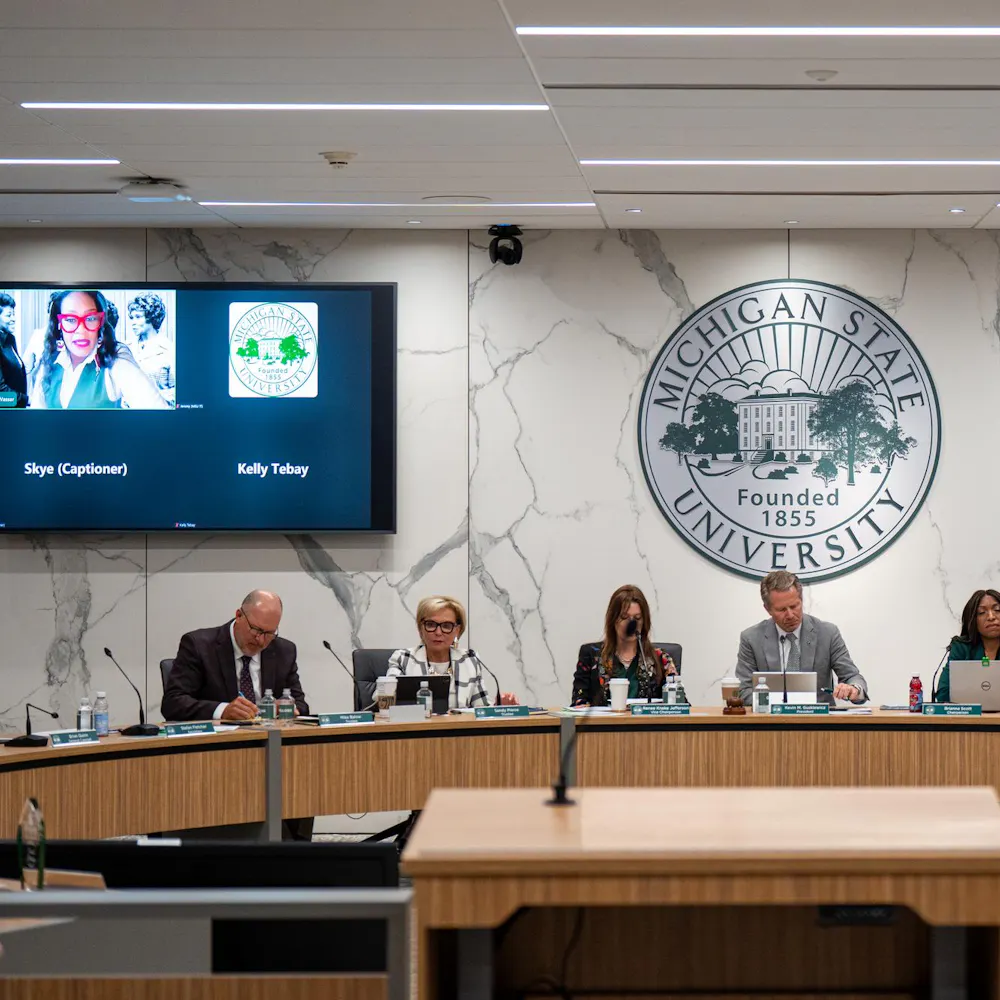
Academic Council unanimously approved a change to the MSU copyright policy on Tuesday to allow faculty - instead of the university - to own its work.
This completes the policy's run through academic governance, and it will now go to the MSU Board of Trustees for final approval at its April meeting.
In MSU's current copyright policy, the university owns all works completed by faculty and then assigns the rights back to its creator.
The policy doesn't recognize differences between traditional academic works, such as a novel or musical composition written by a professor, and works for hire that can include scientific research completed in MSU labs.
Unlike other institutions, MSU considers all work under the policy a work for hire. A work for hire typically uses a large amount of university resources or is specifically requested by the university.
The council's vote asks university officials to differentiate between works for hire and traditional academic works, which usually are defined as those done by faculty without substantial use of university resources, such as laboratories.
The lack of a distinction between the two categories sets MSU apart from other universities - and not in a good way, said Sheila Teahan, member of the University Committee on Faculty Affairs and associate English professor.
"MSU's current policy is highly anomalous," Teahan said. "There simply isn't another research institution that says that. Peer institutions recognize traditional academic works."
MSU President Lou Anna K. Simon said the issue went through the appropriate channels of government, and she will support the change in the policy when the MSU Board of Trustees reviews the change at its next meeting. The board must approve the change before it is implemented.
"It clarifies for faculty in ways that better convey the intent that MSU has a policy comparable to peer institutions," Simon said.
Economics Professor Charles Ballard said he voted to change the policy "to get in line with the rest of the world."
"Faculty is central to the mission of the university," Ballard said. "I think many faculty members interpret the policy as infringing on the rights that faculty members have at other places, and that could have repercussions in maybe retaining faculty."
When the policy was approved in 2001, the faculty did not oppose the university's ownership, said Susan Melnick, co-chairwoman of the committee and associate professor of teacher education.
"At the time, the members of that committee accepted the fact that the university originally owned work but gave that ownership back to the faculty," Melnick said. "I think that it came up this year based on a number of concerns within the university climate for exactly what rights and what voice faculty have."
The current policy has offended many people, said Teahan, who collected more than 150 signatures from people against the current policy in two colleges.
John Rauk, chairman of the Department of French, Classics and Italian and an associate professor, is one of the faculty members who signed that list.
"All the faculty who are made aware of this situation support the change," Rauk said. "MSU is an outlier when it comes to this. Especially in arts and humanities, it just seems to be an inappropriate policy. We're not dealing with patents, we're pursuing our own research and knowledge."