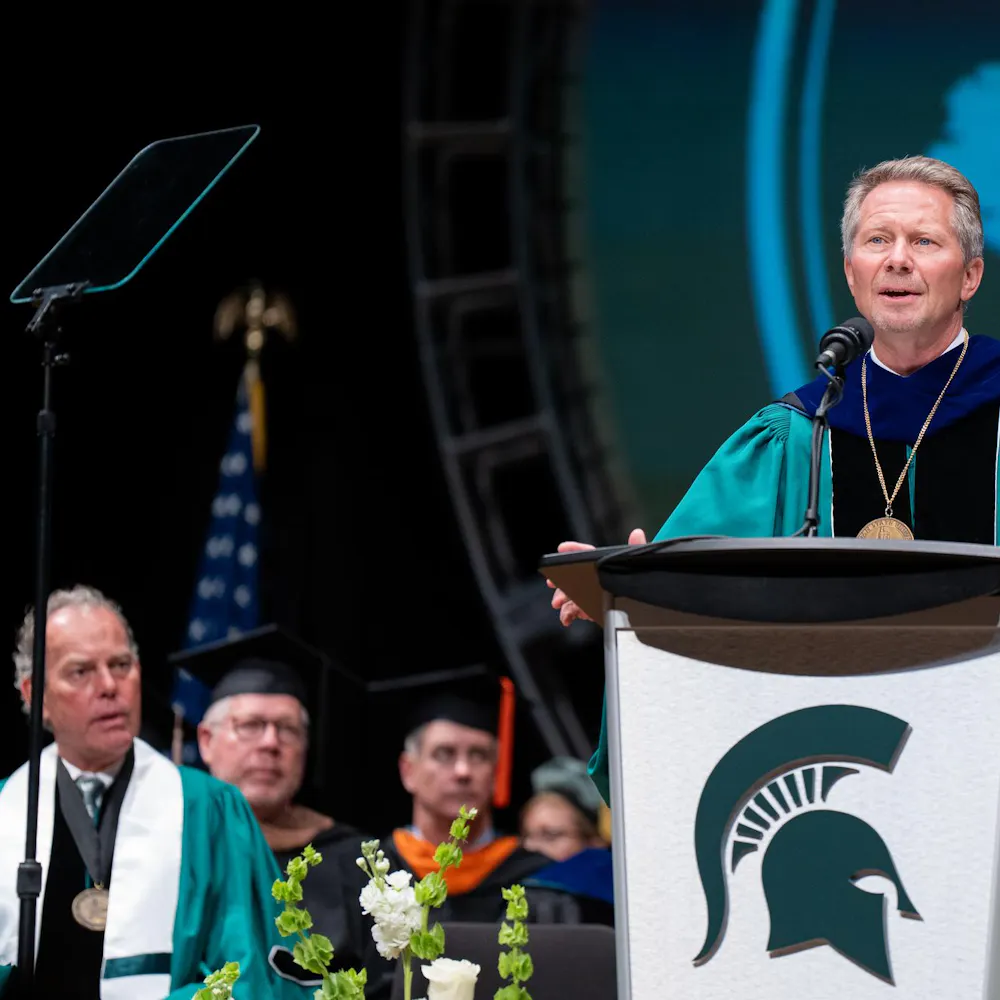
Lansing - Adjusting to more than $11 million in recent budget cuts, MSU President M. Peter McPherson could only say, "Frankly, this is painful."
On Wednesday, lawmakers approved an executive order correcting the state's $158-million general fund deficit. The order, issued by Gov. Jennifer Granholm, reduced university funding by 1.5 percent - including a $5-million cut for MSU.
The cut follows a $6-million slash in December by then-Gov. John Engler - totaling $11 million in losses during the past three months.
"Throughout the university there will be reductions to make up for this 1.5 percent," McPherson said. All state-funded universities have seen reductions fall by a total of 3.5 percent this fiscal year.
Prior the latest cuts, McPherson said university units designed plans to offset potential cuts of 3, 5 or 7 percent.
The $5-million loss puts those plans in effect, causing a hiring freeze and a reduction in teaching assistants next year, he said.
The immediate cuts won't cause a tuition hike, McPherson said. But that could change when Granholm introduces her 2004 budget proposal on March 6.
If next year's cuts begin to erode the core strengths and quality of MSU, tuition hikes will be needed, McPherson said.
"It's important for the Legislature not to cut too deep, because (the cuts will) be passed on to students," he said.
The impact of the executive order on MSU extends beyond the cut to higher education. Funding for the Life Sciences Corridor was trimmed by $12.5 million. The program, which awards grants for biological technology research to a group of four universities in Michigan, was scheduled to receive $45 million from the state.
Bob Huggett, vice president for Research and Graduate Studies, said the corridor's Steering Committee will re-evaluate priorities in response to the cut.
University of Michigan spokeswoman Julie Peterson said U-M has made major cuts to utility and energy costs to cope with decreased state funding. It's also using hiring freezes, she said.
"We are really going to have to look at cuts in our academic programs," Peterson said. "That is hard for the university to handle."
Cuts to higher education were second only to state agency reductions in the executive order. State police funding was cut by more than $5 million, the Department of Corrections was cut by nearly $8 million and the Department of Community Health faces nearly a $17-million cut.
Medicaid coverage, revenue sharing to local governments and benefits to needy and disabled adults were spared by the executive order.
Higher education is one of the first places legislators look when trimming the budget, said Matt Resch, spokesman for House Speaker Rick Johnson, R-LeRoy.
"Higher education has been treated very generously over the last decade," Resch said.
While these cuts will affect college students statewide, Rep. Gretchen Whitmer, D-East Lansing, said it's important to keep them in perspective.
"With other departments suffering double-digit percentage cuts, a 1.5-percent cut to higher education seems pretty equitable," she said.
Staff writer Sarah Frank contributed to this report.
Joey Guillen can be reached at guillenj@msu.edu.