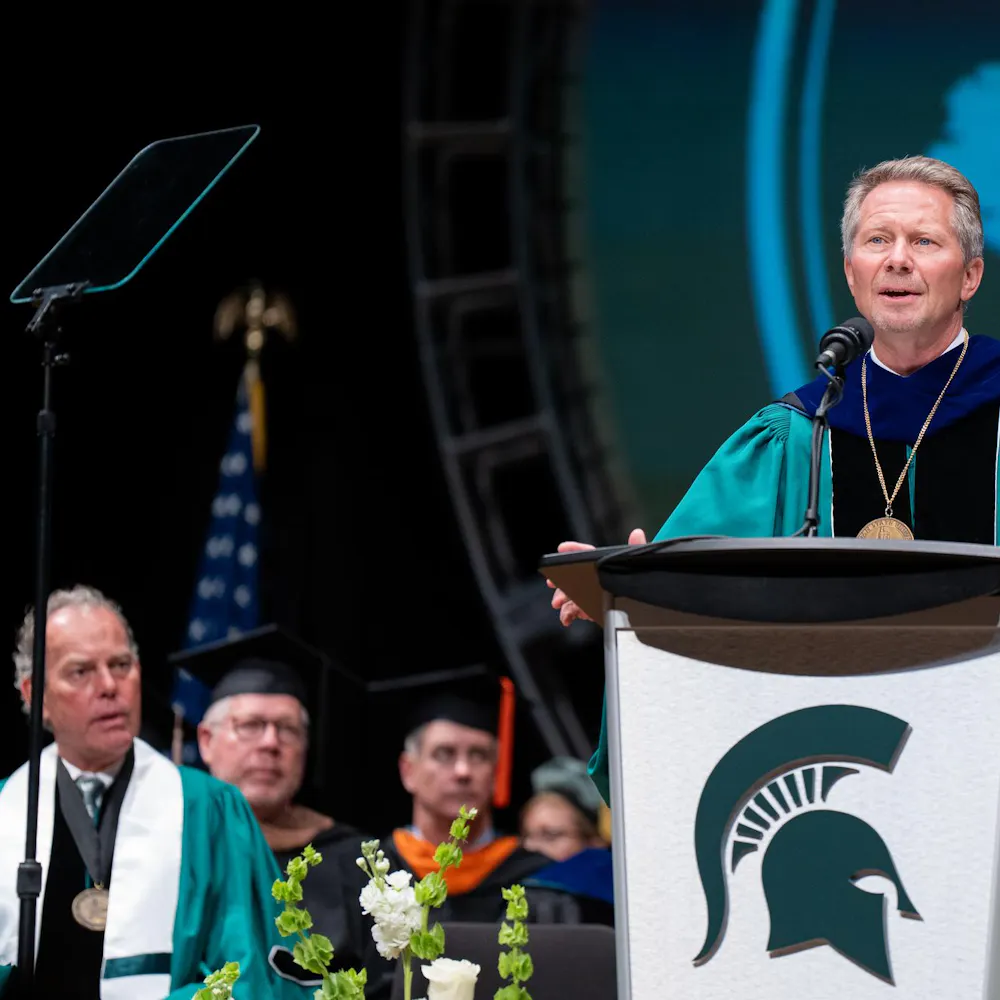
MSU President M. Peter McPherson released a draft of new rules Monday aimed to protect political and social activism on campus from undercover investigations.
The move comes more than a year and a half after an undercover investigation of a campus activist group by MSU police was unearthed, leading to an outcry from many students, faculty members and area civil liberties leaders.
University officials have admitted an undercover officer posed as a student to gain entry into United Students Against Sweatshops, now known as Students for Economic Justice, for about four months beginning in February 2000.
In response, the MSU Board of Trustees approved a resolution in September 2001 authorizing such an investigation only under “extraordinary circumstances” and with the approval of the university president. McPherson told The State News in an April 2001 interview that he had OK’d the investigation.
McPherson also formed an independent panel to examine the issue and created the Task Force on Student-Police Relations in response to the investigation.
The guidelines released Monday, recommended to the president by Academic Council’s University Committee on Student Affairs, define extraordinary circumstances as when reasonable cause exists to conclude a group’s actions could “lead to loss of life, physical harm or substantial property damage.”
University Committee on Student Affairs Chairperson Jared English is expected to officially present the recommended guidelines today. McPherson said he will place them into policy soon after.
“I thought it worked well,” McPherson said Monday of the process to form the guidelines. “I had regrets about all this. It would’ve been good to have a policy in place.”
But despite McPherson’s wish to have a policy at the time he approved the investigation, he told The State News he would have approved it even with the new guidelines in place.
When the investigation was uncovered, then-MSU police Assistant Chief Jim Dunlap, who was named chief this year, said the investigation was in preparation for a May 2000 commencement speech by World Bank President James Wolfensohn.
April 2000 marches against the World Bank and International Monetary Fund in Washington and a protest that began Nov. 30, 1999, in Seattle against the World Trade Organization led to violence and thousands of arrests.
Some members of the campus group attended those protests, and officials said they worried violence could erupt on campus.
Officials later said a “specific, identified subject” within the group was being examined in connection with the New Year’s Eve 1999 arson of Agriculture Hall. McPherson said university officials would have discussed that reasoning earlier, but U.S. prosecutors leading the case would not allow it.
As part of the new guidelines, all undercover activity must be recorded in a public document, despite worries that such documentation could damage any group not found to have done wrongdoing, McPherson said.
But he said it’s important there be a check on the police to prevent an abuse of power. The documentation will not include names of any groups investigated to protect those groups’ privacy.
The guidelines do not affect undercover work aimed at drug rings or other criminal activity.
Members of Students for Economic Justice are glad McPherson has assembled the guidelines, but doubt it will stop police from infiltrating their events, especially after past incidents, social work junior and group member Jane Kilmer said.
“I’m not really sure it isn’t going to happen again because last time they made up lies,” Kilmer said. “All five reasons they gave us before (for the infiltration) were lies, but could be defined as ‘extraordinary circumstances’ - destruction of property.
“I’m just not sure this will help.”
But Jeff Ziarko, who was responsible for assembling the recommended guidelines as the former University Committee on Student Affairs chairperson, said the president made the right decision.
“I’m very excited the president agreed with our recommendation and that we have this procedure in place to protect students,” he said.
But Henry Silverman, president of the Lansing-area branch of the American Civil Liberties Union, said the guidelines will not benefit students. He said they are more protective of the university and police rights than student rights.
“I would like to see it clearly stated that the university will not infiltrate legitimate student groups,” he said. “In reading those guidelines I don’t see that.”
Staff writer Alison Barker contributed to this report.
Kristofer Karol can be reached at karolkri@msu.edu. Brian Charlton can be reached at charlt10@msu.edu.