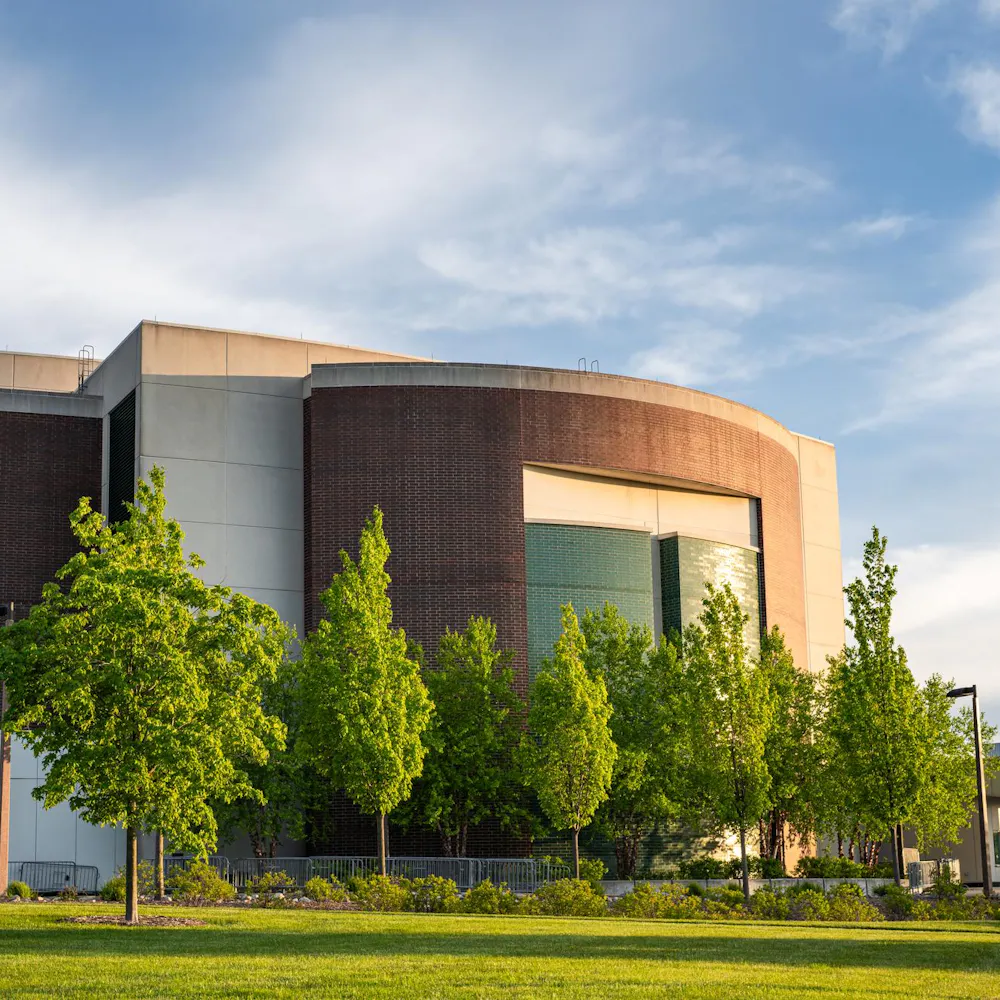
As of Wednesday afternoon, about half of the 4,800 grass modules had been placed into the floor of Spartan Stadium.
With the process on schedule, the MSU football team will hold its first practices on the new field Aug. 17 and Aug. 24.
Associate athletics director Greg Ianni said once the team takes the field, the project will see its final test - maintenance.
“There are issues,” Ianni said. “It’s going to cost us more to maintain it. And it’s going to be hard work to maintain it, but I think in the long-run it’s in the best interest of the institution and our athletic program.”
Ianni said Spartan Stadium’s 8-season-old artificial turf wasn’t completely dead, but the timing was right to pull up the carpet.
“This stuff is pretty well-worn,” Ianni said. “We probably could have gotten a couple more years out of it, if we really were forced to.”
Spartan head coach Bobby Williams said a natural surface helps recruiting efforts, and the new field is something his coaches were using two recruiting classes ago.
“That’s a huge selling point,” Williams said. “More and more of the student athletes coming out, they want to play on grass.”
Williams said a natural surface is more appealing because it cuts down on nagging injuries.
Williams said the entire team will get a chance to step on the field Aug. 11 for team pictures. Spartan Stadium hasn’t seen natural grass since 1968.
With the buzz of grass already swirling through his team, Williams said he wouldn’t be surprised to see the photo shoot turn into a miniscrimmage.
“They all are very excited about the grass,” he said. “I’m pretty sure there will be a few passes thrown out here and a few formations set.”
Installation of the grass is being lead by Turfgrass Management Professor Trey Rogers, who oversaw the installation of the mobile indoor field the Pontiac Silverdome received for the 1994 World Cup.
Rogers said the entire process has advanced technologically since 1994.
“In 1994, it was one that we actually made up and developed,” he said. “It was hexagon-shaped and it was a little bit bigger. We’re using one that’s now commercially available.
“This is superior to the Silverdome field. It was actually built with this type of field in mind. We have a tremendous environment for keeping things alive here.”
One of the biggest changes from 1994 was the number of Kentucky bluegrass strands used to develop the grass. Rogers said his staff used nine different strands for Spartan Stadium.
“You always probably want to use four or five different varieties,” he said. “That’s just a common thread. In case one variety was ever to have a disease problem you wouldn’t lose the whole field.”
Spartan Stadium’s new modular field will be only the third of its kind. In 2000, Giants Stadium in East Rutherford, N.J., was the first to permanently use the technology. And in 2001, Virginia Tech University’s Lane Stadium in Blacksburg, Va., became the second field to make the switch.
Spartan Stadium turf manager Eric Adkins said the draining system will take care of any other damage problems that occur.
“With the way these things drain and the way they’re designed it’s probably unlikely that we would have damage,” Adkins said. “There is that possibility that we could change them if need be.”
He said to replace one or two of the 1,100-pound modules would take no more than 15 minutes.
Even with the field not yet complete, Williams and junior wide receiver Charles Rogers couldn’t resist the temptation to toss the pigskin.
After catching a pass from Williams, the standout receiver said he’s looking forward to the switch.
“I would rather play on grass than turf any day,” Rogers said. “I think good things are going to happen to us by going to grass.”