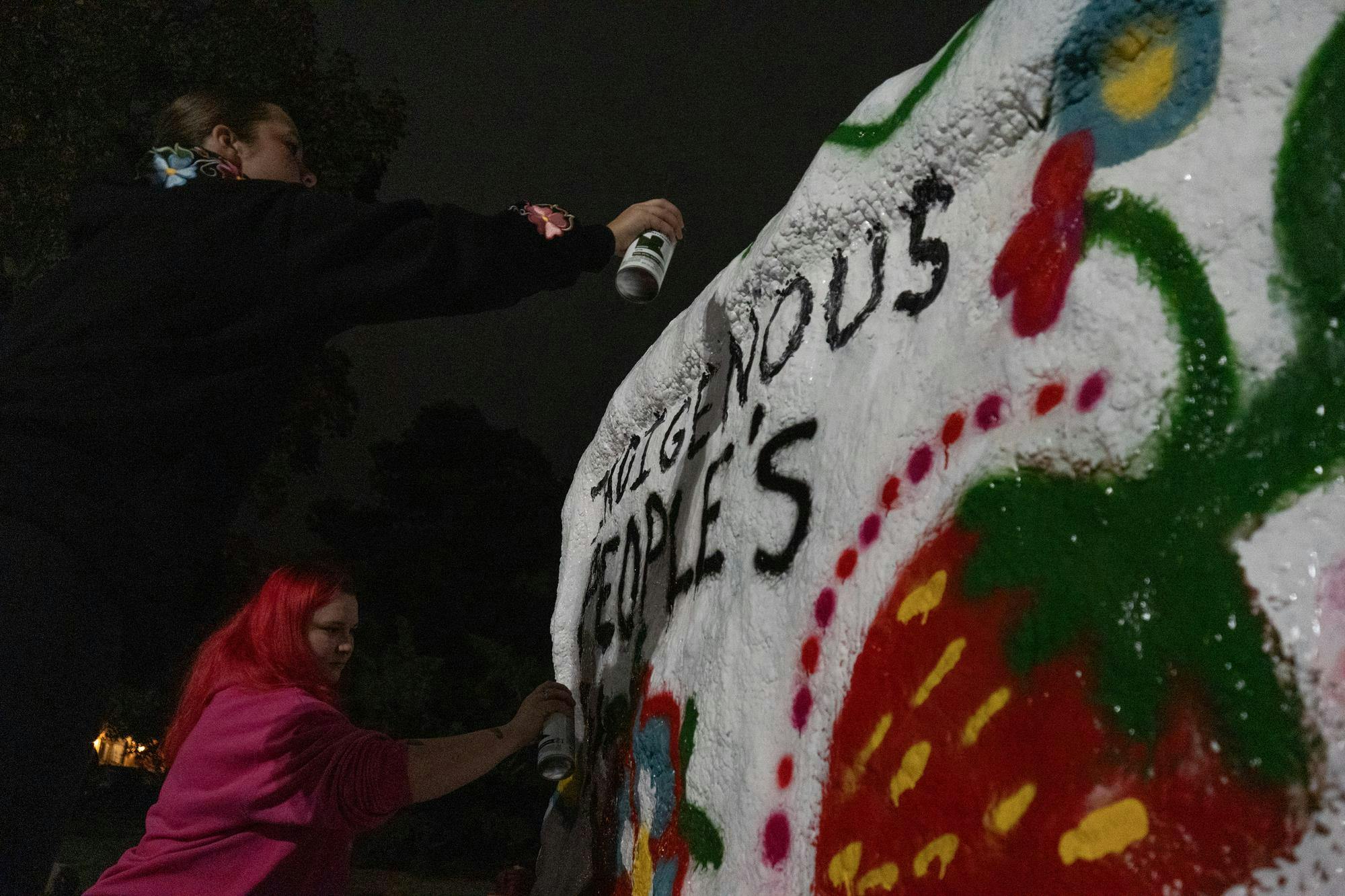
Under a streetlight the night before Indigenous Peoples' Day, a handful of students camped out at The Rock on Farm Lane, which was covered in vines, strawberries and handprints, to keep watch over a message they knew someone might try to erase.
Students from the North American Indigenous Student Organization gathered on Sunday night for their annual painting of The Rock ahead of Indigenous Peoples' Day. The past two years have seen outside groups paint over their message with anti-land back rhetoric. In 2024, NAISO's artwork was covered up by “‘Dibs.’ — Columbus 1492,” an attempt at a joke referencing the arrival of Christopher Columbus to the Americas in 1492.
This year, NAISO camped out by The Rock to prevent a potential repeat.
“It’s annoying we have to do this,” NAISO recruitment chair Jada Hall-Pine said. “No other organization has to sleep overnight, only us.”
NAISO's executive board felt they “had to” plan a sleepover in order to preserve the artwork, Hall-Pine added.
“Indigenous Peoples' Day was started in response to Columbus Day as a reclamation of the actual history that’s behind someone like Columbus,” NAISO co-chair Maggie Broderick said. “Rather than celebrating someone who committed countless atrocities that he would be, at bare minimum, arrested for today, we’re instead celebrating the resilience of Indigenous people and nations in face of historical violence.”
Students painted The Rock with nature in mind, covering it in flowers, vines, leaves, bugs, strawberries, hand prints and polka dots to spread the message of Indigenous Peoples' Day. On the back of The Rock, students wrote “We are still here” to spread the message of “resilience,” Broderick said.
The surrounding sidewalk was decorated with chalk-drawn images of animals, the names of different reservations and the Six Nations of the Iroquois Confederacy flag. Broderick said one of the reasons she added the flag was to symbolize part of her own “reconnection journey and to emphasize community and empathy.”
NAISO aims to bring awareness to Native struggles while amplifying Native student voices and culture. Being able to paint The Rock for Indigenous Peoples' Day allows students to “be together,” “uplift” and “celebrate complex history,” Broderick said.
“It’s a really awesome welcoming space as well as doing a lot of important advocacy for Native nations and students on campus,” Broderick said of NAISO as a whole.
Support student media!
Please consider donating to The State News and help fund the future of journalism.
Discussion
Share and discuss “NAISO camps out to protect The Rock artwork for Indigenous Peoples' Day” on social media.