Students, faculty and community members gathered at the MSU Museum on Friday for a campus-wide panel centered on the Native American Graves Protection and Repatriation Act, a law requiring federally-funded institutions to return Indigenous remains to federally recognized tribes.
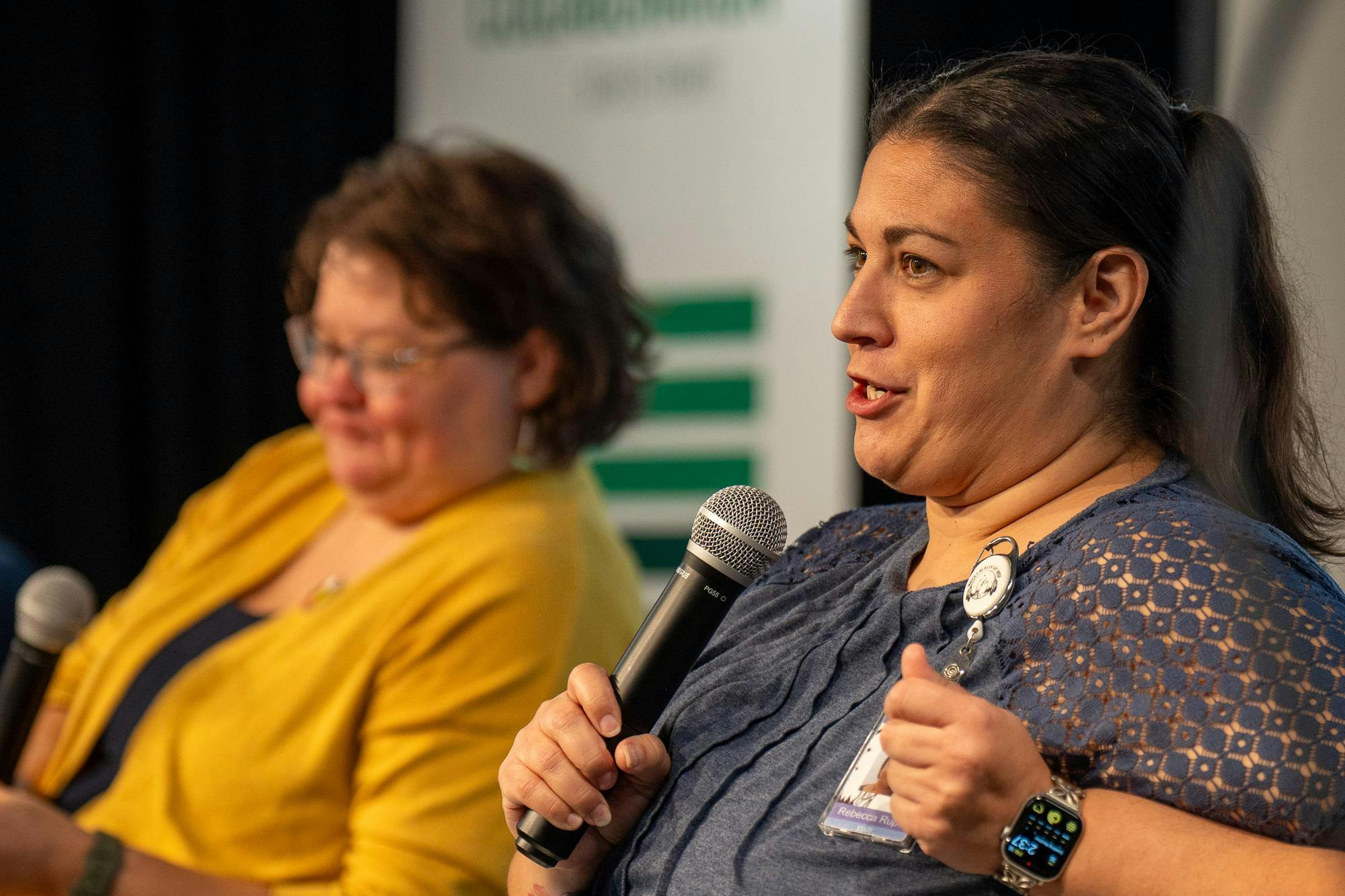
The panel, titled “Bring Them Home: A Tribal Panel on NAGPRA, Repatriation, and Collections Across Campus," was held in observance the week of Indigenous Peoples’ Day and featured Rebecca Rupe, archives and collections coordinator and NAGPRA representative for the Match-E-Be-Nash-She-Wish Band of Pottawatomi, and Marie Richards, an archaeologist and citizen of the Sault Ste. Marie Tribe of Chippewa Indians. Panelist William Johnson, curator at the Ziibiwing Center of Anishinabe Culture and Lifeways and NAGPRA designee for the Saginaw Chippewa Indian Tribe, was unable to attend because of travel delays.
The discussion was moderated by Dr. Jessica Yann, the NAGPRA program manager at the MSU Museum.
Opening the panel, Yann recited Michigan State University’s land acknowledgment. The statement recognizes that MSU occupies the ancestral, traditional, and contemporary lands of the Anishinaabeg — Three Fires Confederacy of Ojibwe, Odawa and Pottawatomi peoples — and was funded in part through land dispossession under the 1862 Morrill Land-Grant Act.
Addressing how land-grant institutions connect to NAGPRA, Rupe emphasizes that the university's responsibility goes beyond legal compliance.
“For me, I think it goes past NAGPRA,” Rupe said. “You guys have great big collections, unethically usually sourced. So transparency and community (are vital when) working with tribes, especially removed tribes.”
Rupe also mentioned that transparency regarding campus holdings is critical for the day-to-day well-being of Indigenous students who may need to take specific cultural or spiritual precautions when near ancestral remains or sacred belongings.
“I think that would be something that universities, not just that Michigan State, but across the nation, can really just be transparent with their students, especially their Native students who come from potentially cultural backgrounds where we have to take precautions when we’re close to things like that," Rupe said.
Expanding on what true institutional accountability looks like, Richards said repatriation requires shifting away from traditional concepts of university ownership and focusing instead on long-term relationships and care.
“Ownership isn’t a possession, but how you treat individuals that live on the land,” Richards said. “We own the responsibility of care and not necessarily something that is titled in possession.”
Yann mentioned MSU’s university-wide NAGPRA policy, adopted in 2022, alongside updated federal regulations enacted in 2024. Under MSU’s framework, a “duty of care” clause mandates that Native American objects and collections be stewarded strictly under guidance from relevant Tribal nations. Until collaborative consultations take place, restricted campus collections remain off-limits for research.
For audience members interested in museum studies and anthropology, the panel offered vital insight into back-end university-tribal relations and student awareness.
“I wasn’t aware of the full depth of the relationships between MSU, NAGPRA and some of the tribes,” said Ashleigh Prisby, a 2026 anthropology alumna. “I didn’t know the amount of work that went into these sort of things, a lot of things that are private, some things that are a little more public … trying to find a balance between where the line of that is, is something that’s really important.”
While attendees acknowledged positive administrative progress under current Michigan Anishinaabek Cultural Preservation and Repatriation Alliance leadership, others argued that true institutional reconciliation requires the university to directly address its past resistance to repatriation.
Brothers Zach and Adam Khalil, Sault Ste. Marie Tribe citizens and co-directors of the documentary "Aanikoobijigan [ancestor/great-grandparent/great-grandchild]," spent eight years documenting the struggles of the MACPRA to recover ancestors held by MSU.
“My biggest fear is that this would become a platform to promote what MSU has done without acknowledging what else has happened,” Adam Kahlil said after the panel. “Michigan State University held our ancestors under the football stadium for decades, which wasn’t addressed or brought up … there’s a lot of things that are public knowledge that were not put forward in a very transparent way.”
Zach Khalil also noted that MACPRA formally requested the return of all ancestral remains in 2011, but faced nearly a decade of institutional delays and bureaucratic obstacles before ancestors were returned 11 years later.
“Part of that new leaf, truly being a new leaf going forward, needs to involve the institution publicly taking accountability for the mistakes they made in the past,” Zach Kahlil said.“ The tribal panelists were saying (great things), I think our issue kind of stems from the institutional representatives not leading and being forthright about the mistakes that Michigan State University has made in the past.”
Support student media!
Please consider donating to The State News and help fund the future of journalism.
Discussion
Share and discuss “MSU Museum panel links Indigenous repatriation, tribal stewardship and campus history” on social media.