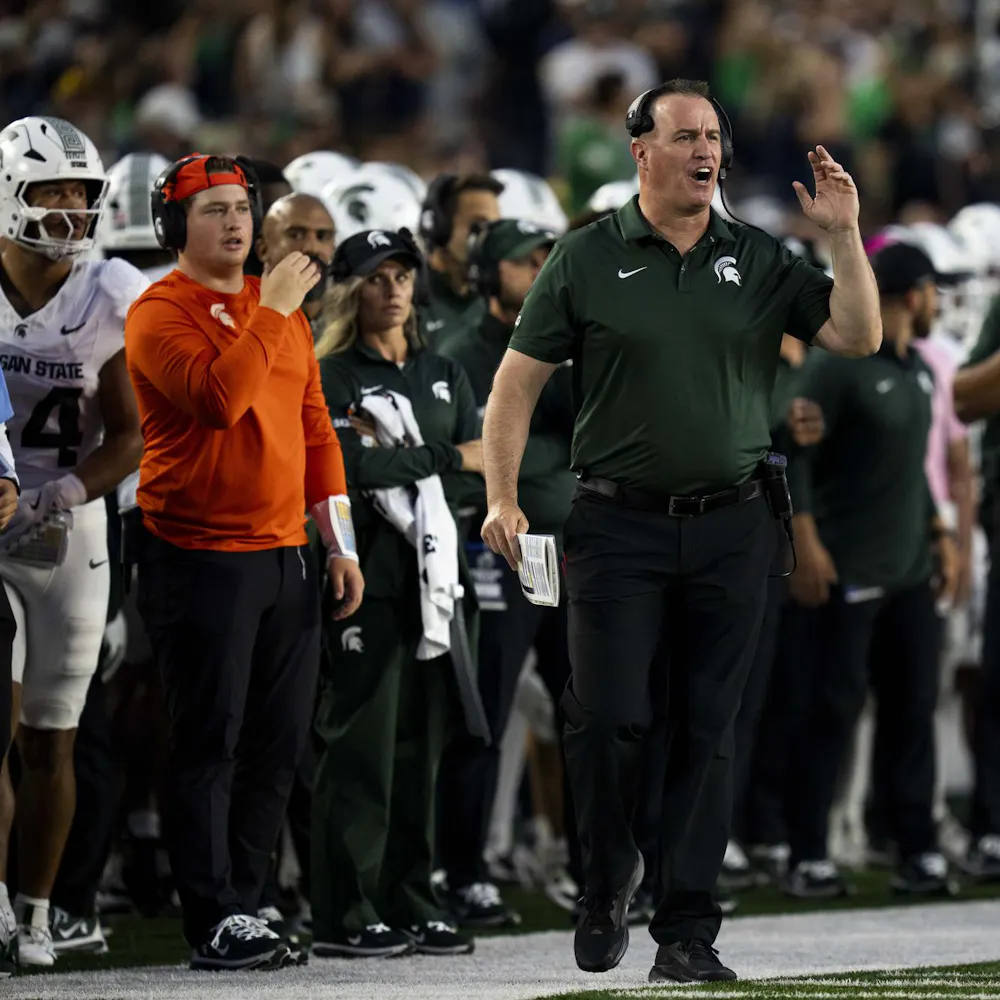
When Michigan State football takes the field Saturday, the quarterback on the opposing sideline in No. 0 with Northwestern scripted across his chest will be no stranger to defensive coordinator Joe Rossi. In fact, Rossi has coached against him more than anyone.
But when asked about Northwestern quarterback Aidan Chiles, Rossi responded as if the question were about anyone else, though he probably had to watch less tape to develop his answer.
“He’s a good player, good human being, athletic, big arm, can make plays, can create,” Rossi said. “He’s playing well.”
Chiles and Rossi began their time in East Lansing together, both committing to their roles Dec. 14, 2023. The quarterback followed his head coach, Jonathan Smith, from Oregon State, while Rossi was signed away from Minnesota, where he had become known for building top-tier defenses.
Over the last two seasons at MSU, Chiles started 20 of 24 games as quarterback. That means Rossi has not only watched him play but has coached against him in practice more than any other coach in Chiles’ career.
Seeing Chiles line up against his defense will be a familiar sight on Saturday, but the offensive scheme around him will be unconventional — not just for the players, but for the fans as well.
Northwestern offensive coordinator Chip Kelly has brought back the wing-T, an offense that hasn’t been popular since the 1970s.
“I think it’s pretty unique what they’re doing and it’s a testament to them because they’re scoring a lot of points,” Rossi said.
MSU’s defensive coordinator hasn’t faced the scheme in more than two decades, since his days as a player at Allegheny and his first coaching job at Thiel.
It’s a run-heavy system that relies on extreme misdirection, pre-snap motion and clever backfield fakes to confuse defensive players. Instead of overpowering opponents with sheer strength, it uses pulling blockers and quick lateral movement to catch the defense out of position.
“If there are new things that you’re going to see, your defense is structured in a way that it should be able to handle things. So you can’t focus so much on them,” Rossi said. “You got to focus on, what are your alignment rules? What is your communication? What is the call that you’re making based on the call that you have?”
Despite being past its time, the scheme has worked. Northwestern’s offense averages 35.4 points and 203 rushing yards per game, fourth best in the Big Ten, and has scored on 22 of 23 red zone trips. The system has not only produced a potent offense but has helped Chiles play the most efficient football of his career.
The senior ranks as the seventh most efficient passer in the nation, with a rating of 185.8. He has completed 71.4% of his passes, best in the Big Ten, for 1,172 yards and nine touchdowns. He has yet to throw an interception, an improvement from the 14 he in his two seasons at MSU.
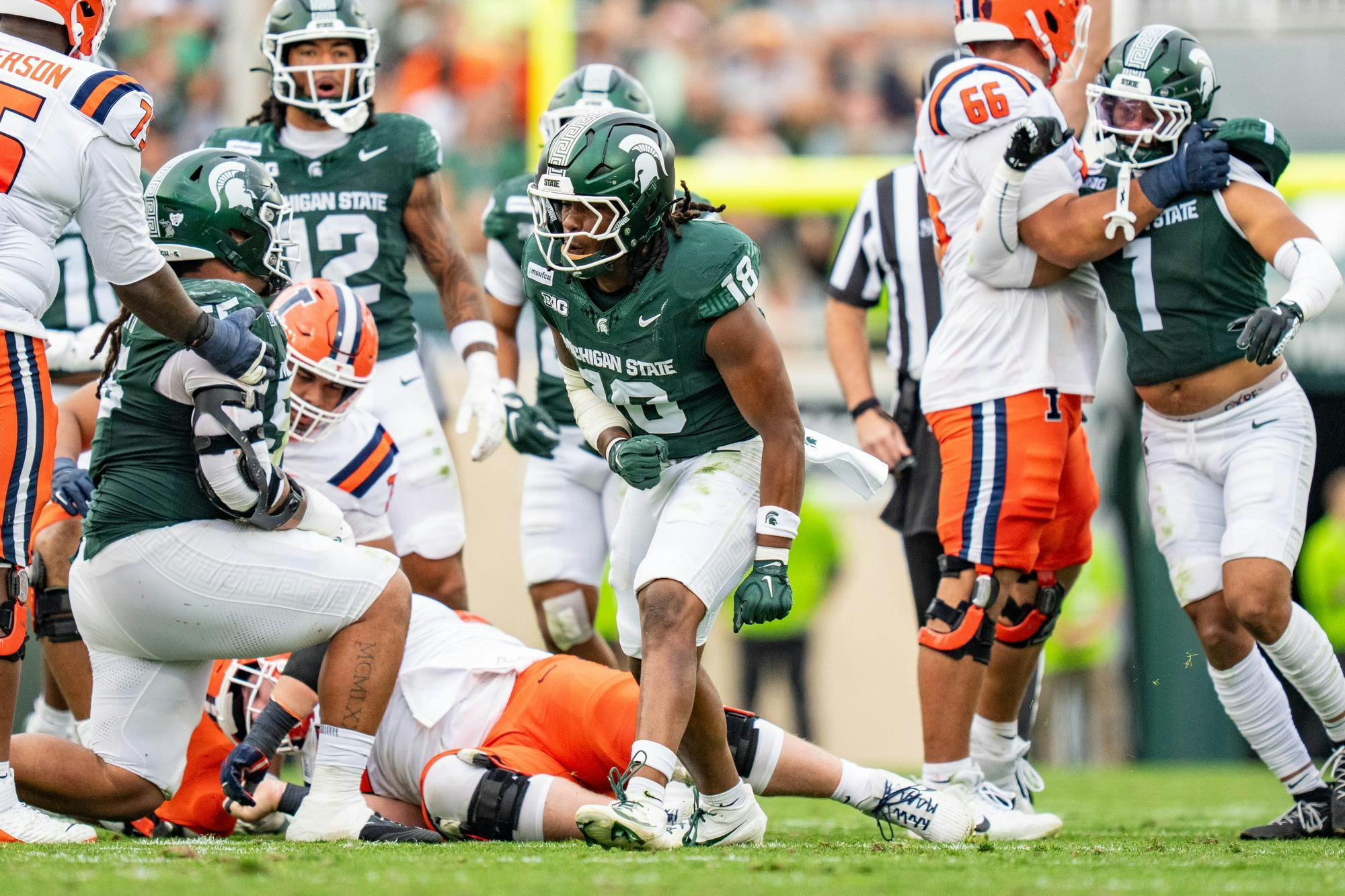
A productive offense that has turned the ball over only twice is hard for any defense to stop, and there’s a reason Northwestern’s only loss was a 29-23 road defeat to then-No. 4 Indiana. Stopping it gets even harder for a banged-up Spartans defense.
Three linebackers, senior Jordan Hall, sophomore Brady Pretzlaff and graduate Caleb Wheatland, who have all started for MSU, were listed as out on Wednesday’s injury report. Cornerbacks were hit just as hard; graduate Tre Bell, sixth-year Charles Brantley and sophomore Tyran Chappell, all previous starters, were listed out alongside sophomore Keshawn Williams.
“It’s your job as a coach that that stuff can’t be a factor,” Rossi said regarding all the injuries to his defense. “We gotta get the guys that are healthy, ready, and we gotta put a plan together that they can execute, and we gotta go win a football game. That’s ultimately what it comes down to.”
The Spartans (2-4, 0-3 Big Ten) will try to earn their first conference win against No. 25 Northwestern (4-1, 1-1 Big Ten) at noon on Saturday Oct. 17 at Spartan Stadium. The game will air on Peacock.