When last year’s remnants of a disappointing season for Michigan State Men’s soccer ended, the Spartans were eager to shake off the memories and start a new campaign this year, but first they had a major question to answer in the summer before: who would be their year-long central striker?
Last season, a gap emerged for the central striker position, as senior forward Richie Ludwig and senior midfielder Miles Merritt spearheaded the attack as the primary central targets. But that still left a hole that MSU could only fill with their No. 9.
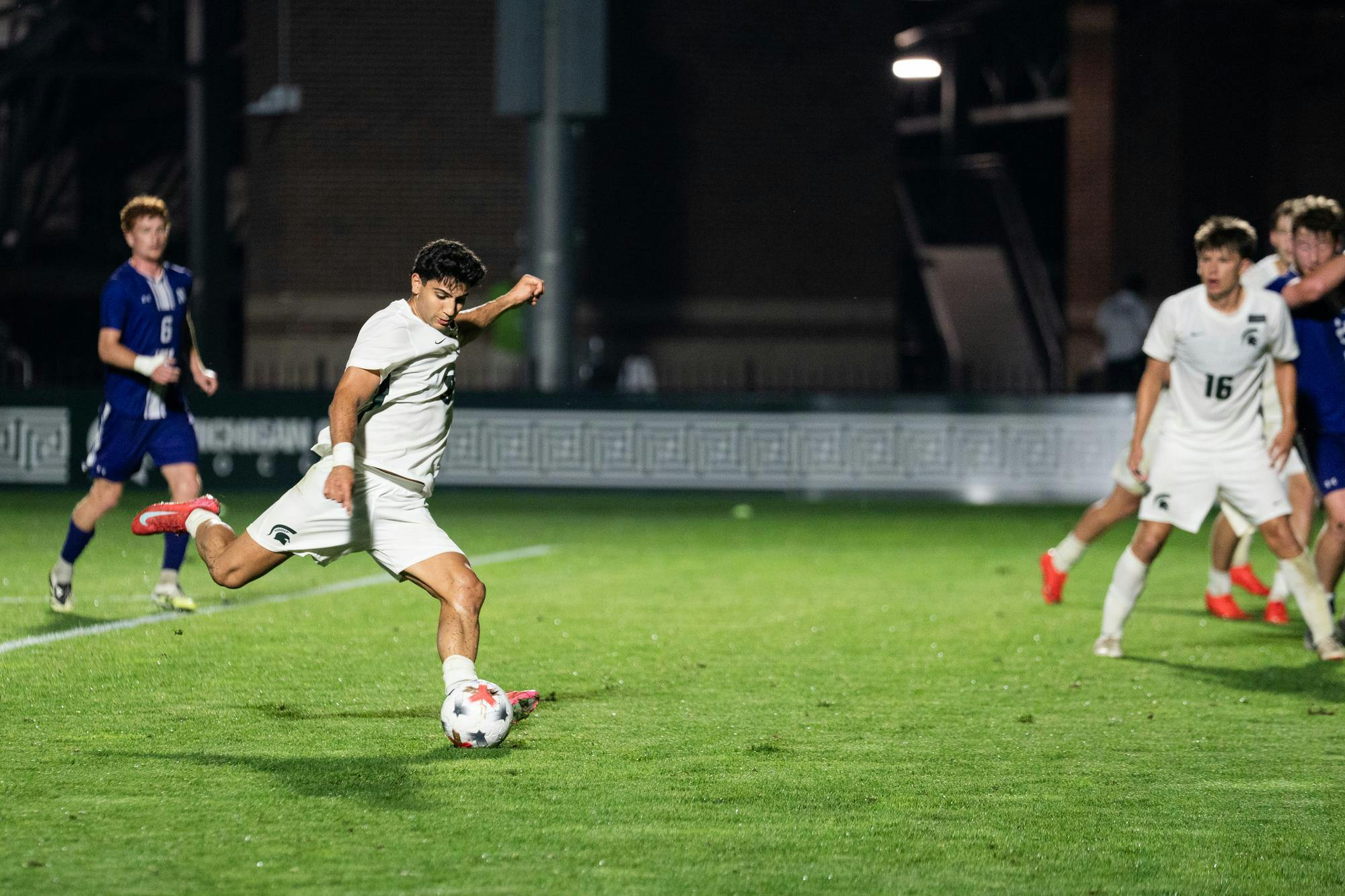
Senior forward Andrew Darakdjian was the missing piece for MSU, who in the 2026 season are the only team undefeated in the Big Ten conference play. Darakdjian leads the team in goals, scoring a brace against Northwestern and a goal against SIUE and Seattle University. He is No. 2 in the Big Ten in game-winning goals and No. 7 in total goals.
Traditionally, the No. 9 is the central striker, the player expected to occupy the box, create opportunities and finish them. The Commerce Township, Michigan, native has played this position throughout his career, including at Oakland, where he was a striker before transferring to Michigan State in 2025. But before he could take on that role in East Lansing, he had to get through a season he never expected to miss.
In MSU’s final spring exhibition against Marshall, Darakdjian was celebrating when he landed awkwardly after his jump. He knew something was wrong almost immediately.
“Right after the celebration, at halftime, Vince, our athletic trainer, came to me and he gave me a little rundown, and he told me that I tore my ACL,” Darakdjian said. “The next day, we came home, did some MRIs and X-rays, and they told me that I needed surgery the next week. So from there, it was just the road to recovery and doing anything to be back with the team.”
For a player who had transferred from Oakland after leading the Golden Grizzlies in scoring with 11 points in 2024, the injury changed the purpose of his first season at Michigan State. He had come to East Lansing to play, score and work toward his goal of becoming a professional. Instead, his season became a process of getting back to the point where he could do those things again.
“Just sitting on the sideline watching the group, it was very tough, but honestly, it was just trying to get better 1% every day," Darakdjian said. "I didn’t walk for six weeks, and from there, it was just learning how to walk again, learning how to run again and then getting back into soccer. Going from not walking to the speed of play in the Big Ten is a big jump that I had to pass."
The recovery also changed his relationship with the team. Unable to contribute on the field, Darakdjian remained around the players who had become his teammates, relying on them through a period when soccer — the part of his life that had brought him to Michigan State — was suddenly something he could only watch.
“More than physically, they helped me mentally,” Darakdjian said. “Obviously, it’s a tough thing to step away from such a big part of your life. These guys, they helped me. I would hang out with them all the time, on the pitch and off the pitch, and it made a huge difference for me.”
The return did not come all at once. Darakdjian had to work his way back into the speed of the game before he could return to the role he had expected to play when he transferred. But the role itself had never been in question.
“When I transferred in, I was always a striker, especially at my old school,” Darakdjian said. “I came here to score goals. Coach Damon and I, we both know the expectation, and when I came back from injury, the goal hasn’t changed and the expectations haven’t changed. Obviously, it took a little longer to get back on the pitch, but my job was to score. So that’s all that I focus on.”
The year away from the field also gave Darakdjian a different understanding of patience. As a striker, he can go through stretches without finding the back of the net, but his time away from the game taught him that progress does not always happen on the schedule he wants. That patience has become part of his return, and Head Coach Damon Rensing sees it in the way Darakdjian worked his way back into the role he was brought to MSU to fill.
“He’s got a nose for the goal. The games have been pushing him, and he’s been great. He’s a good number 9, always finding himself in front of the goal.” Rensing said.
Support student media!
Please consider donating to The State News and help fund the future of journalism.
Discussion
Share and discuss “Inside Andrew Darakdjian’s return to the No. 9 for MSU men’s soccer” on social media.