When executive documentary producer Alysia Sofios stepped into the sheriff's office of small town Paw Paw, MI, she had one simple offer: A box of cupcakes and reassurance that “I don’t want anything from you.”
But, truthfully, she did want something — badly. The success of her job depended on it, especially with Netflix and Hulu on the line.
That desire was to sit down with a jumpsuit clad Linda Stermer, who had been convicted for the second time of setting her family home ablaze and murdering her husband a month prior.
After a few sweet treats and conversations with the town’s sheriff, Sofios got it. Armed with a couple of nearly dead camera batteries and her cell-phone as backup, Sofios had as much time as she needed for an interview with Stermer in the confines of the Van Buren County Jail.
“Cupcakes have now gotten me two documentaries,” Sofios said.
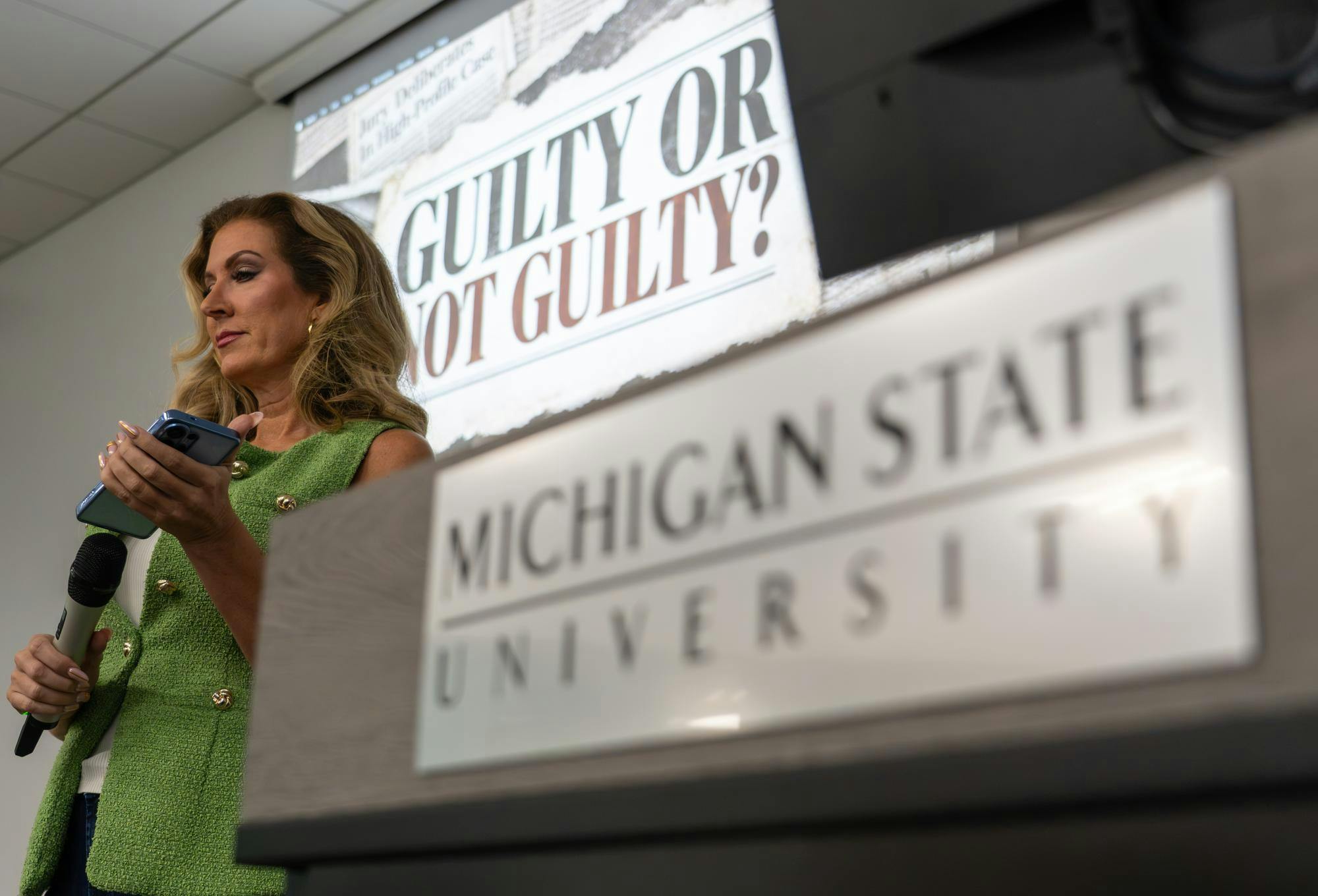
On Wednesday, Sofios came to MSU — her alma mater — to speak to a crowd of students from the DS 211: Documentary Film History and Theory class about her process as a documentary producer.
Sofios began her lecture in an “unconventional” manner: A live phone call with Stermer, directly from where she’s held at the Women's Huron Valley Correctional Facility. A brief Q and A ensued, allowing students to hear straight from the source of Sofios’ upcoming film, “Overkill.” Stermer discussed her experience throughout her years-long case, supplementing with remarks about her relationship with Sofios.
“(Sofios) was very unaggressive,” Stermer said. “It was very much appreciated that (she) took time to really dig into the things that I felt were important without my prompting.”
But Sofios would describe herself as exactly the opposite. In her lecture, she expressed the need to be aggressive behind the scenes in order to capture the entire complexity of a story.
“You have to do things that you know will assure you to have the best opportunity to get in front of somebody,” Sofios said. “You can't always just sit back and let it happen.”
When face-to-face with her sources, Sofios takes care to remember no matter who they are, they’re “just a person.” Within her work, Sofios has spoken to several serial killers held at San Quentin Rehabilitation Center, which is known for housing the largest death row population in the United States. Even though these sources were being held on death row for capital offenses, she still felt the need to put herself “in their shoes.”
“I feel lucky to be in that chair talking to them and them telling me their story,” Sofios said. “I do talk to a lot of prisoners, so I know what they’re up against.”
Though she’s surrounded by extreme crime cases on the daily, Sofios hasn’t let herself get “desensitized” to the impact of what she's covering. While she has developed the ability to become indifferent to a particular “situation or environment,” Sofios ensures that she never lets herself become numb to the story itself. Without feeling, Sofios believes that she wouldn’t be able to tell stories authentically.
“You don’t want to be numb going through life,” Sofios said. “It’ll bleed over into everything.”
Sofios recognizes the importance of maintaining her personal ethics, even when facing demands from major streaming services or broadcasters. Though she primarily relies on intuition to make tricky decisions — such as the choice to film a tough moment or push more about a touchy subject — Sofios always falls back on what she understands to be most ethical.
“If you are in it for the right reasons, your instinct is going to be correct,” Sofios said. “I don’t want to say I wish I would have filmed that. I do that and then decide later.”
Though Sofios asserts that her line of work “is your life” and “not just a hobby,” she enters each day eager to tell yet another story.
“I can’t imagine doing anything else,” Sofios said. “I always say I only tell stories that I feel like I can tell better than anyone else in the world, or else it’s not my story to tell.”
Support student media!
Please consider donating to The State News and help fund the future of journalism.
Discussion
Share and discuss “Executive documentary producer sheds light on bringing humanity to true crime stories” on social media.