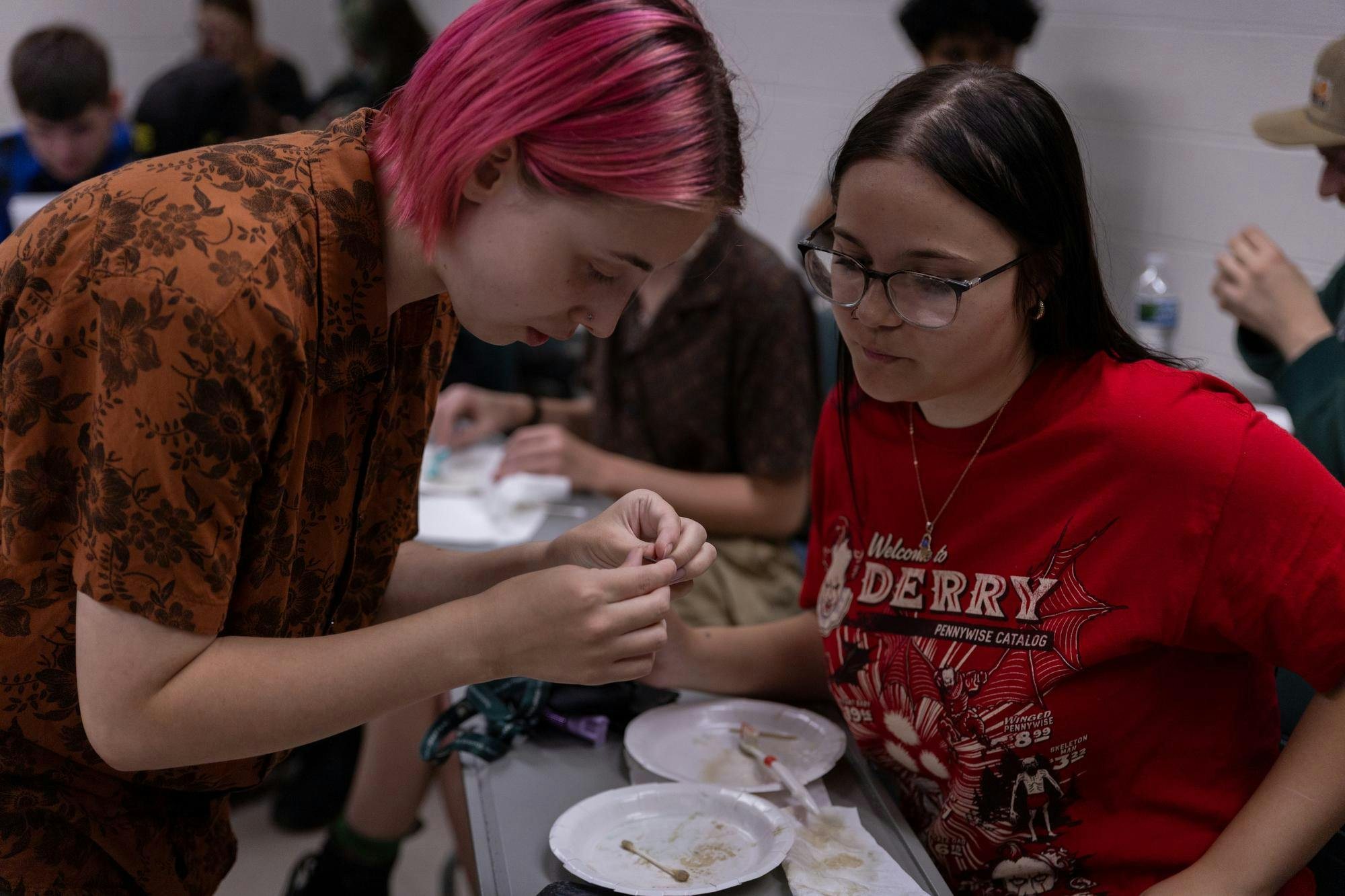
Michigan State sophomore AJ Cousineau, president of the MSU Classical Society, helps another student clean their Roman coin during the MSU Classical Society meeting at Wells Hall in East Lansing, Mich., on Tuesday, Oct. 13, 2026.
For some students, history usually means reading textbooks or sitting through lectures. At a Classical Society Club meeting, it meant holding a piece of the Roman Empire in their hands.
The student organization hosted its semesterly ancient Roman coin-cleaning event, giving students the opportunity to gently remove dirt from centuries-old bronze coins, examine their designs and take their coins home.
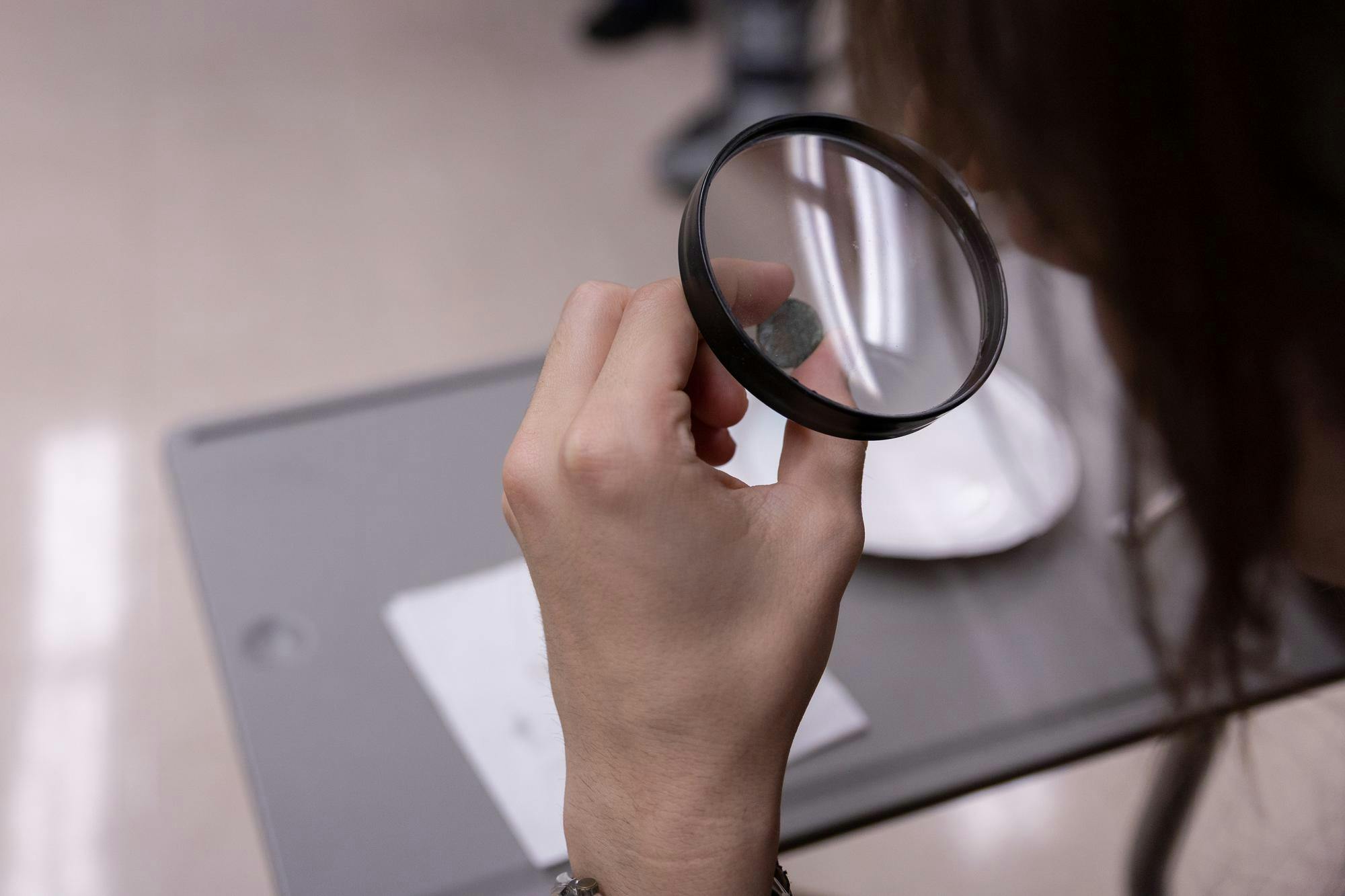
The coins, which date primarily to the late Roman period, offer a glimpse into a civilization that existed over a thousand years ago. Using distilled water, toothbrushes, cotton swabs and toothpicks, students worked to uncover the images and inscriptions preserved on the coins.
For Classical Society President and anthropology sophomore AJ Cousineau, the event is about more than cleaning old currency. It is an opportunity to introduce students to ancient history through a unique firsthand experience.
“I think it's a really fun interactive way to get people into this type of study,” Cousineau said. “The idea of getting to care for and handle something that is so old and historic and important to a group of people that no longer exists ... that's so cool and so interesting.”
Cousineau said the event has been a tradition since the club's early days. With help from faculty adviser Brandon Conley, an associate teaching professor in MSU's Department of Romance and Classical Studies, the organization supplies the coins and materials students need to participate.
“I remember doing it last year,” Cousineau said. “It was the first club meeting that we did and it was really, really interesting and really fun, and I thought it would be a great way to get more people to come and learn some new techniques and new things because this isn't something that everybody gets to do in their life.”
The cleaning process requires patience. Students begin by soaking their coins in distilled water before gently removing dirt with softer tools. They must be careful not to scratch the bronze or mistake corrosion for dirt.
The goal is not to make the coins shiny, but to reveal as much of their original details as possible without damaging them. Once students can identify images or letters, they can use reference guides and online resources to learn more about the coins.
Cousineau said the coins often feature portraits of emperors on one side, with images of gods, goddesses, soldiers or other symbols on the reverse. Some also contain Latin or Greek inscriptions that can help identify their origins.
The activity attracted students with different academic interests, including English sophomore Lizzy Carrillo, who was a first-time attendee. Carrillo said she enjoyed the opportunity to participate in something more interactive than a typical classroom experience.
“I just think it's a lot more tangible for you to do something that's fun," Carrillo said. “I feel like I actually get to do something that's stimulating to my brain.”
Carrillo said handling an artifact made ancient history feel more accessible. Instead of viewing the past as something distant, she could take home an authentic object connected to it. She plans to keep her coin in her dorm.
Business sophomore Keira Whitchurch, a Classical Society member, also enjoyed the opportunity to connect with the ancient world. Whitchurch described herself as a longtime ancient history enthusiast whose interest grew after traveling to Greece and Italy with her father. For her, the coins offer a reminder that people in ancient civilizations were not so different from people today. Whitchurch said examining ancient objects helps make historical figures and civilizations feel more real.
“It's almost like a bedtime story,” Whitchurch said. “You know what happened, but you can't (understand) unless you're there or interacting physically with something that is a part of that ancient, long dead civilization.”
Attendance at the coin-cleaning event was roughly double that of its usual meetings, according to Cousineau. The club has worked to increase its visibility this year through posters, social media and more structured educational activities. For Cousineau, these activities help students easily approach a field of study that can otherwise feel intimidating or distant.
“I hope that they have more of an appreciation for this type of history,” Cousineau said. “It's amazing, it's super cool. Thousands of years of history, insane.”
By the end of the meeting, students were not just learning about the Roman Empire. They were leaving with a small piece of its existence and a new way to unite with the past.
“I hope that (attendees) feel excited about it and that they're happy that they came,” Cousineau said. “I hope that that's kind of what they're walking away with ... ‘wow, I have an appreciation for this now.'"
Support student media!
Please consider donating to The State News and help fund the future of journalism.