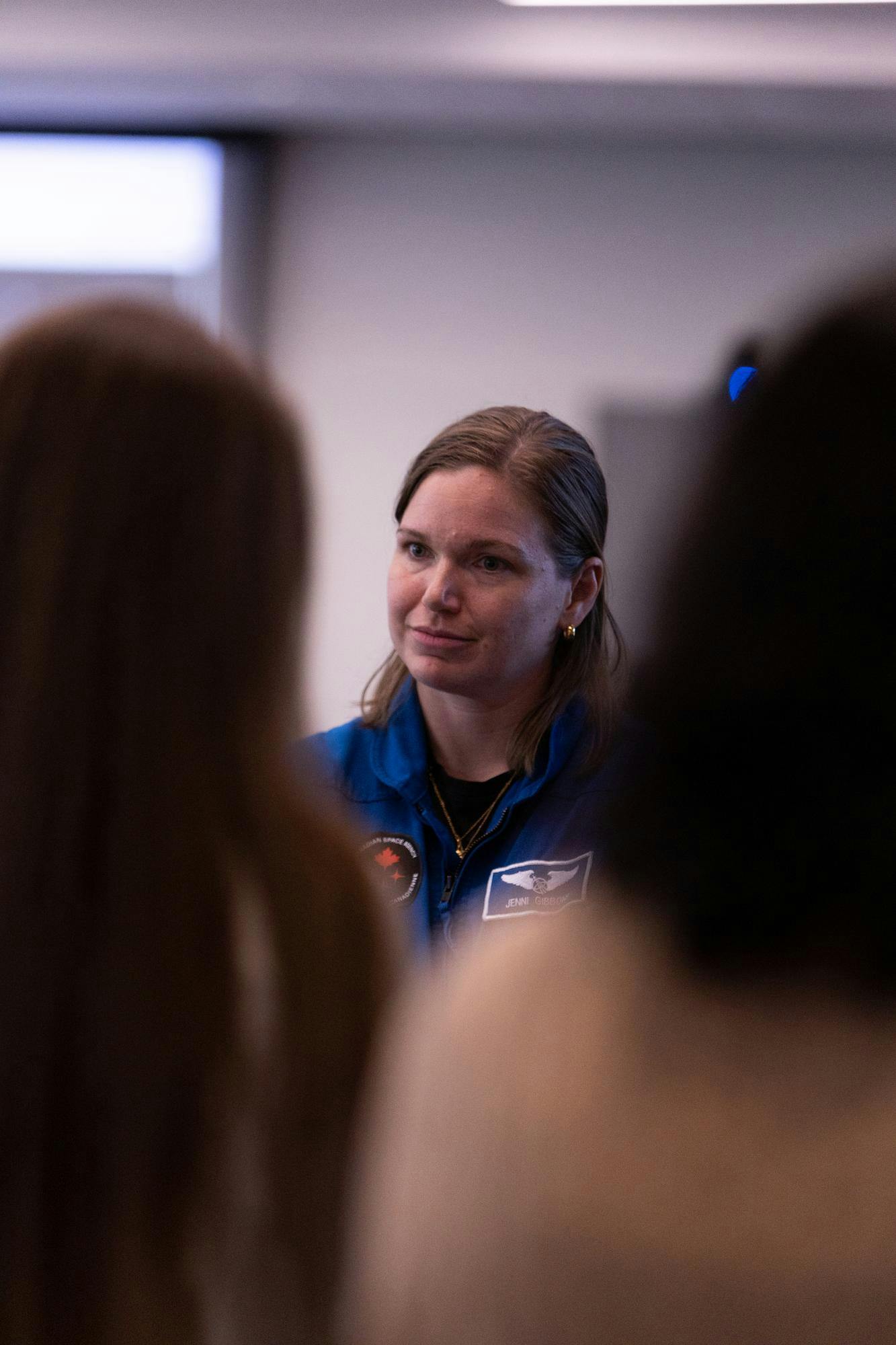
The journey Canadian Space Agency astronaut Jenni Gibbons took from Houston, Texas, to Michigan State University on Thursday is far from the most strenuous she's had to prepare for. After all, she'd been primed to take on the space flight that later set the record for the farthest distance humans have ever traveled from Earth, only six months prior.
The Artemis II space mission sent four astronauts on a ten-day lunar flyby before returning to Earth. Gibbons served as Jeremy Hansen's backup, the first non-American to fly to the Moon and venture beyond low Earth orbit.
The mission has been “the bulk of (my) life’s work for the past three years," said Gibbons to a crowd of College of Engineering students, alumni and faculty for the annual Patton Allison Memorial Lecture.
“Service is very important to me, and this was an active service to do this for my country, this crew and this team,” she said. “So I was very happy, and learned and grew a tremendous amount doing all the training to be fully trained to fly.”
Since Gibbons did not end up flying, she took on a support role by troubleshooting various spaceflight scenarios. The training will help prepare for future Artemis missions, including Artemis III, which is expected to launch sometime next year, and Artemis IV, an expected lunar landing.
When a rocket launches, "you don't just see it," Gibbons said. "You feel it everywhere."
The ground begins to shake and the air begins to smell like burnt metal, a "completely consuming experience," she said. As the rocket lifts off the launch pad, everything begins to move with it.
The stage separation for Artemis II, the process of discarding used-up pieces in space, was the "highest speed they’ve ever done.”
Seats on Artemis II were limited to three Americans and one Canadian, based on contributions to the program. Canada earned a seat due to its robotics contributions to the International Space Station.
It was an "honor" to serve as Hansen's backup, who represented Canada on Artemis II, Gibbons said. That space mission is the “the pillar of space exploration in this country.”
Space missions last between six months to a year, and prospective astronauts need to balance being operational "while still being a team player," Gibbons said.
Mission assignments are dependent on the last time an astronaut went to space, availability, training, past maternity leave and rotation contributions.
“As far as what makes you stand out, there’s a lot to it that is out of your control," Gibbons said.
Training tends to be mission-specific, although the same operational foundations are there. Astronauts are taught how to deal with space motion sickness and stress over the course, which can last between one and three years.
“We do a lot of studies on ourselves to prevent space motion sickness,” she said. “We do a lot of practice on the ground because you want to see how it actually affects you before you get to space.”
Astronauts train with water in their spacesuits to test movement and weigh the suits. There's also lots of "boots on the ground work," Gibbons said, such as trips to Iceland at Apollo training sites to strengthen astronauts' ability to identify rocks.
For Canada, stress management is an integral part of the astronaut training process, according to Gibbons. During recruitment, prospective astronauts undergo repeated psychological and medical testing and are presented with stressful scenarios to resolve.
Although astronauts come from differing backgrounds, the position is traditionally filled by active-duty service members or those educated in science, technology, engineering and math, Gibbons said. There's no "one major" students need to be, but they should complete a master's degree at minimum.
“I don’t know what technologies are going to come out of the moon base, but this is how we make progress,” Gibbons said. “By working on making things better for astronauts in space and keeping people alive, we learn how to make life better here on Earth.”
Support student media!
Please consider donating to The State News and help fund the future of journalism.
Discussion
Share and discuss “Astronaut Jenni Gibbons talks Artemis II training at MSU event” on social media.