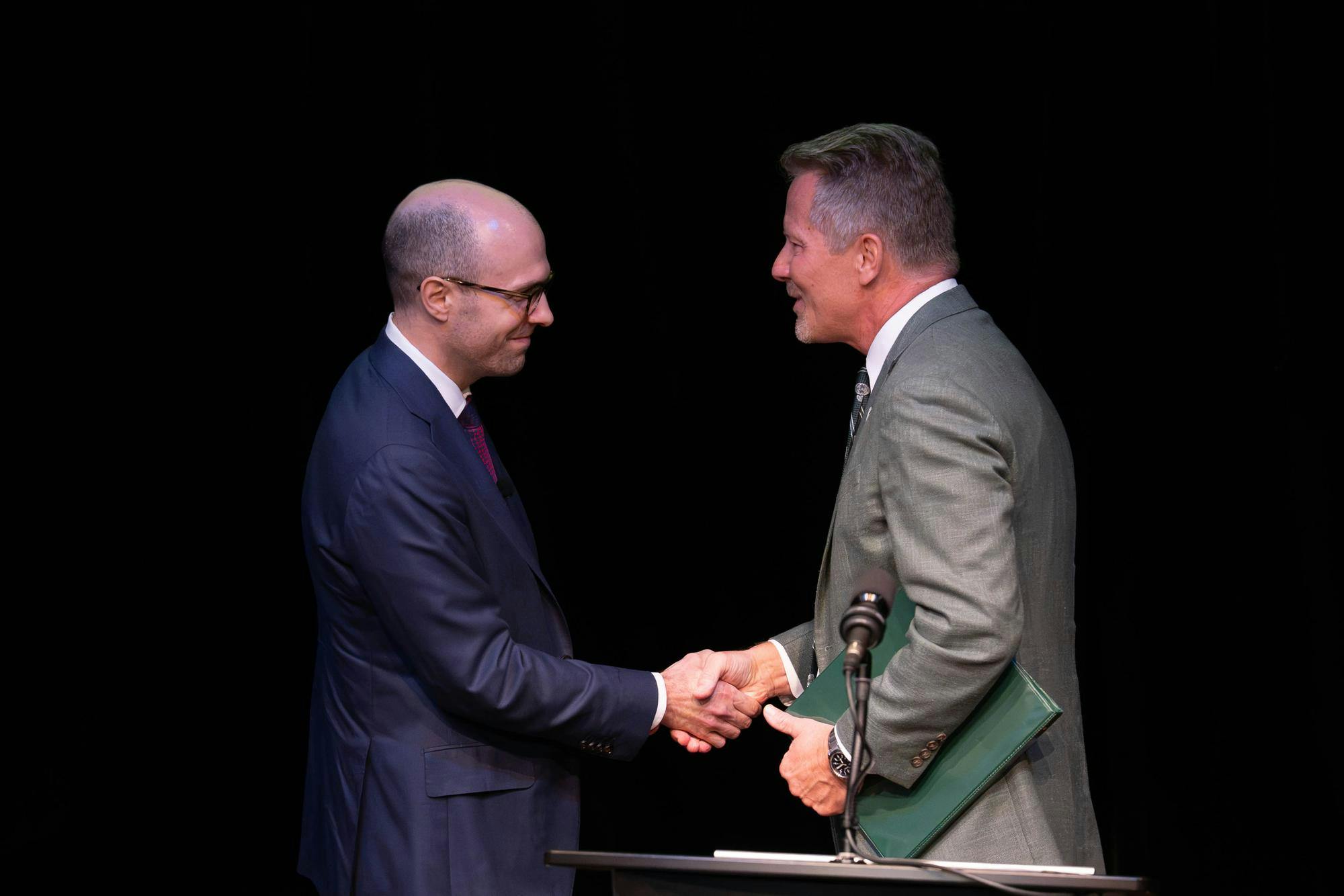
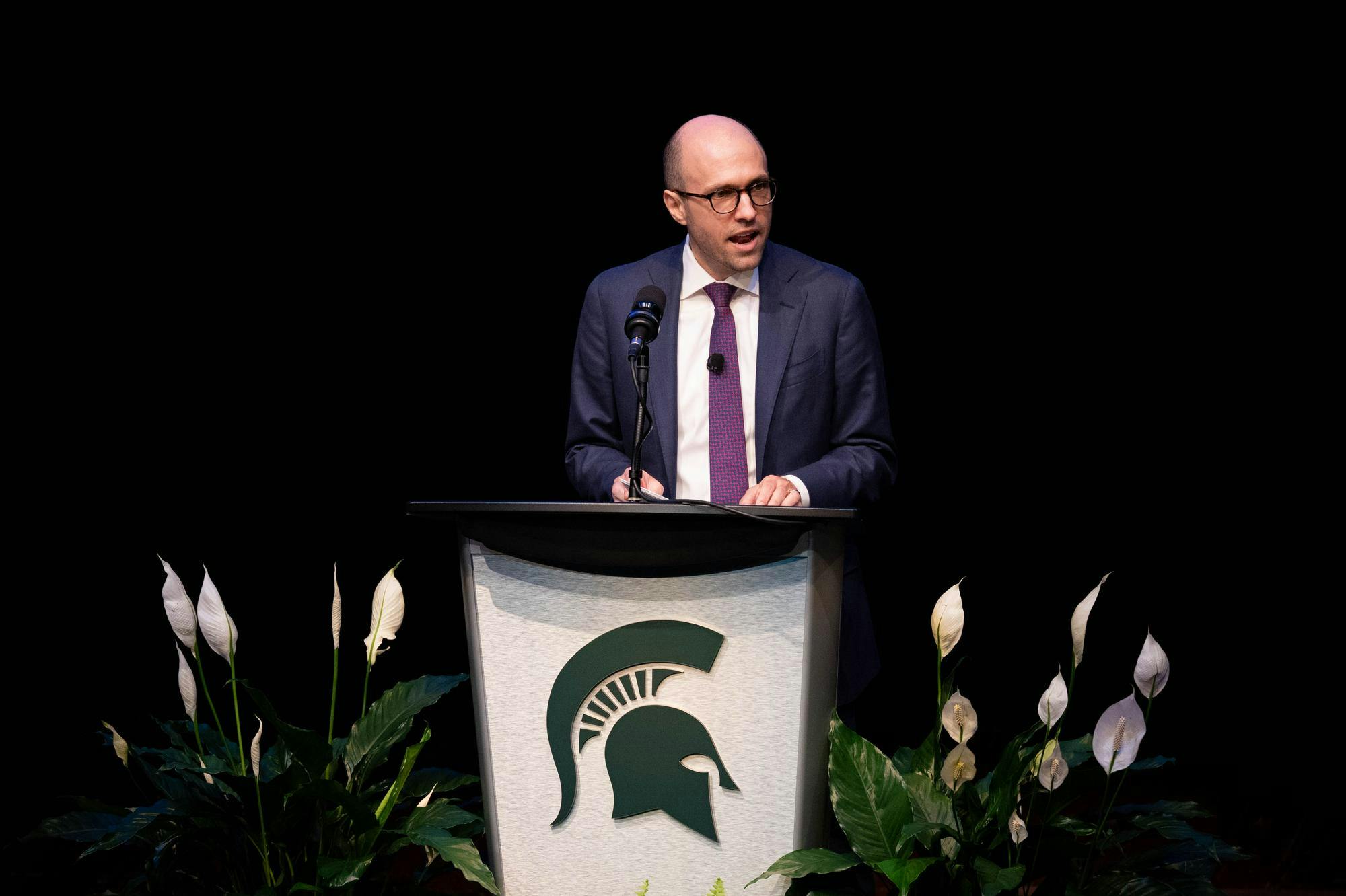
A.G. Sulzberger, chairperson and publisher of The New York Times (left), shakes hands with Michigan State University president Kevin M. Guskiewicz (right), during the Presidential Speaker Series at the Pasant Theatre in Wharton Center in East Lansing, Mich., Tuesday, Sept. 29, 2026. The New York Times is marking its 175th anniversary in 2026.
Celebrating its 175th anniversary, New York Times Publisher A.G. Sulzberger defended independent press and reflected on the newspaper’s extensive history during Michigan State University President Kevin Guskiewicz’s Presidential Speaker Series.
During his over 30 minute address at Wharton Center on Tuesday evening, Sulzberger recalled a sit-down with President Donald Trump.
A free press is an "essential part of our national fabric,” Sulzberger told Trump, and The Times journalists would not be deterred by attacks.
“And they have not been,” Sulzberger said.
Sulzberger is part of a long-standing journalist dynasty as the sixth member of his family to serve as The Times publisher. He was a key contributor to the paper's 2014 Innovation Report, which assessed the future of the organization in the face of the digital age's expedited development.
Trump is not the only president to have interacted with The Times unfavorably. President John F. Kennedy asked The Times to take a reporter off assignment covering Vietnam “a bit too honest,” Sulzberger said.
It is clear that in the institution’s nearly two-century run, adaptation has been vital to the paper's survival, Sulzberger said in his address.
Adolph Ochs, Sulzberger’s great-great grandfather, bought the paper in 1896 and embraced then-new photography and radio journalism while lowering the price of the print paper.
Later, under the leadership of Arthur Hays Sulzberger, the paper prioritized news coverage despite government restrictions during World War II.
In the 1970s, Arthur “Punch” Sulzberger responded to declining newspaper readership and television competitors by expanding The Times’ offerings. He added sections focused on science, sports and lifestyle.
More recently, Arthur Ochs Sulzberger Jr., Sulzberger’s dad, led the paper through the rise of the internet, navigating unprecedented circumstances with no real business model.
“The Times have to transform,” Sulzberger said, while emphasizing that changes requiring the newspaper to compromise its independence or integrity are not worth making.
During his tenure, Sulzberger champions a need for accountability journalism, saying the company has “nearly doubled news headcount in the last decade," including the expansion of national and international coverage. Investigative reporters have more than tripled, the publisher said.
Guskiewicz, who briefly spoke before Sulzberger, spoke of the university’s role in promoting academic freedom and civic engagement.
“Our academic and civic freedom share a trust in a free people’s ability to make better decisions when given access to the most current evidence based information,” Guskiewicz said.
Guskiewicz said he is “constantly encouraging our students to ask why or why not.”
As parting advice to students, Sulzberger urged students to “build something of value.”
“When you face hard choices, face them with considered balance,” Sulzberger said. “And when you lead, lead in the spirit of stewardship.”
Support student media!
Please consider donating to The State News and help fund the future of journalism.