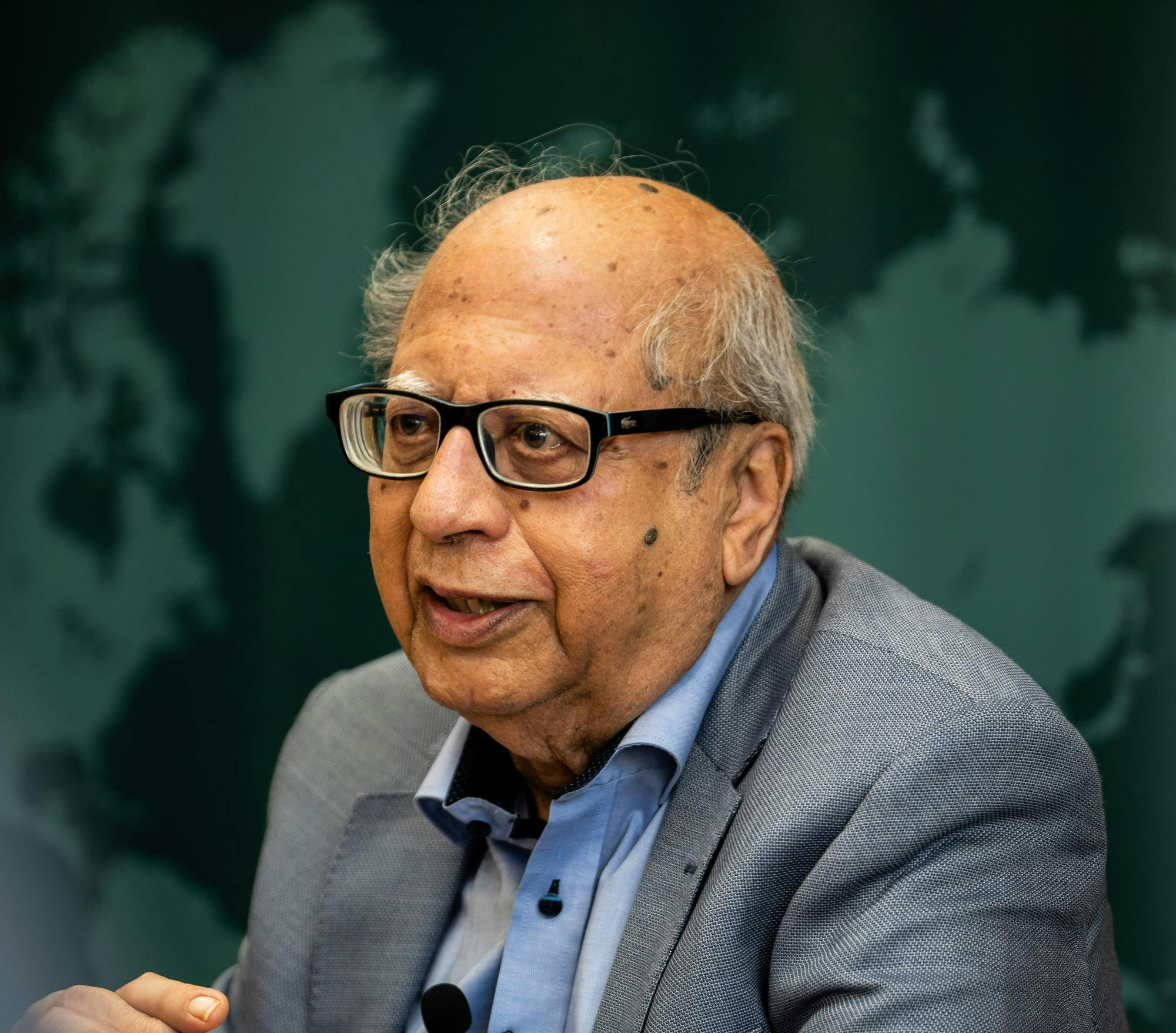
Twenty-five years ago, Mohammed Ayoob was eating toast at his breakfast table when a breaking news alert on the BBC World Service said a plane had crashed into one of the towers at the World Trade Center.
“It became obvious this was no accident, but a pre-planned attack," said Ayoob at the 20th anniversary celebration of Michigan State University's Muslim Studies program Friday evening.
The event honored Ayoob, a distinguished international relations professor emeritus and the program's founding coordinator, at the MSU International Center.
After the 9/11 terrorist attacks, Ayoob felt he had to take on the responsibility of organizing a program on the Muslim world at MSU to “explain the diversity and complexity of the Muslim countries and the different socioeconomic and political contexts in which they lived.”
Ayoob recognized the "inevitable Islamophobia that attacks would generate" once the terrorists were identified.
Consultations with former MSU president Peter McPherson and provost Lou Anna K. Simon led to the Muslim Studies Initiative launch in 2002, before becoming the Muslim Studies Program in 2006.
Ayoob was then inspired to write his book, “The Many Faces of Political Islam,” which was later widely used in courses teaching the subject. Paired with the program's success, Ayoob convinced Dr. Jeffrey Riedinger, the former MSU Dean of International Studies and Programs, and other administrators to fund the Muslim Studies Program so it could be housed in ISP.
Riedinger, who was also at the event, said he was more than happy to "twist enough arms at central administration" for the program.
“A major thrust of the Muslim Studies Initiative was to demonstrate that the interaction of religion and politics in Muslim-majority countries was highly contextual,” Ayoob said. “I told my students for close to 50 years that one cannot understand a text without understanding the context in which it was written.”
The same goes for understanding what happened on 9/11: “It was not Islam that motivated the attacks; the reality was far more complex and was primarily related to the widespread opposition to American policy in the Middle East, rather than to Islam that was used as a justification for the attacks and to mobilize support for other terror attacks," Ayoob said.
The collapse of the communist regime in Afghanistan and the disintegration of the Soviet Union, Ayoob said, led to the emergence of the Taliban, making Afghanistan a “safe sanctuary” for Al-Qaeda to plan its terror attacks.
Ayoob said similar circumstances fueled other "so-called Islamist movements," such as Hezbollah in Lebanon and Hamas in Palestine.
“The continued Israeli occupation of Palestinian territories, the expansion of settlements, the creeping annexation of the West Bank and the economic strangulation of Gaza gave Hamas a degree of credibility among segments of the Palestinian population,” he said. “The fact that the Fatah-run Palestinian Authority was not only corrupt but was also perceived as an agent of the Israeli occupation increased Hamas’s popularity amongst the Palestinian population. These factors had nothing to do with Islam.”
Ayoob emphasized that social, economic and political context matters, as it prevents “reductionist conclusions" — a fundamental tenet of the Muslim Studies Program.
“The Iranian revolutionary experiment may have failed. Hamas and Hezbollah may be on the ropes, but that yearning will persist as long as there are unrepresentative and oppressive regimes in power in Muslim-majority countries and as long as external powers continue to prop them up,” he said.
Muslim Studies Program Director Mohammad Khalil presented Ayoob with a plaque in recognition of his “visionary” leadership as the founding coordinator of the Muslim Studies Program.
The program is also launching a Mohammed Ayoob endowment, funded by a $50,000 anonymous donation.
MSU Chief Inclusion Officer Jabbar Bennett said the program's anniversary “comes at the perfect time” with the recent 25th anniversary of 9/11.
“It was the years that followed where Michigan State recognized the need to deepen understanding of Muslim societies and communities and to address ignorance and prejudice through education and scholarship,” he said. “That work is in service of the university’s mission, which is to replace myths and stereotypes with knowledge, create opportunities for meaningful dialogue and help people better understand experiences, perspectives and beyond.”
Bennett concluded that the need for rigorous scholarship, meaningful dialogue and opportunities to better understand Muslim communities has not diminished, and the program remains committed to raising awareness among students and helping them navigate an “increasingly interconnected world.”
Support student media!
Please consider donating to The State News and help fund the future of journalism.
Discussion
Share and discuss “MSU Muslim Studies Program celebrates 20th anniversary” on social media.