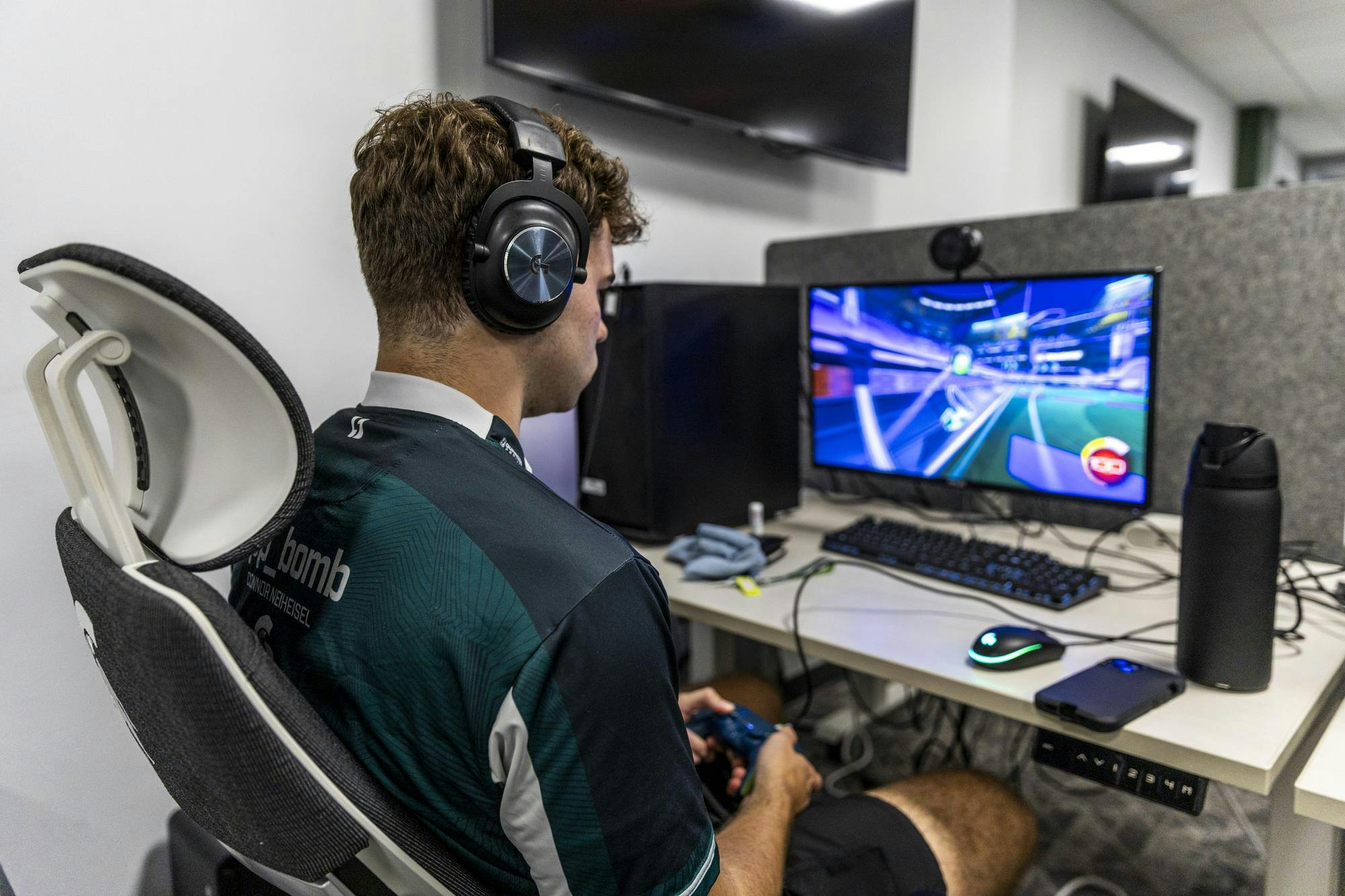
For the past two years, Michigan State’s Rocket League team had been trying to break into the upper tier of collegiate competition. This fall, they finally did.
MSU qualified for the Collegiate Rocket League (CRL), becoming the first team in program history to reach the stage. The 16-team competition brings together North America's top teams.
The achievement comes less than three years after Michigan State launched its official varsity esports program in 2023. Before that, MSU esports was primarily organized through student-run clubs that formed under the MSU Esports Club Association in 2016.
Reaching CRL took the entirety of the program's first two seasons.
“We’ve got a lot of ups and downs and roster changes. So it’s just kind of a demonstration of the hard work and effort we’ve been putting in,” said Connor Neiheisel, a computer science junior and captain of the varsity Rocket League team.
The reaction when the team qualified was immediate.
“We were all screaming. I don’t know if there’s a video of it on the security camera, but we were so happy,” Neiheisel said.
The qualification came through two open qualifiers in August. MSU finished its first attempt without a full roster, as third player David Enriquez was still in Mexico, preparing to move to East Lansing. The team had its full lineup for the second qualifier, where it secured one of the eight available spots.
“We’ve had multiple tournaments where we’ve gotten upset or not performed to the best level,” Neiheisel said. “I think having a time when we had the opportunity and we took it was really awesome.”
The varsity team is built around three starting players, matching Rocket League’s 3v3 competitive format. That means a roster change can directly alter how the three players communicate and play together.
Digital storytelling sophomore and Rocket League team player Christian Riegert has been with the program for the past two seasons. He said MSU had repeatedly finished just outside the line each year.
“We’ve been stuck right outside of the top 16 teams,” Riegert said. “Been ranking 16th through, I’d say, 25 the past 2 years I’ve been here.”
The roster changed this season with the addition of Enriquez, whom Riegert has known since he was 14. Enriquez became an immediate contributor, giving the team another piece to work with after years of development.
Michigan State esports director Christopher Bilski called Enriquez an “instant impact player” and said his addition helped give the team the catalyst it needed to get over the edge.
“It was just switching the team up and putting in the hours,” Riegert said.
Bilski has watched that development at the program level. He was hired as MSU’s inaugural esports director in 2022 after working in collegiate esports at Grand Valley State University, Muskingum University and Aquinas College.
“I think for both our program and especially for our players, it’s a validation of all the time, effort and work that they’ve put in,” Bilski said. “This is a huge achievement for our students. It’s literally the pinnacle of collegiate Rocket League to qualify for this.”
Bilski oversees MSU’s varsity esports program, which includes Rocket League, Valorant and Super Smash Bros. Ultimate. The university officially introduced those varsity teams during the 2023-24 academic year.
Now the Rocket League team is competing in a league where the margin for error is smaller.
CRL Fall 2026 league play began Sept. 6 and runs through Oct. 11. The 16 teams play a round-robin schedule in online 3v3 matches.
Support student media!
Please consider donating to The State News and help fund the future of journalism.
Through the first two weeks, Michigan State is 1-5.
“We started off very poor. We’re playing against the top in collegiate Rocket League right now. And we’ve just never been there before,” Riegert said. “We’re playing scrappy, but we’re losing against all these professional players who have household names in Rocket League outside of college.”
That adjustment is part of what makes the qualification significant for a program that is still building its identity.
James Jordan, Michigan State’s Rocket League coach, has six years of coaching experience and previously competed in the Rocket League Championship Series. He was hired as the program’s Rocket League head coach when MSU launched its varsity teams.
Neiheisel said Jordan has helped the players develop a defined approach to the game after spending their first seasons learning how to play together.
“One of the biggest things is that, under our coach, Jordan, we have a sense of identity in how we want to play,” Neiheisel said. “We have an idea of what we need to do to win.”
The players said that chemistry extends outside of matches.
“It makes everything easier because if someone makes a mistake, you’re not gonna be mad at them or hold it against them because they’re your friend.”
Maxwell Montague, a varsity Rocket League player and president of MSU’s Rocket League club, sees the varsity team as part of a larger esports community on campus. MSU’s esports community began with student clubs before the university created its own competitive program, and the two now exist alongside one another as different parts of the broader esports program.
Montague said Bilski has helped establish expectations that extend beyond competition.
“He’s instilled a culture in our program that has pushed everyone to be the best possible version of themselves,” Montague said. “Excellence, showing up on time. Having integrity, owning up, accountability.”
For Bilski, their record is less important than how the team performs against its own ceiling.
“I tell my students, I judge ourselves by how we play against our potential,” Bilski said. “And so I think our potential is at a very high level. If we play our best, it’s going to be a very high level of Rocket League.”
Discussion
Share and discuss “MSU esports make Collegiate Rocket League for first time in program history” on social media.