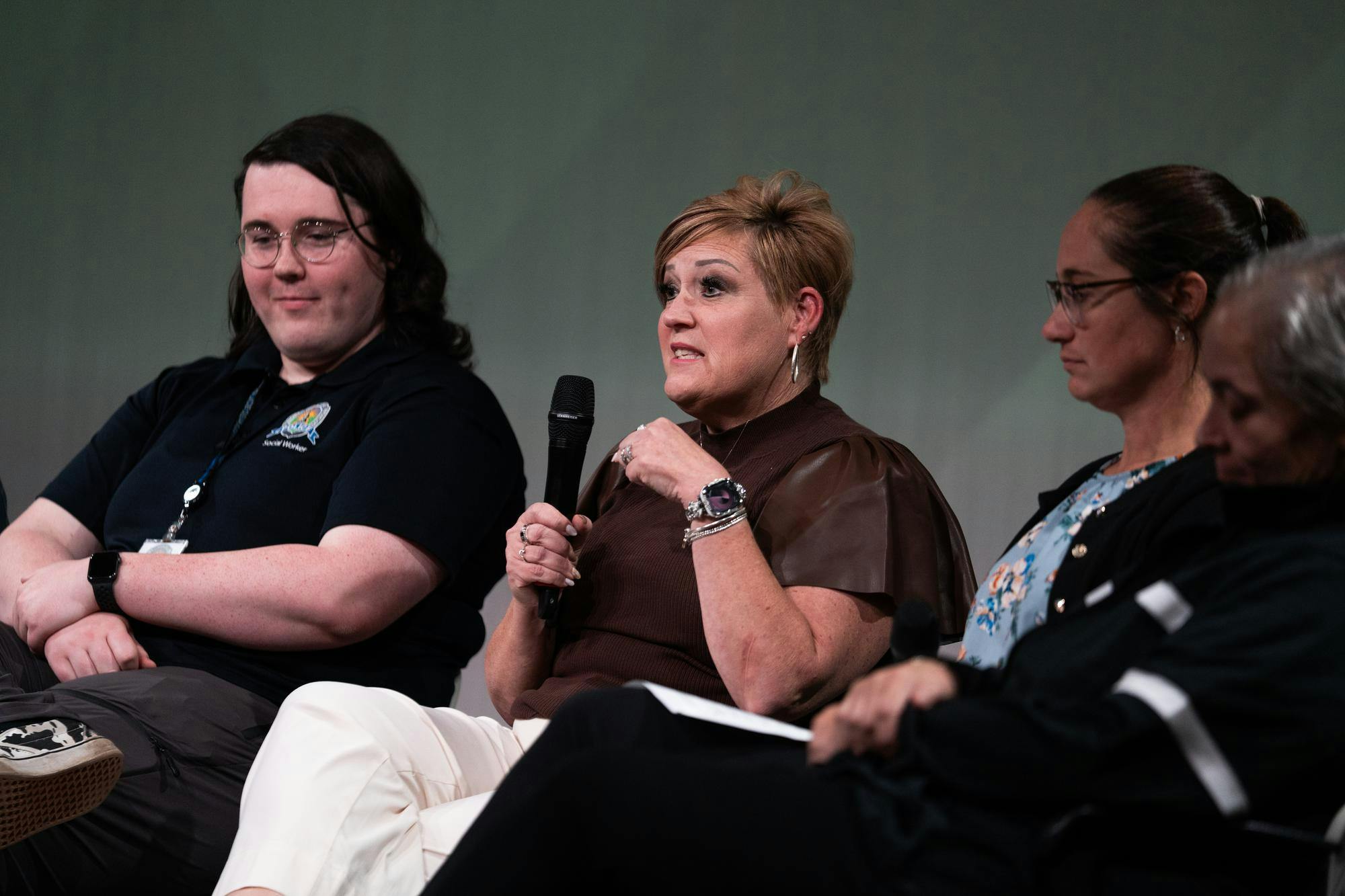
The Advocates and Leaders for Police and Community Trust (ALPACT) Metro Lansing hosted a panel discussion with local law enforcement on mental health crisis response on Wednesday.
The six members of the panel included professionals from various law enforcement and mental health agencies in the Greater Lansing area, including the MSU Department of Police and Public Safety (MSU DPPS).
Community members were welcomed to Studio A of WKAR to observe a documentary screening of “Ernie & Joe: Crisis Cops,” which follows two officers from the San Antonio Texas Police Department, who focus on guiding individuals experiencing mental health crises to proper care rather than sending them to jail.
After the screening concluded, the event's organizers asked panel members questions about mental health policy. Throughout the discussion, a common theme emerged: collaboration amongst the respective organizations and the Greater Lansing community.
Christy Granger, the Community Mental Health Authority of Clinton, Eaton and Ingham Counties’ (CMHA-CEI) community/court liaison coordinator, emphasized the importance of maintaining and creating relationships with a variety of partners in order to provide services the community desires.
“When we come together and work as a team, the needs of the individuals in the community are being addressed appropriately,” Granger said. “We're all working with the same individuals and we all have the same goal: community safety.”
In order to maintain a collective sense of community safety, MSU DPPS social worker Maria Valayil discussed the need to regard the “potential harm or danger to the individual as well as the community itself.”
As a police social worker, Valayil must heed the “physical, emotional and psychological safety needs of individuals in crisis,” according to the MSU DPPS website.
“If somebody comes out, you're going to be respected (and) you're going to be given the help that you need with compassion,” Valayil said. “That gives the community a sense of safety and a sense of well-being that really can't be replaced by anything else.”
Since her work largely pertains to MSU, Valayil has witnessed a “stigma” around reaching out for help when a student is struggling with their mental health. In an effort to curb this stigma, Valayil will be collaborating with the Spartan Wellbeing Collective to initiate “coffee cart conversations” — judgment-free mental health discussions — during the spring semester.
“We really need to break down those barriers if we're going to give the people the help that they need,” Valayil said. “(We need to) make it an environment where people can reach out without worry.”
According to Granger, about 75% of mental health crisis cases have a co-occurring substance abuse issue. Due to substance use being voluntary, Granger says this can create a “barrier” when it comes to administering care.
It’s about understanding "the effects" that each drug has on mental health, Granger said, and being open using peer recovery coaches.
For Darin Southworth, chief deputy of Ingham County’s Sheriff Office, one of the main concerns is the lack of programs that handle both issues simultaneously. When it comes to scenarios of “self-medicating” with substances, Southworth has run into individuals having to “select one (issue) at a time” in order to receive care.
“We're trying to bring more attention to it to get more programs that are able to tackle both,” Southworth said. “But those being very separate treatment programs (with) separate rules (and) separate in the way that they work is definitely a huge barrier right now for trying to get people the support they need to manage both of those (concerns).”
While all of the representatives on the panel stressed the need for continued resource building, such as the recent establishment of a Crisis Care Center in Lansing and the upcoming welcome of a crisis stabilization unit through CMHA-CEI, they also emphasized the value of promoting existing programs to help those in need.
Promoting free, existing programs is especially important due to the consistent student turnover, Valayil said.
“Every year is a challenge of educating a whole new cadre of people coming in, and our freshmen are the ones that tend to struggle the most."
Support student media!
Please consider donating to The State News and help fund the future of journalism.
Discussion
Share and discuss “Law enforcement panel champions collaboration, mental health resource awareness” on social media.