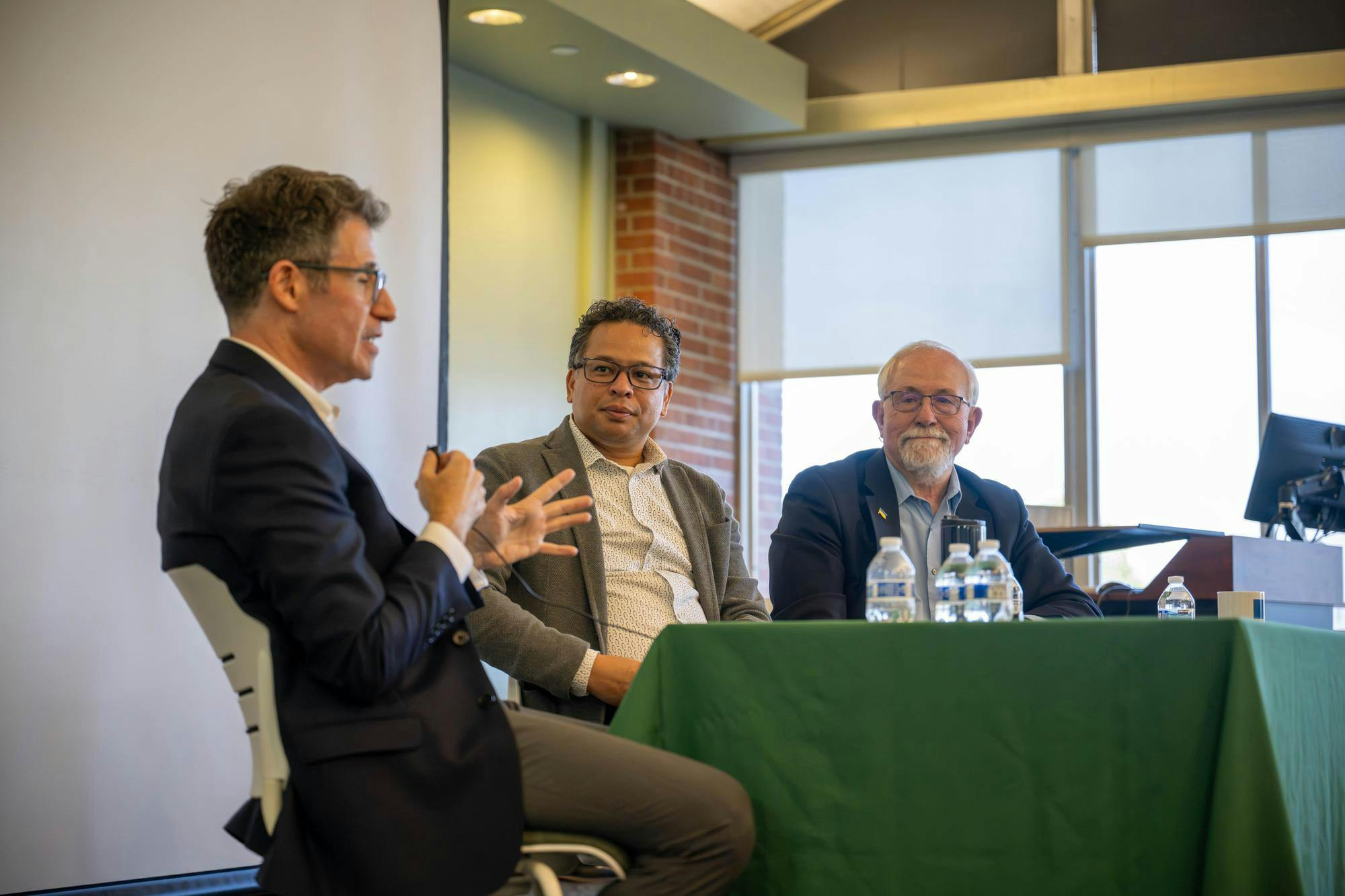
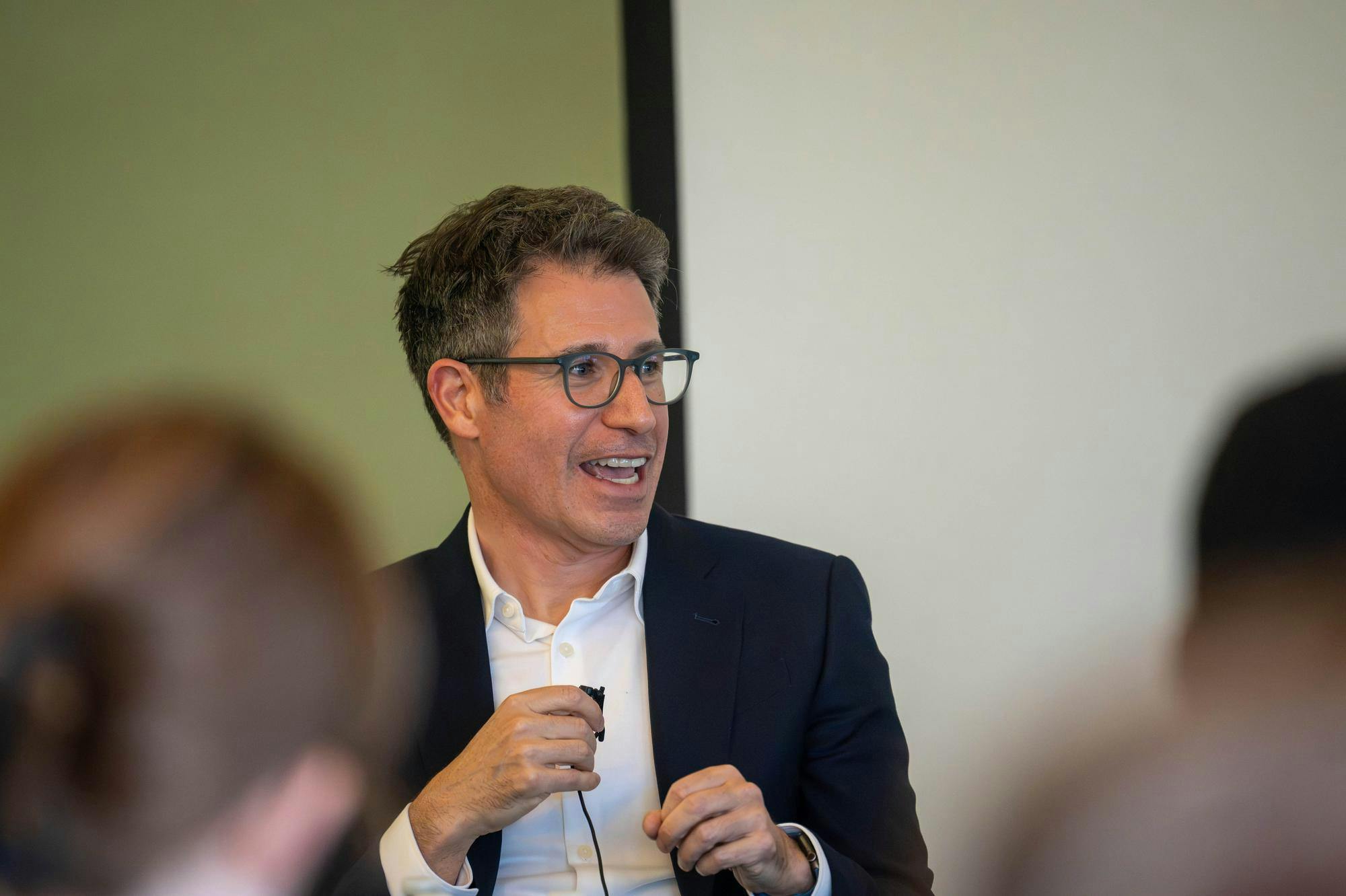
Professor Norm Graham and Professor Robert Brathwaite listen as former CNN international correspondent and Michigan State University alumnus Marc Stewart speaks during a Q&A event hosted by James Madison College at Michigan State University in East Lansing, Mich., on Monday, Sept. 14, 2026.
Michigan State University alumnus and international correspondent Marc Stewart championed the university's global learning opportunities to encourage students to cultivate cultural literacy with the advent of artificial intelligence on Monday.
Stewart graduated from James Madison College as an international relations major in 1995. After college, Stewart began an illustrious career in international journalism, having reported from Europe and the Asia-Pacific region, but most notably in China as a Beijing correspondent for CNN. The alumnus returned to the university this week for multiple speaker events on campus.
Being able to immerse himself in Chinese culture and getting to know the locals was one of Stewart's favorite parts of the job. “The best stories were just talking to people in their everyday environment," he said.
When asked about the most difficult part of having a career abroad, Stewart said the biggest challenge reporting in China was the government interference.
Stewart would get censored for controversial or critical statements said on television, but aimed to get "all sides" of the story regardless.
Another difficult part of his journey was the “extensive” visa process. “If China is unhappy with the tone of your reporting, they will revoke your visa," he said.
When asked about the defunding of journalistic sources like PBS, Stewart’s said “the burden falls on the individuals to be smart news consumers.” He predicts that people will turn to “non-traditional” and "convenient" sources like social media.
In China, however, popular social media apps like X, Instagram or Facebook don't exist because the government’s “messenger service” is the media, Stewart said.
Regardless of his difficulties, Stewart advised students to have “curiosity with other cultures” and to “make the most of where you are” so you are “able to thrive” when challenges appear.
Stewart said MSU's “diverse experiences” helped him be “well-rounded” and remain curious. The former CNN correspondent also pointed to MSU’s alumni network for helping him get unique opportunities.
“I think the benefit of going to a big university is that it’s quite easy to meet people,” Stewart said. “When I was trying to build a network of sources, and I saw someone went to MSU, and they knew about this area of expertise, I would reach out to them immediately (on LinkedIn).”
In a conversation with students at the Broad College of Business, Stewart emphasized the importance of building global relationships as AI advances.
The "big storyline" in China is the rise of nationalism post-COVID-19, Stewart said, as the country attempts to put itself back on track.
“They want to market China as an alternative to the U.S., a stable NATO partner, and a tech hub," he said.
China's economy has grown tremendously over the past few decades, Stewart said, referencing the recent openings of Five Guys and Shake Shack in Beijing. But in order for China's economy to continue to grow, the country needs to find ways to introduce companies to its market.
“The growth of China is fast, but it’s also because it’s just trying to keep up with the West," Stewart said.
As AI changes the global economy, being able to do math formulas and “ace" finance classes no longer holds the same importance.
“What’s going to matter as you study business is having a global knowledge of different cultures and different regions,” Stewart said.
Support student media!
Please consider donating to The State News and help fund the future of journalism.