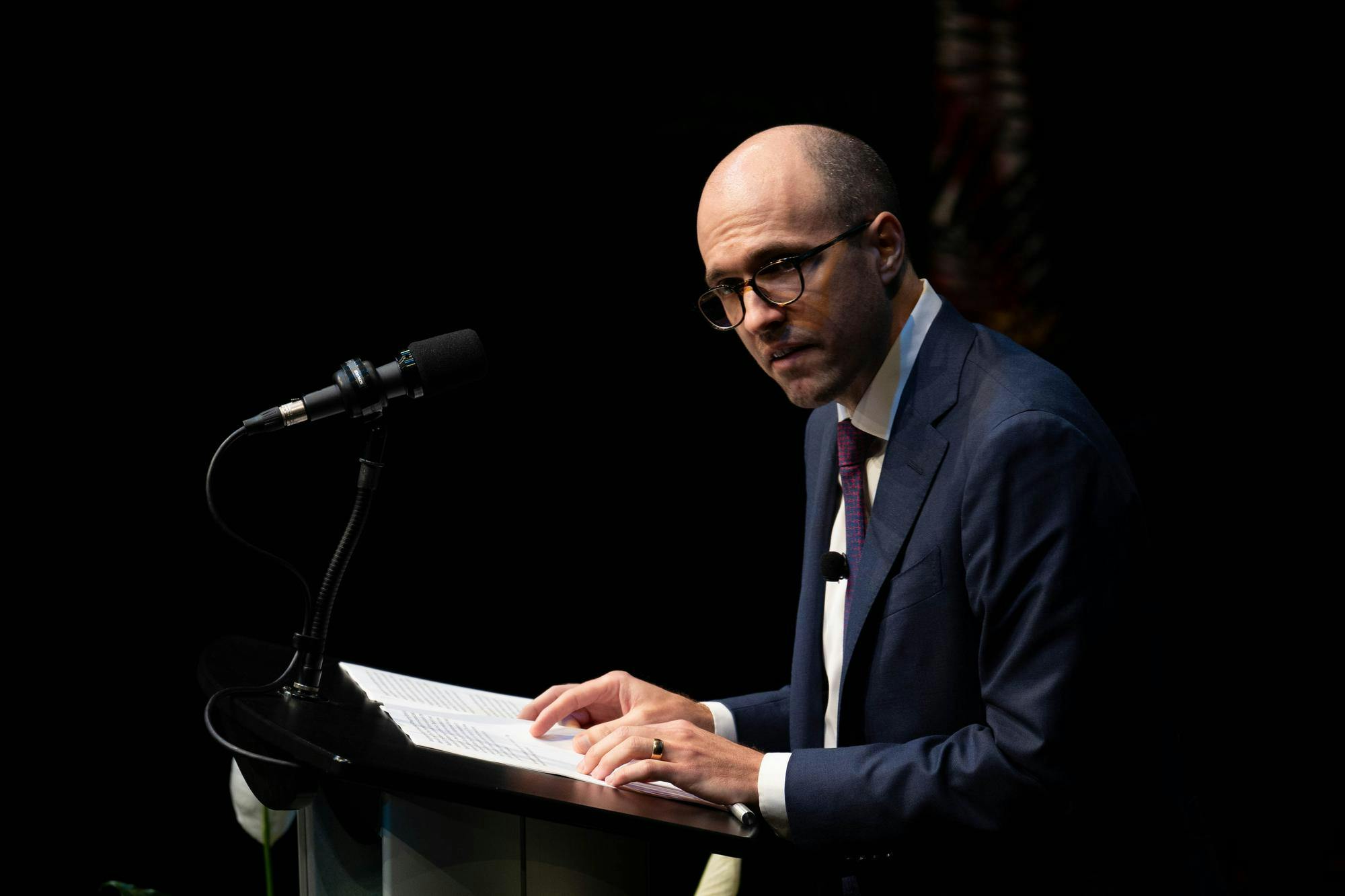
New York Times Publisher A.G. Sulzberger visited Michigan State University as part of President Kevin Guskiewicz's Presidential Speaker Series on Tuesday night. Following the publisher's speech, The State News spent six minutes with him backstage.
This year, The Times is celebrating its 175 anniversary, which Sulzberger spoke about extensively during his over 30 minute address.
Sulzberger is a part of a long-standing journalist dynasty as the sixth member of his family to serve as The Times publisher. Sulzberger began working for The Times in 2009, after reporting at The Oregonian for three years. He was a key contributor to the paper's 2014 Innovation Report, which assessed the future of the organization in the face of the digital age's expedited development.
The following interview has been edited for clarity and length.
You've been with MSU students all day. What do you think the average MSU student can do in their day to day life to support a free press?
The most important thing, and I think it's true of MSU students, but it's true of really anyone, is to have a relationship with a news provider you trust. Ideally, a local news provider you trust, because local news is the most in need of supporting this moment. There are all sorts of challenges to the press right now. We talked about some of them — press freedom, the business model, technological intermediation — but one of the challenges is not enough Americans making room in their lives to ensure they understand what's happening in their community, in their nation and in their world.
If you can find ways to support the local press, if you can buy a subscription to the East Lansing paper or anywhere else, that matters more than people understand.
At the national level, there's threats to free speech. How would you describe the current state of free press in the United States?
I spent a lot of time studying how the press was attacked in eroding democracies. It's often the first target and for some obvious reason, right? Once you go after the people who tell you what's going on and who ask the tough questions of leaders, it's much easier to go after other pillars of society. I think we should always take seriously any attacks on press freedom.
That said, the press is much freer still today — thank goodness for the First Amendment here in the United States — than it is in many, if not most, countries in the world. But we should be clear: We are facing the most direct attack on press freedoms in this country that we have seen in maybe a century — probably since Woodrow Wilson. I hope the public remembers it's not just journalists at a company you don't know or care about being attacked. It's actually the public's right to know. When a reporter stands up in the White House, Pentagon, a City Hall, at a town council meeting and asks the tough question, that is because most people don't get the opportunity to ask a question.
What role do you think student newspapers play in the broader American news ecosystem? I know there are good examples of specific papers that you think kind of play a good role in American journalism.
I am such a believer in the importance of student newspapers. It is a role that's always been important. If you hear the stories of the great journalists of this generation, or the ones who preceded it, so many start with giving trouble to a college dean or a university president with some tough question binding their university community with information. The role of student newspapers has gotten much more important as the local news ecosystem has declined. You really can't disentangle those things. I keep encountering examples where the organization that employs the most reporters doing original work happens to be a student-run organization. I think that's true here, but it's also true in Mizzou (The University of Missouri); in Laramie, Wyoming; and other places. Student journalists are playing a more important role than they may even recognize: Helping to support an informed, engaged community.
You grew up surrounded by journalism. Was there a specific moment within your family or a memory you have that made you want to go into media?
For me, it was the experience of an inspiring professor who happened to be a working journalist with all the rough edges, practicality and high standards that it brought. I learned so much from her. I found her really inspiring and she helped get me my first internship. That really was the moment that I obviously felt connected to journalism, but I wasn't sure it was gonna be my path, and that was the moment that changed.
Support student media!
Please consider donating to The State News and help fund the future of journalism.
Discussion
Share and discuss “Exclusive: 6 minutes with New York Times Publisher A.G. Sulzberger on free press” on social media.