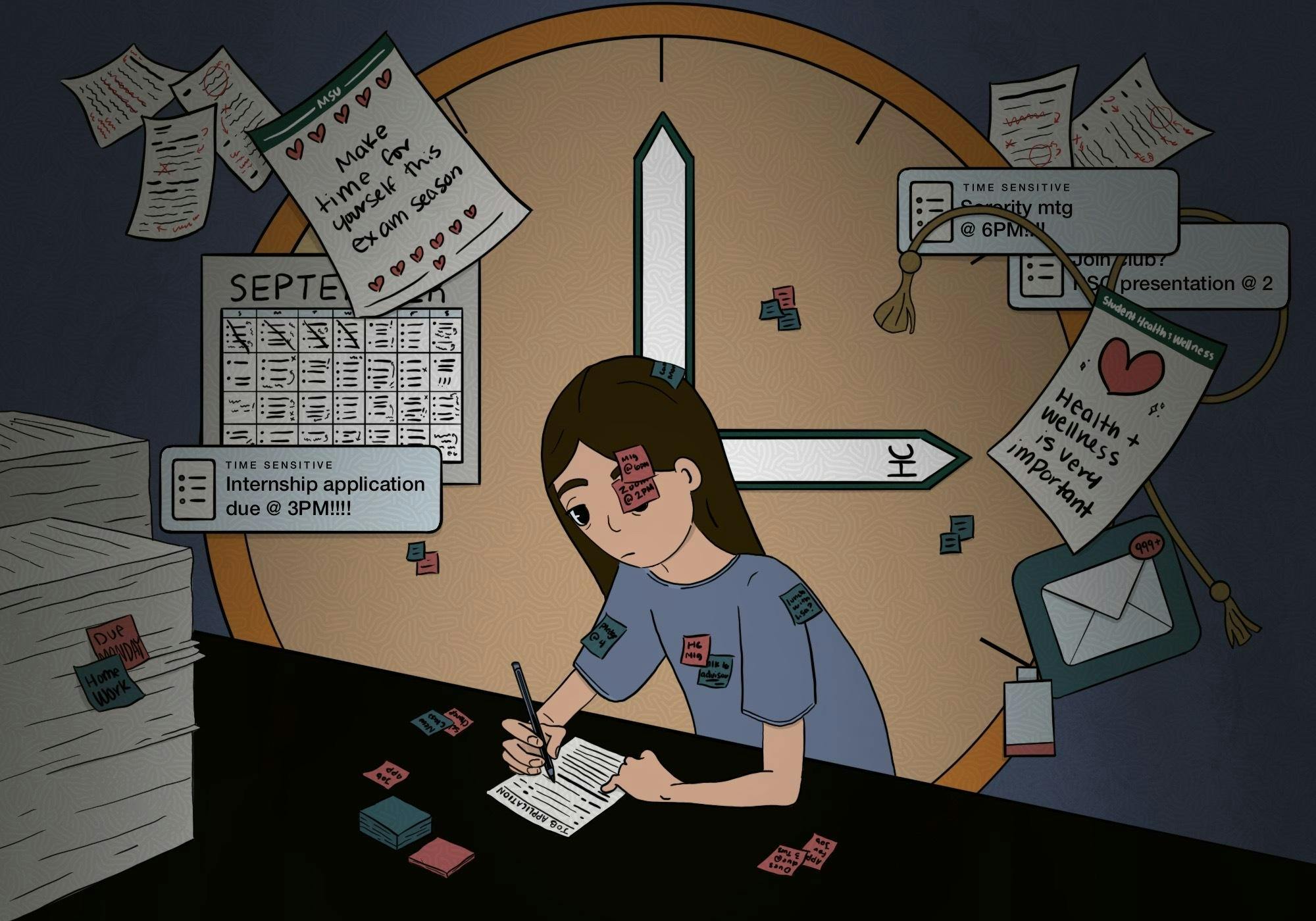
Coming to college brings a flurry of exciting new experiences, friends, freedom and, of course, the anxiety to set forth your career in the right path.
Coming to college brings a flurry of exciting new experiences, friends, freedom and, of course, the anxiety to set forth your career in the right path.
When I arrived at Michigan State University, I didn’t realize how much career anxiety would impact the way I felt about myself, and the decisions I would make in my four years here.
After stalking the LinkedIn pages of several successful students in my field, I quickly came to terms with the fact that I needed to start building my portfolio immediately if I wanted to be successful in my career after college. I needed to join clubs and get opportunities that would look good on my resume as a freshman so that I could get even better jobs as a sophomore and so on, and hopefully secure an internship before graduation.
Construction management, human resources and labor relations junior Taylor Venhuizen said she also felt pressure to optimize her time in college early on as a freshman.
“MSU is such a big school where you feel like if you don't do what everyone else is doing, you're going to be left behind. And I think part of that is definitely true,” Venhuizen said. “It’s just like in our world, in our society. I don't think it necessarily comes from college. I think it (feeling the need to optimize your time in college) comes from seeing other people talking about how they're getting denied jobs because they don't have experience, but how are you supposed to get experience as someone who's young and is still in college?”
This career optimization anxiety is often what brings students to overwork themselves, assuming responsibilities in numerous jobs, internships, clubs and practically any opportunity they can get their hands on, all while juggling schoolwork, their own well-being and a social life.
Additionally, the pressure to further optimize your time at MSU by taking advantage of campus amenities and networking opportunities can amplify the feeling that you should be pushing your career forward now, while you still can.
During my sophomore year, especially, it felt like I was applying to internships with any free time I had — even while eating meals and sitting through classes I was supposed to be paying more attention to.
I found myself feeling guilty whenever I took time to myself instead of being productive because it felt like there was always more that I could be reaching for.
Students like accounting senior Amelia Owinski understand that routine all too well. As someone who was in a co-ed fraternity, is in the Eli Broad College of Business, and multiple clubs and jobs, she often has had a full schedule during the school year.
“I felt like there was always something unfinished. Like I always had a school project coming up and I felt like I didn't have time to just sit down and actually get it done correctly,” Owinski said. “I became like way too reliant on ChatGPT to help me plan things out and get stuff done, and it felt like more of checking things off a checklist than spending the time to learn the fundamentals of classes.”
Somewhere along the way, college stopped feeling like four years to learn and started feeling like four years to optimize, and by attempting to engineer every step of your future, you risk missing the experiences that could actually help you shape it better.
However, you don’t need to sacrifice being present in your life to get ahead in your career. The best form of career optimization may be giving yourself permission to stop optimizing every moment.
Some of the best insights about yourself and opportunities that shape your future won't come from another application or another line on your resume. They'll come from conversations, hobbies, friendships and moments you never planned for.
Slow down long enough to find what makes you feel alive, not just what makes you look accomplished.
Support student media! Please consider donating to The State News and help fund the future of journalism.