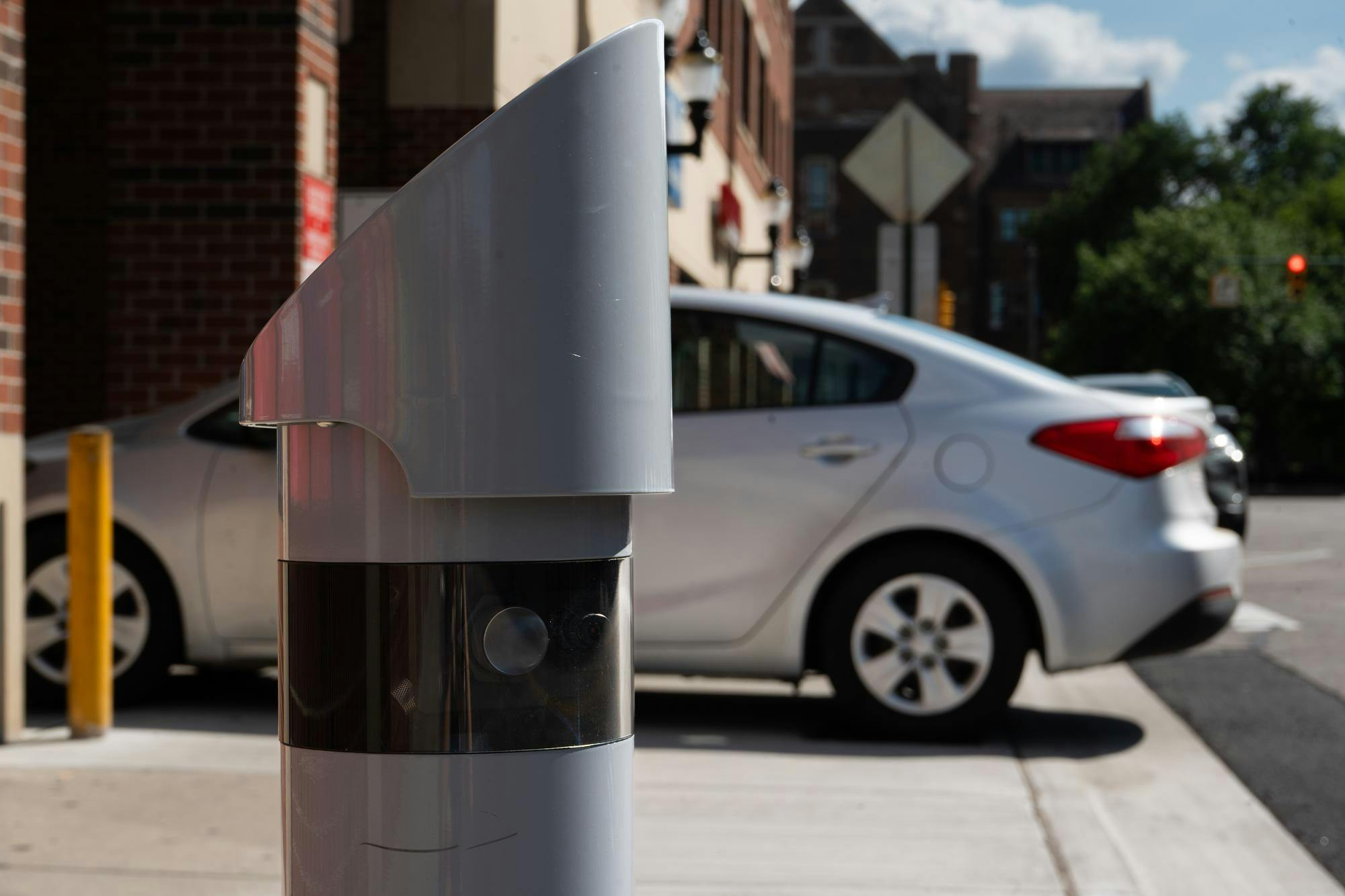
Along with the image, the vehicle make, model and color, as well as the date and time of the violation are also captured.
After the image is captured, it must first be reviewed and verified by the East Lansing Police Department’s division of Parking and Code Enforcement (PACE) and Municipal Parking Services (MPS), the company providing SafetySticks.
Then, if a violation is found, a parking citation including the evidentiary photo is mailed to the registered owner of the vehicle.
In the case of a dispute, individuals will use the same process as for normal parking violations — a hearing before the court and the PACE designee who issued the citation.
At the July 21 East Lansing City Council meeting, councilmembers voted unanimously to implement the SafetySticks after a discussion and presentation by ELPD Captain Adrian Ojerio.
He explained that SafetySticks have the potential to prevent accidents that may occur due to vehicles making unpredictable movements around others parked in illegal zones, as well as obstructed bike lanes, loading zones, bus zones or other access zones.
Since the cameras are automated and run 24/7, they will also allow for consistent enforcement of violations and lift a significant weight off the shoulders of PACE. Ojerio reported that the city conducted a pilot test using seven SafetySticks during the month of April, which yielded 1,347 violations that were reviewed and confirmed. However, no citations were issued during this period.
Between Dec. 2025 and June 2026, ELPD issued 788 no-parking zone violations, Ojerio wrote in an email to The State News.
Last July, MPS partnered with Flock Safety, a national leader in AI compliance technology, enabling the company to use Flock’s advanced License Plate Recognition (LPR) cameras.
Ojerio said in additional email correspondence that the MPS contract, which is still under legal review, contains language stating that MPS will not share or provide data access to third parties without the City's consent or a court order.
"A specific request for language has been added so that MPS will not share or provide data access to data from East Lansing with Flock Safety."
"Currently, a final version of the contract is still in legal review," Ojerio added.
MPS Vice President of Sales Rob Matthews wrote in an email correspondence to The State News that they “have no integration with Flock.“
According to Flock Safety's LPR camera information page, they follow existing LPR laws regarding data retention, but there isn't yet a Michigan law outlining specific limits.
However, momentum has been building for clearer LPR regulations in Michigan. State Sen. Jim Runestad, R-White Lake, has introduced legislation that would place new restrictions on automated license plate reader technology to address worries about captured data retention.
East Lansing resident Sola Bonner and her daughter, Natalie Bonner, both expressed concerns about the license plate photos being sent to MPS. Instead, they wish such matters would be handled solely by the city.
“It's not just a camera that goes directly to the police,” Sola said. “It sounds like there's a third party that's collecting information, so that feels pretty invasive.”
In MSU's case, Department of Police and Public Safety Communications Manager Nadia Vizueta clarified that cameras currently placed around various parking areas on campus, which are mounted on buildings, parking structures, above green-light emergency phones and on other campus infrastructure, are not utilized for parking enforcement.
Support student media!
Please consider donating to The State News and help fund the future of journalism.
“Parking enforcement is conducted through established Parking and Mobility Services operations and personnel,“ Vizueta said. “Public safety cameras located in parking areas serve safety and security purposes, such as supporting emergency response, crime prevention and investigations, rather than identifying parking violations.“
“The PACE department staffing levels have not been full during the last six months,” Ojerio said. “Additionally, employees from PACE do not have the capacity to monitor the no-parking areas 24/7, as they also respond to complaints for code violations and other citizen concerns during their shifts.”
SafetySticks are being provided to the city with no upfront or installation cost. However, after they’re implemented, MPS will take a 50% cut of the parking ticket cost when paid. They also charge a $7 shipping and handling fee for the delivery of citations, for which they take the full cut.
MSU biochemistry junior, Abby Aimone, said that she wishes the city would put more time into “more important” safety issues in the area.
“I feel like parking violations aren't truly criminal. They’re really just getting money,” Aimone said. “I feel like they're putting too much time into these things when other things are more important.”
At the city council meeting, Ojerio reassured the council that their primary concern is safety rather than making money for the city.
“It’s not about revenue,“ Ojerio said. “It’s about changing the behavior pattern to increase safety in the city.“
Without enough parking in the downtown area, Sola said, the SafetySticks would deter her from going to certain establishments altogether. For example, she sometimes would run into a restaurant to pick up an order while her car was parked on the side of the road with hazard lights on.
“Sometimes I couldn't just park, so I had to just run in quickly and I'm pretty sure it took like two minutes,” Bonner said. “So, it would have been over the 90 seconds (the grace period) and I would have been issued a citation just for trying to feed my children a simple meal.”
Ojerio said that ELPD will decide where to place the SafetySticks after conversations with city partners including the city’s Parking Division, PACE and the Department of Public Works and Environmental Services (DPW). The current contract stipulates that the city can place as many as 30 sticks, and they can be moved if needed.
“I don't anticipate putting that many out,” Ojerio said. “That's quite a lot, and that would generate a lot of review of potential violations that we would have to look through.”
At the meeting, councilmember Steve Whelan ensured that ELPD would be planning on providing them with quarterly reviews to track SafetySticks' effectiveness.
To avoid any confusion for drivers, the City plans on placing signage near the SafetySticks and issuing a communications rollout prior to their implementation.
However, interim City Manager Annette Irwin pointed out that some people, such as DoorDash drivers, may still be unaware of the sticks and rack up multiple tickets by the time they receive any in the mail. This may be an issue for the court to sort out, she said.
The plan is expected to be launched after the Michigan court system signs the contract and connects the SafetyStick reporting system to the local 54B district court, which could take up to 60 days, according to Ojerio.
Discussion
Share and discuss “East Lansing to install SafetyStick monitors to curb illegal parking downtown” on social media.