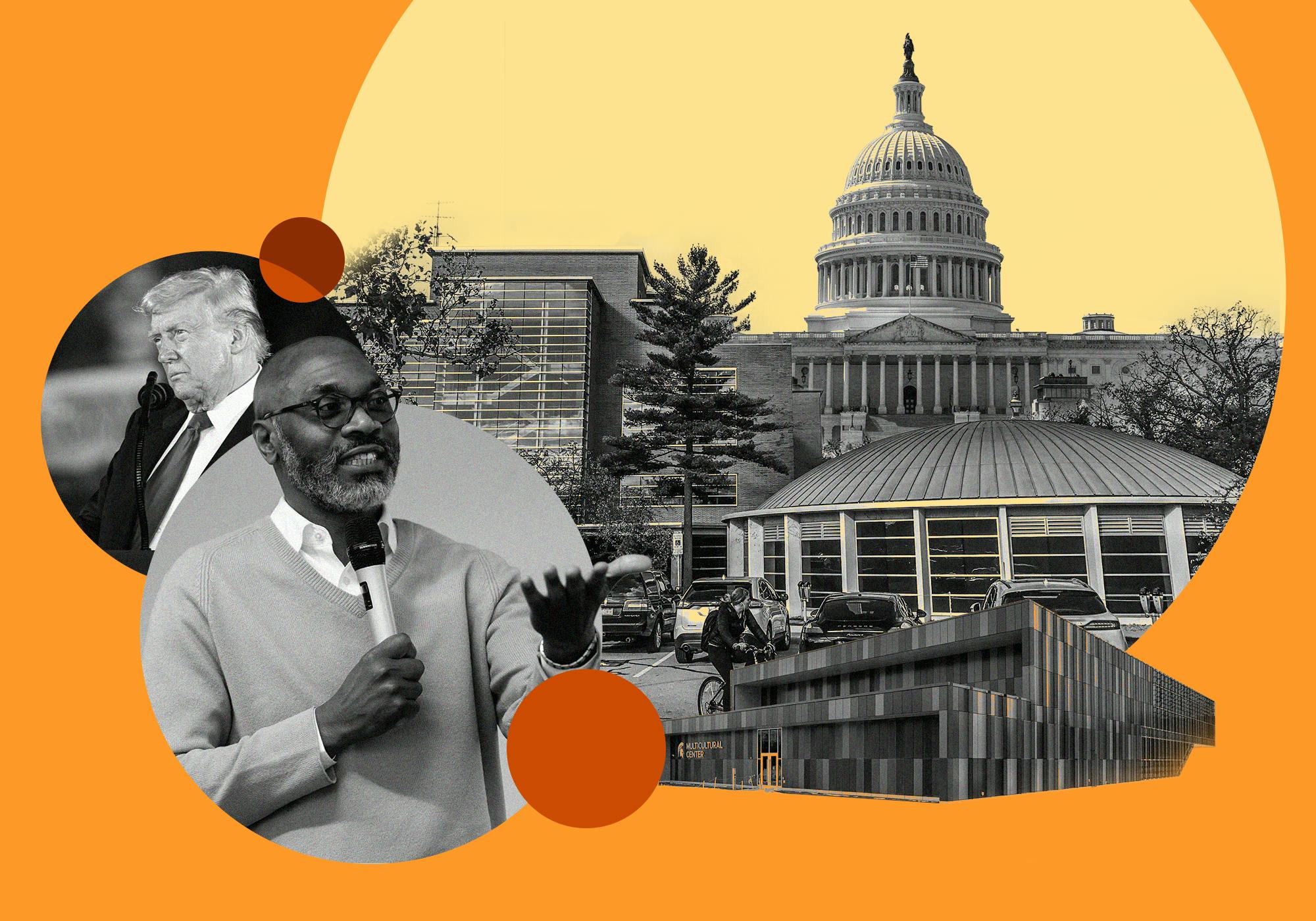
Photo illustration by Tate Rudisill. Photo (top left) via State News archive. Photo (bottom left) by Rachel Lewis. Photo (top right) by Gavin Hutchings.
A State News survey found that Michigan State University students are overwhelmingly supportive of diversity, equity and inclusion programs.
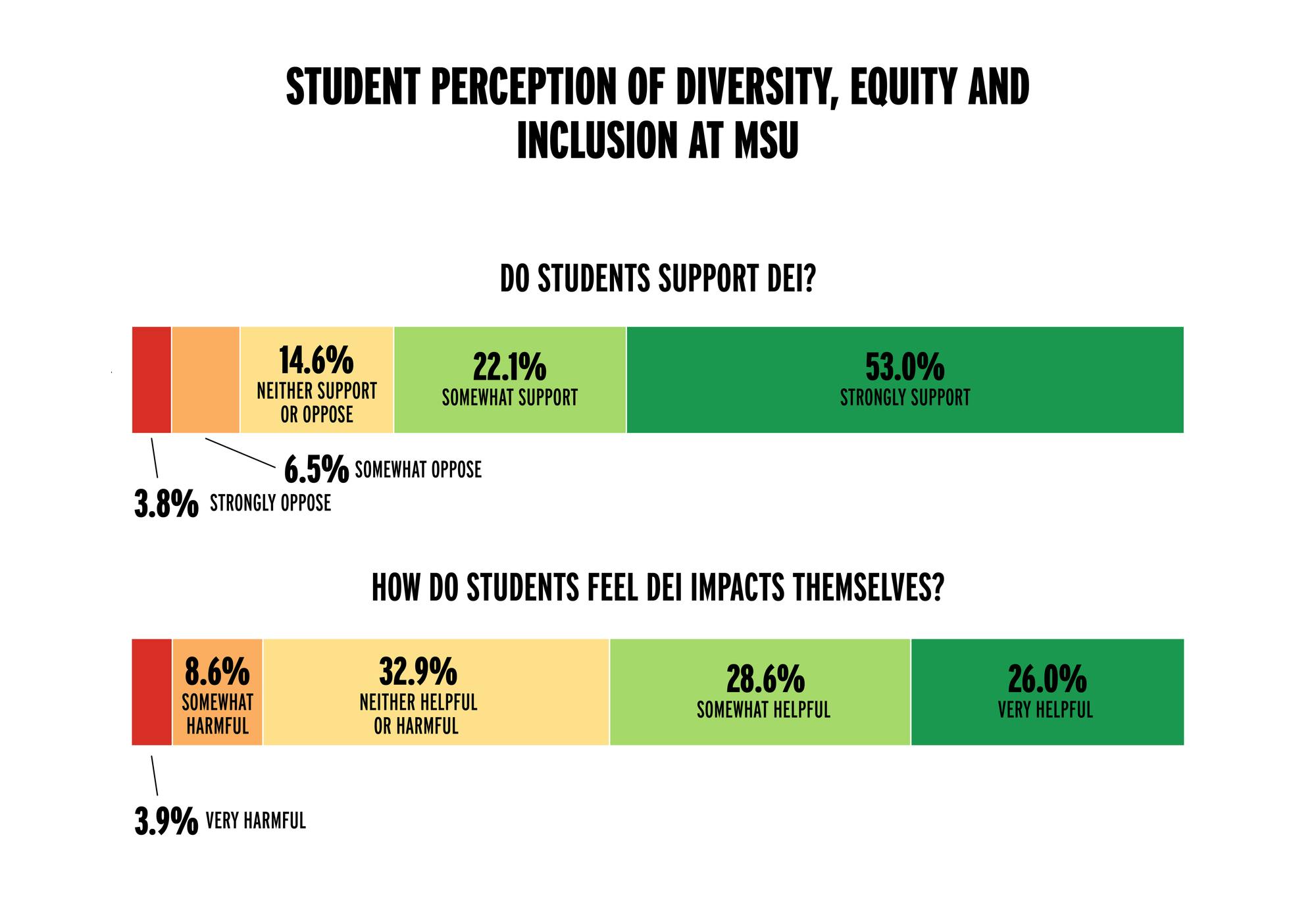
A sample of 800 current students were asked if they “support or oppose DEI efforts at MSU?” Fifty-three percent said they “strongly support” them, and 22% said they “somewhat support” them. Just 4% said they “strongly oppose” the programs. This finding is among the strongest in the entire survey, which touched on a variety of campus issues.
Students of color showed only slightly stronger support than white students. The more meaningful demographic split was with gender. Men were, on average, leaning slightly towards support, while women were solidly supportive.
Just over half of the surveyed students said that MSU is currently putting the right amount of emphasis on DEI. Thirty-one percent said the university is putting too little and 17% said it is doing too much.
The survey also asked students to consider how DEI programs have affected them personally. Fifty-five percent said that DEI has been either “somewhat” or “very” helpful to them. Thirty-three percent were neutral about the programs’ effects. Only 12% said they had been harmed by DEI programs.
Those responses did skew more by race than broad measures of support for DEI. Students of color were more likely to find DEI helpful than their white peers, as were women compared to men. Still, white students and men did, on average, say they found DEI helpful.
The findings suggest that DEI is perceived by MSU students in ways that starkly contrast with the federal government’s current efforts to curb the programs.
Since President Donald Trump took office last year, his administration has worked relentlessly to find ways to force colleges to do away with DEI programs, which had grown into massive bureaucracies and guiding philosophies at many institutions, including MSU.
In response to federal challenges, the university has removed language referencing DEI from many of its public facing documents, urged identity-oriented student groups to change the language of their constitutions and removed the word “diversity” from the title of its chief inclusion officer.
Asked about the survey’s findings in a recent interview, MSU president Kevin Guskiewicz said that the university is working to balance the tensions between on-campus support for DEI and efforts to dismantle it in Washington and Lansing.
“There are a lot of different opinions on this,” he said. “My role and responsibility is to make sure that we’re always in compliance with state and federal law around these issues and with affirmative action, while doing everything possible to support our students.”
One strategy the university has employed has involved changing the titles of employees working in MSU’s DEI bureaucracy and asking that identity-based student groups change their constitutions to not say explicitly that they serve one marginalized group.
For some, the tactic is a way of balancing compliance with the federal government and the interests of students.
“Whatever we want to call it, I think the programs should exist,” said Noah Martin, a recent College of Law graduate who spoke at a Board of Trustees meeting in defense of DEI. “If they need to change the names and call it something else, great.”
But others are skeptical of the name-changes.
“It’s a distinction without a difference,” said Alex Bitzan, a computer science senior and former president of MSU’s chapter of the conservative group Turning Point. He suggested that MSU should more closely follow the spirit of the Trump Administration’s guidance and change the actual work of DEI programs in addition to their names.
James Madison College junior Savannah Thomas also questioned the name changes, albeit for different reasons.
“It’s so nuanced,” she said. Student organizations “have a goal to do,” and if the goal can be met under a different name or with an altered constitution, “it’s not defeating the purpose.”
But, Thomas said she also reckons with “a responsibility perspective." There is a long history at places like MSU of exclusion for students of color. So, “as a Black student," Thomas said she feels “a greater responsibility … to uphold the principles and the fight that got us here.”
Support student media!
Please consider donating to The State News and help fund the future of journalism.
“There’s a collective responsibility to push back against tyranny,” she said. So, Thomas felt conflicted when a student organization she’s a part of changed its constitution.
Board chair Brianna Scott declined requests for an interview. In a written statement, she said that MSU is “unwavering in its commitment to inclusion, despite the changing regulatory and political landscape.”
The university has “taken a thoughtful, proactive and deliberate approach focused on limited compliance-driven adjustments that maintain programmatic efforts to support the success of all students.”
“I think it is important to recognize that restrained changes at MSU may unintentionally contribute to concerns, anxiety, and feelings of vulnerability for members of the community when considered in the broader context of policy changes taking place beyond the university,” she wrote.
James Madison College junior Sammy Leggett said he wants firmer assurance that the university is committed to DEI. Right now, he said it’s unclear to him where MSU stands.
Leadership seems to be “trying to appease all these different circles.” But, “they can’t please everyone,” said Leggett, who is the president of MSU’s W.E.B. DuBois Society.
He described a broad eeriness felt by students of color. It’s unclear what the federal government will do next, and he isn’t sure where MSU actually stands.
“I feel that tensions are high all the time and that my place here at the university is in jeopardy,” he said.
Thomas said she also worries how the situation will evolve in coming years. When the federal government wanted name-changes, MSU complied swiftly. “We don’t know what could come next,” she said, but the name-changes did suggest to her that the university will do the same if new directives threaten more of the core work of DEI programs.
Though “it sounds like a really extreme phrase,” Thomas said the situation reminded her of the American policy principle: “Don’t negotiate with terrorists.”
“The purpose of that phrase is that you don’t negotiate with people who don’t have your best interests at heart, because they don’t care about you prospering,” she said. “Well Trump doesn’t actually care about this idea of the word ‘Black’ being in these constitutions. What he cares about is keeping a hierarchy in society.”
His rules are not “coming from a place of bettering the institution,” Thomas said. They’re “coming from a place of exclusion.”
Discussion
Share and discuss “MSU students strongly support DEI, survey finds” on social media.