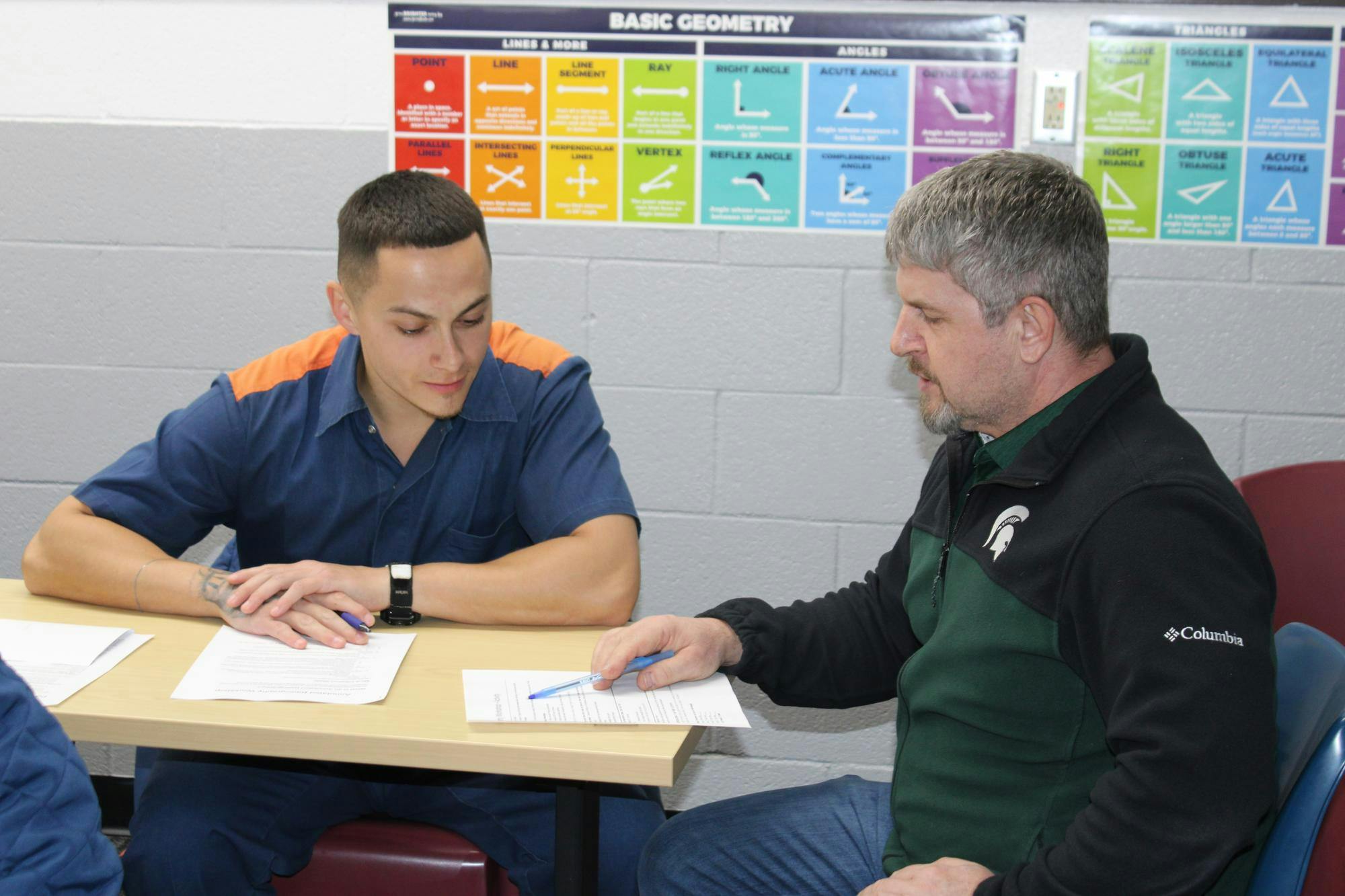
Fifth-year writing phd student Rofiat Bello has been a part of the project since the beginning, watching it expand from an idea to a successful program that has opened new doors for both MSU and incarcerated students alike.
“It's made me grow as a person, thinking about community-engaged work," Bello said. "One thing I really appreciate is seeing how we give people tools. People in prison, most of them, are going to come back to the community. And I strongly believe education is one of those tools that can really, really help them to integrate when they rejoin society at large.”
Before teaching at MSU, Astle taught writing classes within the Jackson Prison System while a professor at Jackson Community College. He was inspired to bring something similar to MSU’s writing program, especially after two former graduate students, Emma Harris and Roland Dumavore, shared their experiences at other schools providing writing assistance to incarcerated people.
The course launched in the spring of 2025 and has run continuously ever since. Its creation followed two years of discussion between the Michigan Department of Corrections (MDOC) and various stakeholders, including the Department of Writing, Rhetoric and Cultures and directors of undergraduate and graduate studies.
Since the fall 2024 semester, the department also offers WRA 441, “Social Justice as Rhetorical Practice,” focused on prison writing by or about the incarcerated, significant texts in peace and justice movements and more.
What Astle encountered in the Parnall classroom within the first couple of weeks ultimately reinforced his commitment to strengthening the program.
“Just seeing the profound challenges guys had to overcome just to be eligible to take college classes — the level of commitment was absolutely inspiring,” Astle said. “And then, just in the classroom, the level of class discussions, the enthusiasm and authenticity with which they offered ideas, opinions, critiques, however the discussion was unfolding, was inspiring as well. They have a wealth of life experience that, typically, undergraduates just don't have.”
In this class, work is primarily centered around the needs of the incarcerated students.
“We ask them, ‘What do you need? What would you like us to focus on next week?’ And we go back [to MSU] and then we prepare for that,” Bello said.
Oftentimes, the incarcerated students come in needing help with their own college coursework from other classes they’re taking, Bello said. They’ve also asked for help with things like business proposals, writing mechanics and grammar, and participated in workshops on writing letters, emails and even poetry.
In a regular class session, incarcerated students are asked if they need help with any individual projects and MSU students are asked to volunteer to help them one-on-one. They go to another classroom while the remaining students hold a workshop-style class.
During the spring 2026 semester, they saw a record number of MSU students enroll in the program, so the class had to be split up into two groups. One group stayed back at MSU to develop workshops and work on their own reflections, while one group visited Parnall each week.
Professional and public writing senior Scarlet Ericksen took the class during the spring 2026 semester, and recalled that the prison environment and conversations with incarcerated individuals were a lot more laid back than she had imagined going into it.
Now unfazed by the TSA-like security process and other prison formalities, Ericksen said that the experience both reshaped personal assumptions about incarceration and helped her develop practical skills.
“It has definitely helped me kind of understand my positionality to prison more, and the write-on program, I think, made it very real how close prison is. It's not far, these people aren’t way different than us, so that is a very stark contrast to kind of the internal beliefs that I had that were subconscious,” Ericksen said. “And it helped me become better at helping other people with their writing. And doing it with a group of people who don't typically get a lot of peer review and learning to help people with their writing in a more regimented way was really helpful.”
She added that the program helped her realize that education through programs like Write On! isn’t only crucial because it provides incarcerated students with social or economic mobility, but that it is crucial simply for the sake of their personal growth and learning.
Bello has held a variety of roles in the program, at one point volunteering at Parnall and last semester helping out back on MSU campus. Throughout five years of being with the program, she said that students often tend to gain perspective on their position in life after taking this course.
“One of the things that I think comes up often is just the realization of how much we already have that we took for granted,” Bello said. “It's realizing that we are in a different positionality. The prison folks are also in a different positionality. We are students, they are students, but our realities are very, very different.”
Support student media!
Please consider donating to The State News and help fund the future of journalism.
Things as simple as utilizing the internet or having free communication with instructors are not available for incarcerated students and make learning all the more difficult. Erickson agreed, echoing what many found most difficult about the course.
She said that she knew everyone wanted to reach for their phones to make sure they were right about something.
"That was difficult to get used to,” Erickson said. “Having to wait to give definitive answers on things because we don't want to tell them to do something the wrong way.”
On MSU’s side of things, the most difficult part about running the program is its credibility and sustainability, according to Astle.
In a program centered on student participation, it’s essential to have core faculty members who can contribute to the organization’s long-term credibility. Additionally, funding helps, and incarcerated student scholarships significantly support the organization’s sustainability.
“The reinstatement of the Pell Grant for incarcerated people speaks to that kind of contingent nature of education inside,” Astle said. “This could go away at any time. I mean, MDOC could just say, 'No, we're not doing anymore,' give no reason, and just say no. It's happened to other people doing similar work. But to meet those challenges, I think MSU and MDOC have been really supportive in various ways.”
Now, an embedded teaching assistantship has been established for the Write On! program within the department.
Next, they will be pushing to create an individual class for the program rather than making it a part of the special topics course, as well as a certification MSU can give incarcerated students upon completion of the course.
Discussion
Share and discuss “MSU students cross prison walls for a different kind of classroom” on social media.