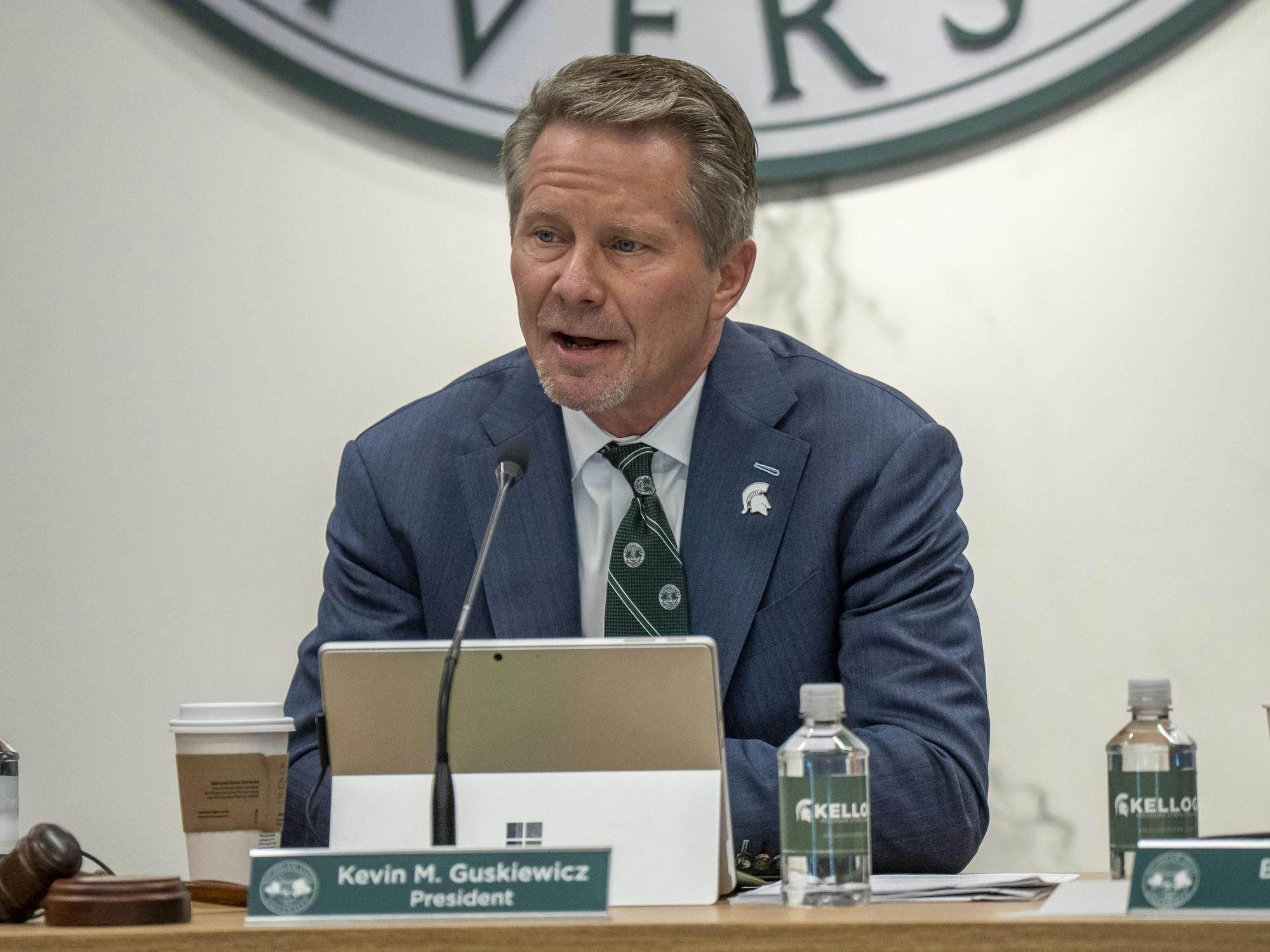
I am writing as a proud Michigan State University alumnus of James Madison College to express my disappointment and anger over the circumstances surrounding President Kevin Guskiewicz’s resignation.
I have read President Guskiewicz’s resignation letter and the public explanations from trustees who have defended their conduct by invoking the First Amendment. That explanation is not persuasive.
No serious person disputes that trustees may ask hard questions, dissent from decisions, or express disagreement. The issue is whether elected trustees are using their positions to strengthen or undermine Michigan State University. There is a fundamental difference between principled dissent and conduct that damages the institution, weakens the president, erodes trust and turns board service into a platform for personal agendas.
The Board of Trustees has an important role, but it does not run the university’s day-to-day operations. The board governs. It sets broad policy, hires and evaluates the president and holds the president accountable. The president and administration manage the university. If trustees have concerns about operational decisions, they should raise them through proper governance channels – with the president, the board chair, committees, or established board processes. Individual trustees should not publicly attack administrative decisions, selectively use internal information, or undermine the president and then claim that the First Amendment excuses the resulting institutional damage.
A trustee’s personal right to speak does not erase the fiduciary responsibility that comes with serving on the Board of a major public university. Board members are not outside commentators. They are fiduciaries. Their obligation is to act in MSU’s best interest, not to make themselves the center of public controversy.
President Guskiewicz’s letter was unusually direct. He wrote that MSU’s progress was being hampered when disagreements moved beyond alternative perspectives and became public undermining, personal interests, and the misuse of privileged and confidential information. That should alarm every trustee, alum, donor, faculty member, student and person who cares about MSU’s future.
A good board governs. A good board supports the president it hired. A good board provides oversight without sabotaging leadership. If the board is dissatisfied with a president, it can set expectations, evaluate performance, require accountability and ultimately decide whether to retain or replace the president. Individual trustees should not wage a public campaign that weakens the president’s ability to lead while damaging the university.
What has happened is not a minor internal dispute. It is institutional damage. It tells future presidential candidates that they can come to Michigan State University and a minority faction of the board may publicly undermine them, second-guess them, leak information and make it impossible to lead. That is not governance. That is dysfunction.
President Guskiewicz accepted the Clemson position even though its reported base salary is roughly $784,000 less than the $2 million base salary MSU had just approved for him. The fact that he is willing to effectively take a pay cut of nearly $800,000 speaks volumes. It is a serious indictment of MSU’s governance environment.
His references to his health, family and faith are another red flag. All major university presidencies are stressful. But it is unusual and deeply concerning for a sitting president to publicly cite health as part of the reason for leaving. Future candidates will see that a respected president left despite higher compensation, described the situation as unsustainable and tied his decision to protecting his health and family.
As an alum, I find this embarrassing and unacceptable. MSU has already endured too many years of leadership instability. The university needs stability, credibility and disciplined governance. Instead, the conduct of a few trustees has again placed the Board itself at the center of controversy.
I am especially concerned about the damage to alum confidence and fundraising. Alums are asked to support MSU because we believe in the institution, its students, its mission and its future. But it becomes harder to ask alums to give when the board appears unable or unwilling to govern itself. Many of us will not be eager to support major university initiatives while board dysfunction continues to damage MSU’s reputation and drive away capable leaders.
The board should take immediate and visible steps to restore confidence, including a clear public commitment to professional governance standards, confidentiality, respect for majority decisions, respect for the proper role of the president and administration and an end to conduct that undermines senior leadership. Trustees who contributed to this situation should reflect seriously on the damage done and change their behavior.
Michigan State University is bigger than any trustee, faction, or personal agenda. The board’s obligation is to the university, its students, faculty, staff, alums and future – not to political positioning or public grandstanding.
MSU deserves better. Its students deserve better. Its alumni deserve better. Its next president deserves a board capable of governing with discipline, integrity and loyalty to the institution.
Glenn Oliver is currently CEO of a tech company serving the water utility industry. He is a James Madison College alum (1984). His opinions are his own and do not express the opinions of The State News.
Want to submit guest commentary?
The State News welcomes guest commentary from students, faculty, staff, alumni and community members. If there’s an issue you care about or a perspective you think others should hear, we encourage you to submit a piece for consideration. Please visit the portal to learn more.