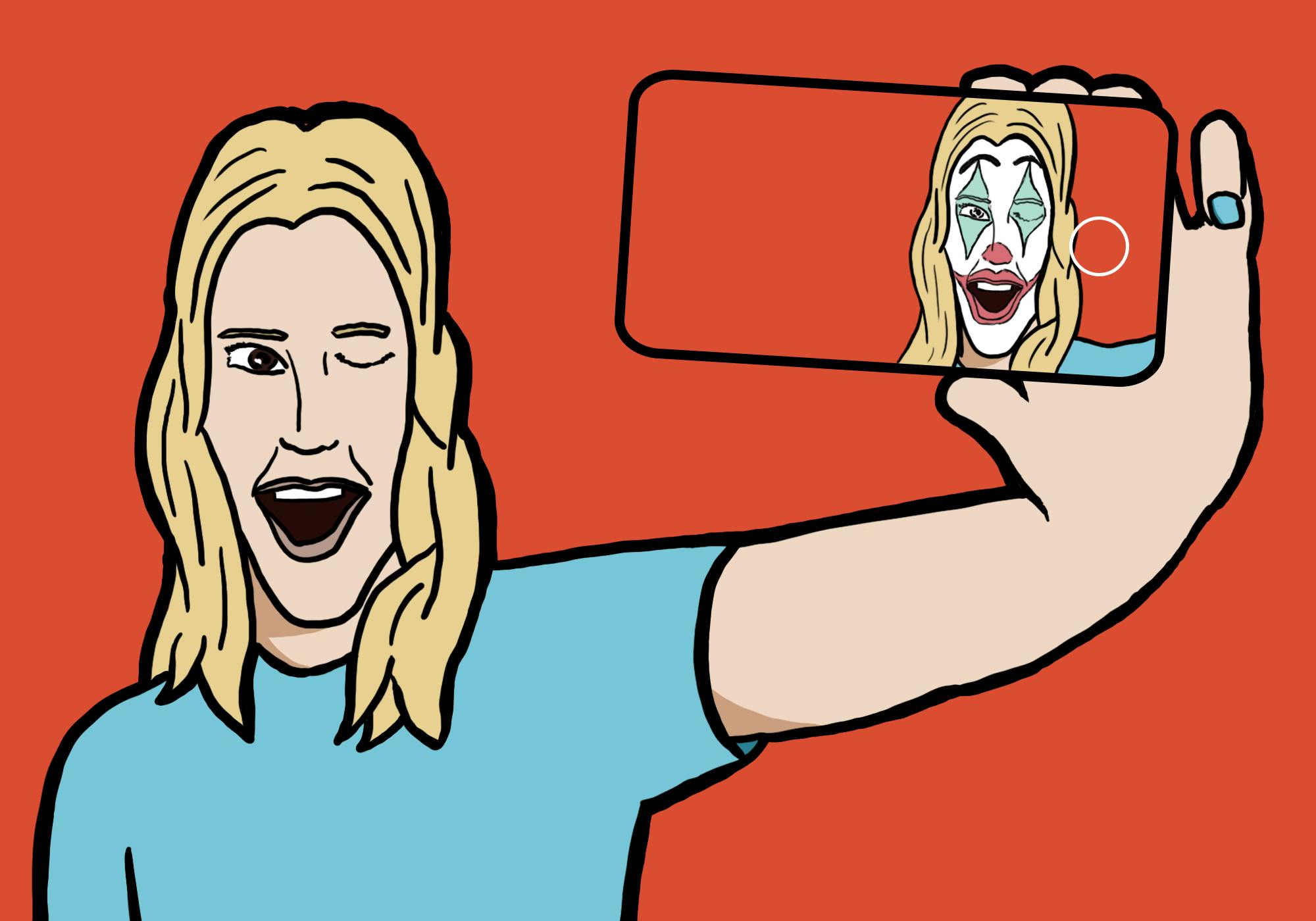
Thirteen years ago, comedian Nathan Fielder Tweeted, “2013 is about love. Don’t kiss people ‘ironically’ this year. Look at them in the eyes and say ‘This is real…’”
To this day, this Tweet gets thrown around for its uncomfortable hilarity, but seriously, unironically, I see his point. Everything seems to be under the pretense of “it’s just a joke.” When you’re spending enough time engaging with something to point and laugh at the idea of earnestly enjoying it, a paradox is born. How do you know what you do enjoy, if not this? Can you recognize yourself clearly if you’re constantly disguised?
This perception is twisted and our culture is suffering because of it.
One of my favorite things I’ve learned thus far in college is Simmel’s theory on the metropolis. In short, the modern world is too frenzied and feverish, we are overwhelmed and do not have the bandwidth to focus on anything but ourselves. We become selfish, inward facing creatures, detached from our empathy and humanity as an act of protection. This theory applies quite well to the modern online world, too.
The internet is best described as a panopticon. All of our actions are on display and can be accessed at any time, forcing us to keep ourselves “in line” to avoid judgement. So, just as we adopt a blasé attitude to protect ourselves in the metropolis, we use irony to protect ourselves in the absurdity of the internet age. I see this manifesting in two primary ways: as a self-confidence tool and as a coping mechanism.
Irony as a self-confidence tool
This is a phenomenon that is almost exclusive to Gen Z. With a large chunk of our childhoods and adolescence having been spent on social media — environments that are notoriously unkind — we have been conditioned to default to defensiveness in fear of becoming the internet’s next punching bag. Pfft, no I’m not spending hours watching this content and listening to this music because I actually like it. That would be embarrassing.
That idea of inferiority versus superiority plays a key role in irony’s appeal because it gives us an excuse to pat ourselves on the back. We enjoy pretending to like these things because our contempt for them confirms that we are better than at least a few people in this world. We are smarter, more talented, more “normal.” We don’t actually think saying “67” is funny, the humor lies in trying to fathom that someone out there does find it funny. We didn’t actually care when Haliey Welch started the Talk Tuah podcast, but we tuned in because she thought her dry, mindless ramblings held substance and that was what intrigued us.
I remember in late 2018 when musical.ly had its TikTok rebrand and everyone hopped on the app “ironically.” Even throughout 2019 and as we crept into the COVID era, using the app was still largely “ironic.” How dumb it is that someone can gain millions of followers from doing a little dance. How dumb, truly. Let me copy it to make fun of it. Now look where that got us, TikTok is our cultural backbone. We ran the irony so hard into the ground that it became our foundation. But how sturdy can a foundation be if it was built in a mirage?
Irony as a coping mechanism
Refer back to Simmel and the metropolis, that whole thing about modernity numbing your compassion in order to function at full capacity. The internet, and TikTok especially, is just as overwhelming to our brains as the metropolis is. Our senses are constantly overloaded with such large amounts of information, and the contrasts between scrolls are jarring. You can see literal murder immediately followed by some brainrot with little to no time to process what you just witnessed. The two become related in our memories, a mixture that serves as a (mostly unconscious) desensitization tactic.
All of social media became digital bystanders to Charlie Kirk’s brutal death in September as a close-up, HD video of the shooting was dispersed to every corner of the internet. I won’t be naive in ignoring the very probable political motivation behind the memes that evolved, but I think that many people had to make a joke out of it to keep the horror from setting in. They had to laugh at the AI Charlie Kirk memorial song, had to superimpose his face onto funny things, had to use his final words as an inside joke to distance it from reality. This way, there doesn’t have to be the acknowledgement that any trauma was received from what was observed.
This hurts more than it helps, though. Treating all disturbing moments as if they were some simulated, fantastical blague will form the world into just that. If we train ourselves to perceive the violence against Charlie Kirk, for example, as a laughable moment, our minds will remember that connection and recognize other acts of violence in a similar manner. We’re slipping into a sort of mass affective flattening, a mass suppression of emotion. We’re less reactive because things like these are so normalized that we have rewarded ourselves the ability to disconnect from them. If I laugh at it, it can’t hurt me.
The use of irony is so natural to Gen Z because it was so deeply embedded in our upbringings. The digital world is inherently fabricated, so we morphed into fabricated forms of ourselves in response. The consequences are larger than internet histories and footprints, we’re deceiving ourselves and damaging our discernment. Are we forever doomed to wander the earth in search of an unironic mecca to house our need for sincerity?
It’s a little dystopian, but it’s all we know. However, we must shift away from irony’s familiarity so as to not set a precedent for truth requiring disclaimer. Like the aforementioned Nathan Fielder Tweet decreed, we must live in candor. Or else we perish in a sea of confusion.
Melody Meyer is a sophomore studying Journalism with a concentration in sports broadcasting and is a columnist at The State News. The views in this article are her own and independent of The State News.
Support student media!
Please consider donating to The State News and help fund the future of journalism.
Discussion
Share and discuss “OPINION: Irony is shattering your sense of self” on social media.