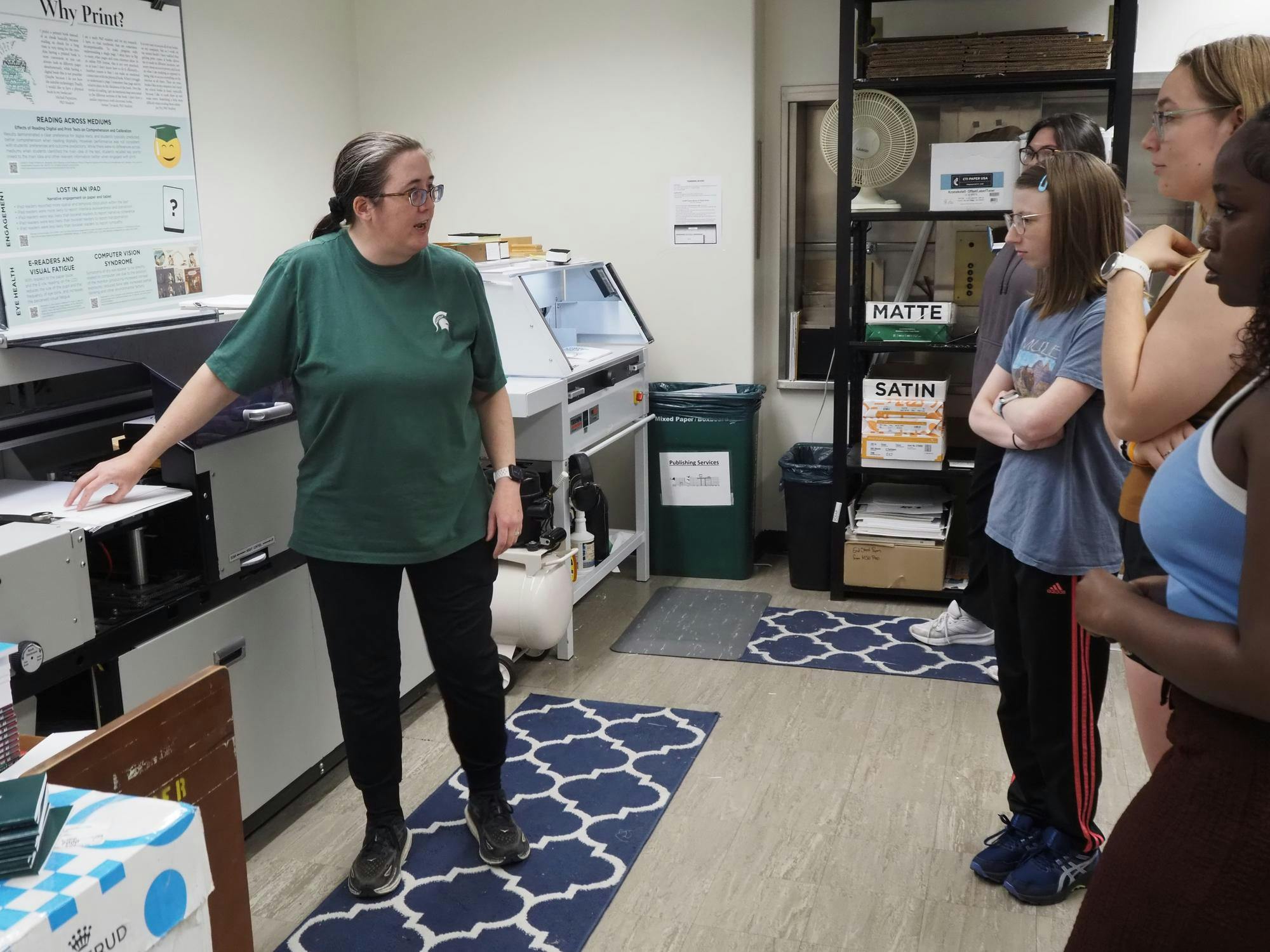
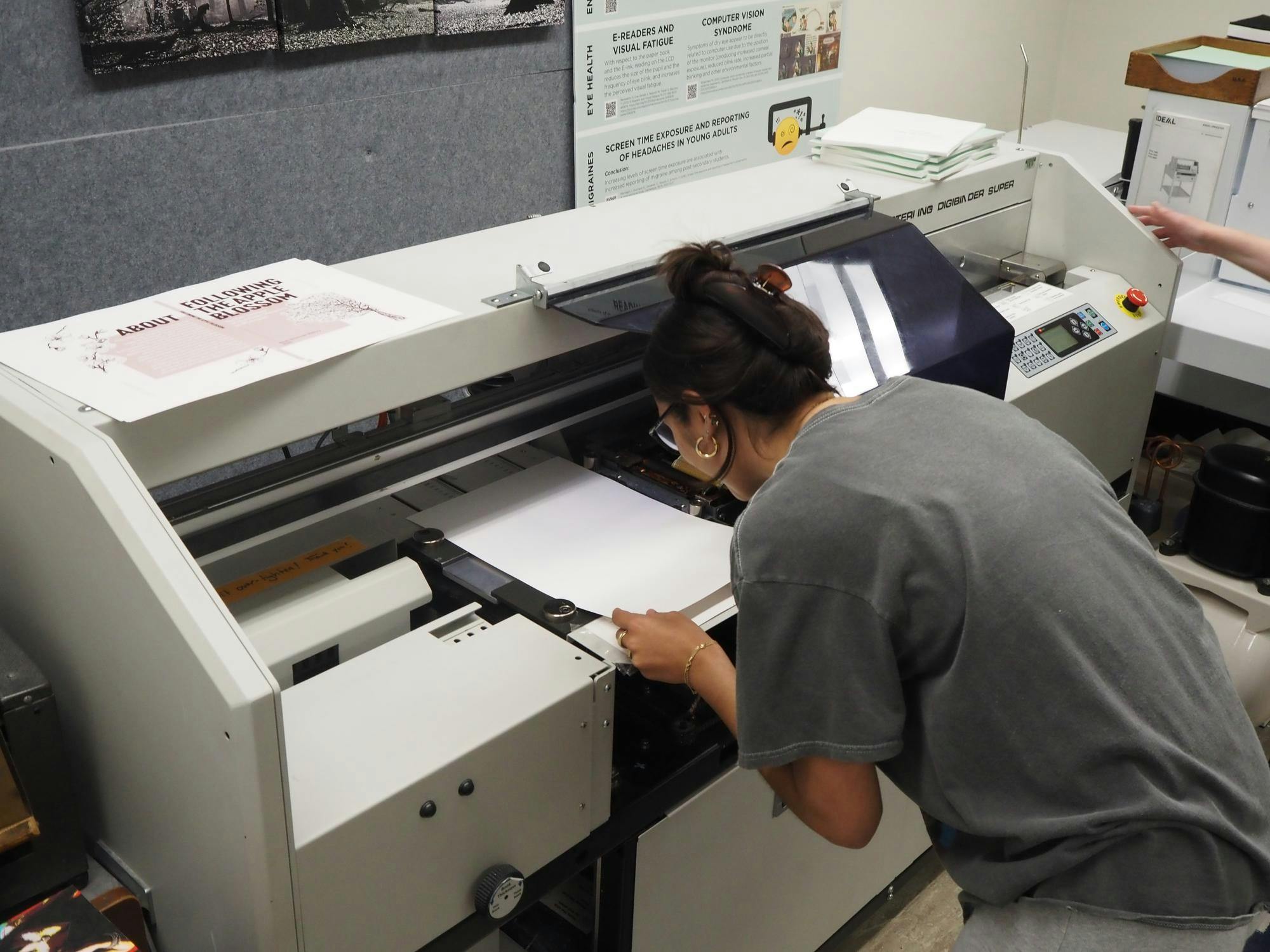
MSU students learn about the book publishing process from an MSU Publishing Services representative for their Asian American history course. Photo courtesy of Alicia Zhang.
A book authored by Michigan State University students chronicling Asian American immigrant experiences in Michigan was published last month.
During the spring 2026 semester, students in an Asian American History course at MSU, HST/MC 319, conducted interviews with Asian American community members across the state and wrote 17 reflective essays for their book, ‘Following the Apple Blossom: Spoken Stories of the Asian Diaspora in Michigan.’ The class worked with MSU Publishing Services to bring the text to life.
Some students chose to interview family relatives or friends, while others interviewed strangers for the project. Full interview transcripts and more information about the endeavor can be found on the class’s website, which was also developed by students in the course.
Students worked across the multidisciplinary website and writing teams, using in-class materials to interpret and understand the experiences of those they interviewed.
James Madison College faculty, director of the Asian Pacific American Studies program and professor of the class, Anna Pegler-Gordon, said that much of her previous work has focused on oral histories, and that part of the reason she started this project was the lack of oral histories about Asian Americans in Michigan. Instead of tasking her class with reading historical sources, they created them.
“There are many groups that really, their histories aren't explored as fully in the regular sort of textbooks. When histories are told, there are perhaps histories, for example, of exclusion and oppression,” Pegler-Gordon said. “But, when you talk to people themselves, you hear about how they interpret their own lives, how they both resist sort of aspects where they may be oppressed, but also how they just don't necessarily always see their lives in that way. The actual experiences that people have are very, very particular and many of those people don't sort of define themselves or see those in the way that the government, for example, might see them.”
Initially, Pegler-Gordon had the idea of students collecting oral histories for archival purposes, but students’ desire to create something with more physical permanence inspired the creation of the book.
The title, inspired by the apple blossom being an iconic staple in Michigan, yet having historical ties to Central Asia, exemplifies several themes explored in the book. Among many apple blossom metaphors used in the book, the symbol represents the deep roots of history that exist in the mundane and the undertaking of revealing and preserving it.
Rising political science and linguistics senior, Lin Cabada, contributed to multiple sections of the book and said that as both an Asian American person and a political science major, it is useful to see real-life examples of how people are experiencing and navigating the systems in their lives.
“At least from my upbringing in Michigan and in the Philippines, I've never seen a history of people at such an intimate level, and I've never seen it in such detail, especially for these minority groups,” Cabada said. “When I was growing up, I felt like, oh, so there's never been anyone like me in this history at all. And I think that representation is so incredibly important.”
The book explores themes of generational impact, cultural identity and the tension that can come with navigating a multicultural sense of self.
Through a collection of different perspectives and lived experiences, it examines how people define and redefine themselves across different cultural spaces while balancing connections to both heritage and place of residence. Framed through a historical lens, the stories also touch on ideas of independence, resistance and perseverance, weaving together a tapestry of personal narratives that reflect the complexity of identity across generations.
Rising social relations and policy senior, Maggie deReyna, described what stuck out to her from both the book as a whole and the individual interview she conducted for the project. She emphasized the theme of the struggle with self-identity for those attempting to balance different cultures, but recognized the importance of acknowledging the differences in people’s experiences with it, which was also a motivator for creating the book.
“A big thing from my interview that I took away is people think of Asia as being a giant monolith, but it's really not. Everyone has vastly different experiences and everyone needs to be treated as having different experiences because despite coming from the same continent, Asia is a huge place,” deReyna said. “It's a massive continent, there's a ton of countries, and we need to stop generalizing it.”
Pegler-Gordon noted that some students who chose to interview family members learned about difficult situations they faced when they first moved to Michigan, situations they had never known about in their family history. Other students deepened their understanding of the Asian diaspora, and some resonated with experiences or themes from the book.
Cabada connected themes of fashioning and refashioning identity from the book to their own life. She said she could deeply relate to some of the experiences mentioned in the interviews, as someone who frequently travels between two cultures.
“I think, at least for my interviewee, like her entire thing is living between two worlds, but at the same time, making it your own separate thing. Like she mentions like she doesn't feel Indian, she doesn't feel American, she's just herself,” Cabada said. “And I'm also biracial, so I really, I kind of like honed in on that aspect of a lot of like people tend to separate these two identities that you have into two categories, but you don't get to experience only 50% of one thing and 50% of the other. Like there's no clean, easy divide.”
According to Pegler-Gordon, students liked the process of interviewing people for their oral histories, especially because it gave them a way to make connections across generational differences and forced them to be completely present with another person. From class discussions, she gleaned that after growing up through COVID-19 and the nature of digital interactions today, many students craved this type of work and found great meaning in it.
She also underlined the role of the space for Asian American history within the MSU community that allows classes to execute projects like this one.
Support student media!
Please consider donating to The State News and help fund the future of journalism.
Describing the moment she first held the published book in her hands, deReyna highlighted that she feels like they’re walking away with real-life publishing and interviewing skills that will likely be useful in her social relations career down the line.
“It was like the most surreal experience ever because like we had known about this project from the beginning of the class, and I was super excited about it because I had never been able to do something like this, but being able to physically see the book and hold it and see my name printed in it, I was like, ‘Wow, I am a published author now,’” deReyna said. “And that was just super, super cool and just super surreal to me.”
Pegler-Gordon said she tells all her students the same thing: Asian American history is fundamental to all history, but most people haven’t been taught it. She said that it is important to recognize the oppression people face, as well as the ways they fought back against it and their central role in American history.
If people take one thing from the book, Pegler-Gordon hopes that they recognize the presence of Asian Americans in Michigan and in the U.S., and that people learn something they didn’t know before about the role Asian Americans have had in the nation’s past and maybe even connect things from the book to their own lives.
Discussion
Share and discuss “MSU students and faculty publish book chronicling Asian American history in Michigan” on social media.