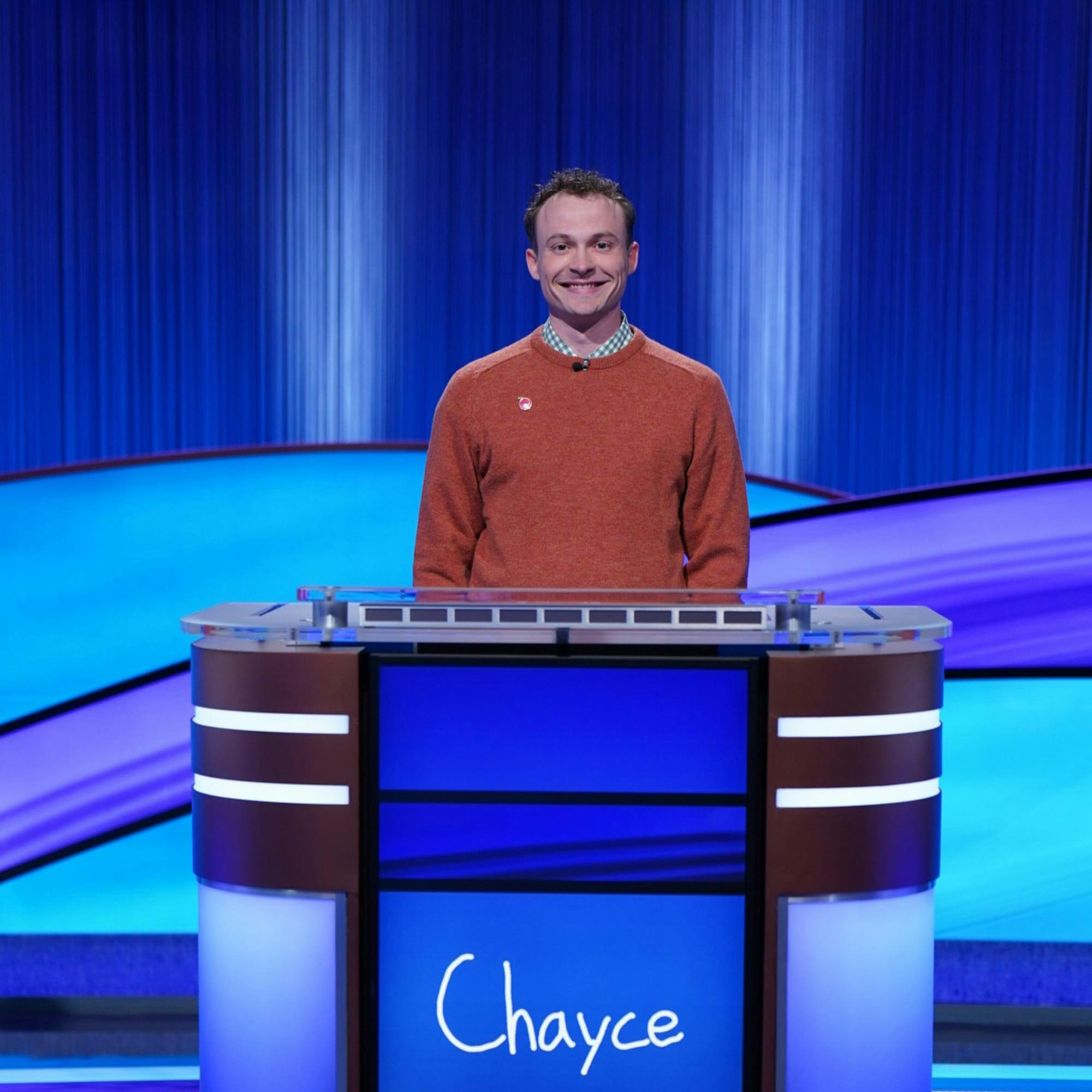
MSU horticulture professor, Chayce Griffith appears on the game show 'Jeopardy!' on May 15, 2026. Photo courtesy of Sony Pictures Television.
MSU is a ripe place for “Jeopardy!” contestants, where an assistant fruit tree physiology professor at Michigan State University appeared on an episode that aired last week.
Chayce Griffith appeared on the trivia game show for the first time on May 15. He fared decently well but ultimately lost to a returning champion, placing second.
Griffith sat between an attorney from South Carolina, Valerie Fulton, and a data scientist from Nebraska, Tristan Williams, competing in categories such as ‘The Elements,’ ‘The Meat-Cute,’ ‘Civil-War Era Numbers,’ 'People' and ‘Court.’
He was neck-and-neck for most of the game with Williams, the previous 7-time-winner, until Griffith significantly overtook him after answering a second-round Daily Double in the ‘People’ category correctly.
“Because I got that daily double, for some reason that made me so much more anxious because then in my mind I was like, ‘oh shoot, I'm up by like $7,000. If I lose this, that's gonna be an epic collapse. I'm gonna feel terrible about myself,” Griffith said. “And so then, because I'm anxious, I start buzzing in too early. And when you buzz in too early, it locks you out for a quarter of a second, which means now other people can get in ahead of you.”
His $6,000 lead was short-lived after Williams won the last Daily Double from the ‘Let’s talk about ‘X’ category, putting him just behind Griffith, $1,500 short. Williams rallied on and led by nearly $6,000 heading into the Final Jeopardy round. Fulton just made the cut for the final round at $600, Griffith stood his ground at $12,800 and Williams held first place at $18,900.
Griffith spent countless hours preparing for entertainment-centered questions, since he knew that was a trivia subject he struggled with.
“When the Final Jeopardy comes up and I see its play characters, I know I've lost already.”
Griffith missed the Final "Jeopardy" clue, which asked about the title character of a 1890 play often called “the female Hamlet,” dropping him to a total of $4,800.
Williams, correctly answering “Hedda Gabler” to the final clue, finished in first place with a $25,601 total for this game and a grand total of $158,501 across the eight games he’s won so far. Fulton finished in third place with $1.
As the episode concluded, “Jeopardy!” host Ken Jennings immediately started talking to Griffith, signaling a buzzer-clicking motion with one hand.
“Ken said something along the lines of, ‘I can tell you're having trouble with the buzzer.’ And then he said, ‘I'm not the one who gets to make these decisions, but I feel like you've got a good chance to come back for Second Chance,’ because I had done well in my game,” Giffith said. “So, I'm holding on to that.”
He said that Jennings also asked him how in the world he knew the answer to the Daily Double clue he was given, “Most indigenous North Africans prefer Amazigh, meaning 'free man,' to this name derived from one the Romans used for foreigners.”
Griffith knew the answer to the clue immediately, giving his wife who sat in the audience a knowing glance before correctly answering, “Who are the Berbers.”
He explained that he knew the answer from a video game he and his wife play with his sister, who currently lives in Guam. They play the history map strategy game nearly every Friday evening to stay in touch.
“When we're playing, there are Berbers, there's Amazigh and they are called Amazigh in the game because that's their preferred term,” Griffith said. “And so yeah, you can see when I got to the word ‘Amazigh’ reading it, I was like, heck yeah.”
He noted that his favorite part of being on the show by far was doing practice runs before actually recording the show with other contestants and getting the chance to bond with them and the production crew.
“It's just so much fun to film an episode of Jeopardy,” Griffith said. “I'd be excited to come back and then just try to be less nervous when I get back. Hopefully, maybe because I've already got one experience under my belt, I can be less anxious and have more fun.”
Originally from Saline, Michigan, Griffith grew up with his mom buying him kids’ world almanacs and trivia books every year.
Support student media!
Please consider donating to The State News and help fund the future of journalism.
“I don't know why, but all that stuff was just really fun for me. And it was always like a parlor trick when I was really little,” Griffith said. “Like I would remember like what the planets were in order when I was really young, and my parents would have me repeat that for people because they thought it was funny.”
Then, he discovered “Jeopardy!” because it came on after his grandma watched “Wheel of Fortune,” and as a kid, he spent a lot of time with her.
“When I was a kid, I'd watch 'Jeopardy' with her and it was cool to see all these questions pop up and be like, man, how could anybody possibly know this stuff? I remember once when I was like 9 or 10, I was watching an episode with her and I knew an answer,” Griffith said. “And it dawned on me in that moment. I was like, oh, so actual normal human beings can know the answers to these questions.”
Griffith started taking the application test to be on “Jeopardy!” in 2020. The first time he took it, he thought he did pretty well, so he continued to take it every year following, hoping he might have a shot.
Griffith earned his bachelor’s degree in chemical engineering from the University of Michigan. After graduating, he got a job at MSU as a technician helping a research assistant, and then moved on to get both his bachelor’s and PhD degrees in horticulture from MSU.
He has gone on to become an assistant professor of fruit tree physiology in the Department of Horticulture at MSU, working to improve things like quality and shelf-life of Michigan cherries, apples and peaches.
Discussion
Share and discuss “MSU horticulture professor competes on 'Jeopardy!'” on social media.