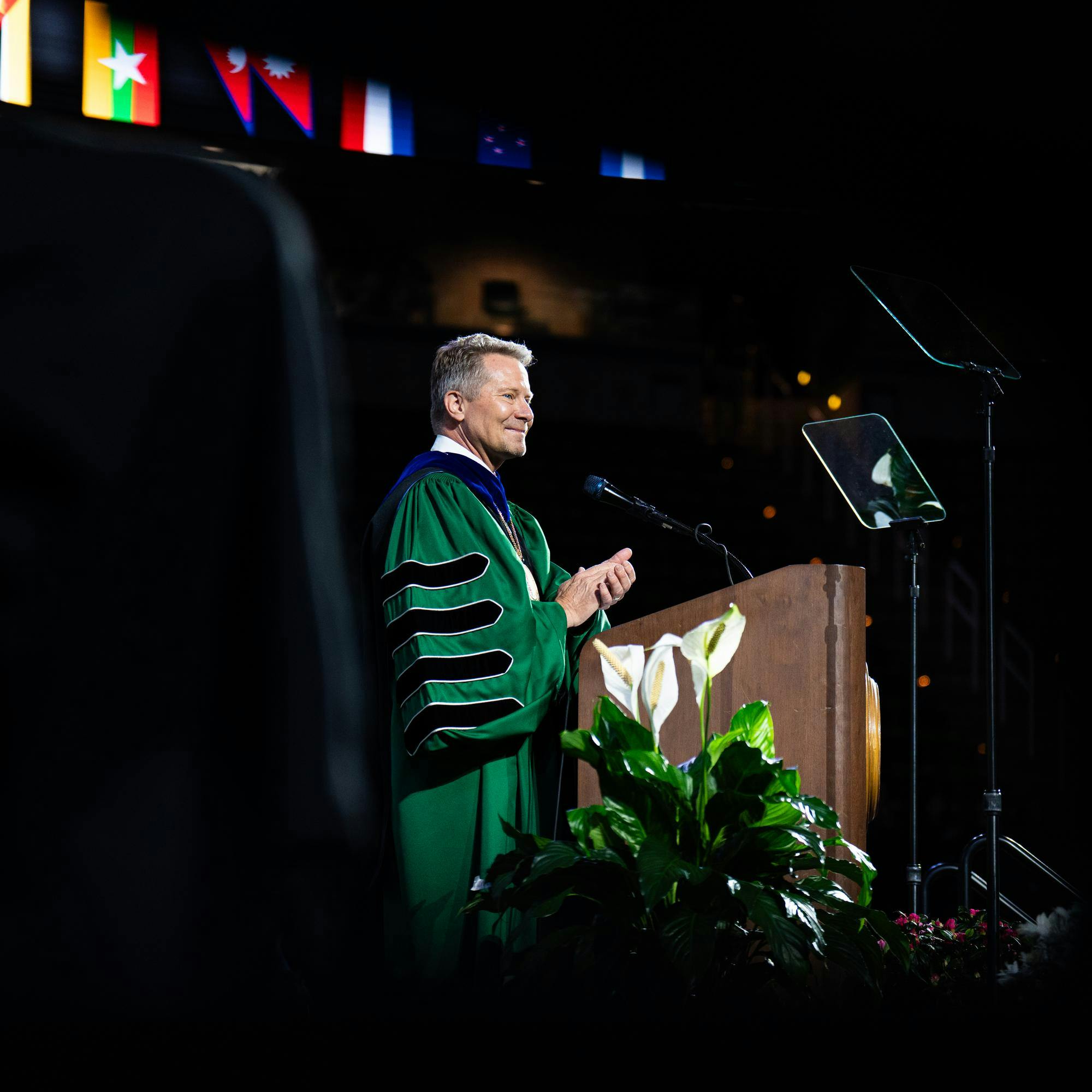
Michigan State's president, Kevin Guskiewicz, gives a round of applause for the class of 2026 after his speech during a convocation inside the Breslin Center in East Lansing, Mich., on May 1, 2026.
Just two years into his tenure as the university's president, Michigan State University's Board of Trustees voted to nearly double President Kevin Guskiewicz's yearly base salary, despite questions over both the necessity of the raise and how the university would fund it.
During the board’s Sunday special meeting held via Zoom, board members said Guskiewicz was being “aggressively pursued” by other universities. The raise was preventative in nature, members of the board said, and essential to ensuring Guskiewicz remained at the university.
Prior to the meeting, Guskiewicz’s previously agreed-upon contract expired in 2029 with a base salary of $1,029,210 and an unvested employer award of $200,000 per year. The new contract extends the university president's term through 2031 and raises his base pay to $2 million, with an unvested employer award of $250,000.
The raise comes at a time when the university has faced numerous budget cuts at the state and federal levels, restricting its operating budget by 9% over the 2025-2026 and 2026-2027 fiscal years, drawing criticism from both students and staff.
The resolution to increase the president's salary by nearly 100% passed 6-1, with trustee Mike Balow dissenting and trustee Rema Vassar abstaining from the vote.
The State News interviewed two experts specializing in higher education and analyzed public data on what neighboring public Big Ten schools pay their leaders.
Funding source still unclear
Trustee Sandy Pierce, the chair of the committee of budget and finance, said the committee is “working diligently” to source the pay from outside of MSU's general fund. The general fund primarily funds the basic educational and administrative functions of the university.
As for finding alternative funding sources for the raise, Balow said that the money would "hopefully" be sourced from donors.
This would be par for the course as other universities typically fund similar raises through donors, said Judith Wilde, a research professor specializing in university presidential compensation at George Mason University.
University Advancement, the fundraising department tasked with courting donors on behalf of the university, has raised over $380 million in the past year. However, the department is not in charge of seeking out funding to support Guskiewicz's raise, MSU Spokesperson Amber McCann wrote in a statement to The State News.
“University Advancement does not have information to share as this effort is being led by the Board of Trustees," McCann said.
It is currently unclear if the Board of Trustees plans to court donors to support the president's new salary. The board may also explore additional alternatives, such as sourcing funds from MSU’s endowment, which is currently valued at $4.5 billion.
Funding raises are also typically supported through the university’s foundation or endowment, Wilde said.
If the university is unable, there is "still a contract" to uphold, said James Finkelstein, a George Mason University professor emeritus who studies college leadership.
“What happens in one year when they can't raise the money?” Finkelstein asked.
‘Not the same’
Pierce said the move to double the president's salary was driven by concerns that Guskiewicz is “being aggressively pursued” by other universities. She described the raise as “an attempt to get in front” of the possibility that Guskiewicz could leave MSU.
Several trustees, including Pierce, said they know Guskiewicz is "frustrated" with the actions of certain board members. Before assuming the role of MSU's president in 2024, Guskiewicz wrote in a 2023 letter that he would only accept the job if the board promised he could lead "without undue interference."
Board chair Brianna Scott pointed to trustees publishing op-eds, appearing on podcasts and sending “email messages where he has been disrespected" as reasons for the president's time at MSU being "at risk."
Support student media!
Please consider donating to The State News and help fund the future of journalism.
The contention amongst the board has gone so far as to impact Guskiewicz’s health, she said.
Scott also referenced MSU's high presidential turnover rate. The now board chair assumed the role of MSU trustee alongside fellow trustee Kelly Tebay Zemke on January 1, 2019. If Guskiewicz were to leave the university, Scott and Tebay Zemke would have witnessed five presidents assume the helm in seven years, including interim presidents and Guskiewicz himself.
“We should be ashamed to hear that we have caused that to any individual, let alone someone who came to this university at a very horrible time in our history," Scott said.
Others on the board pushed back against concerns that Guskiewicz may leave, including Vassar, who said that MSU has “not seen an active offer” from another institution.
In a press release sent out after the Sunday meeting, it says the amended contract is “consistent with leadership positions across higher education.”
Wilde, however, isn't so sure.
“We've never seen an increase this large,” Wilde said of the president's raise.
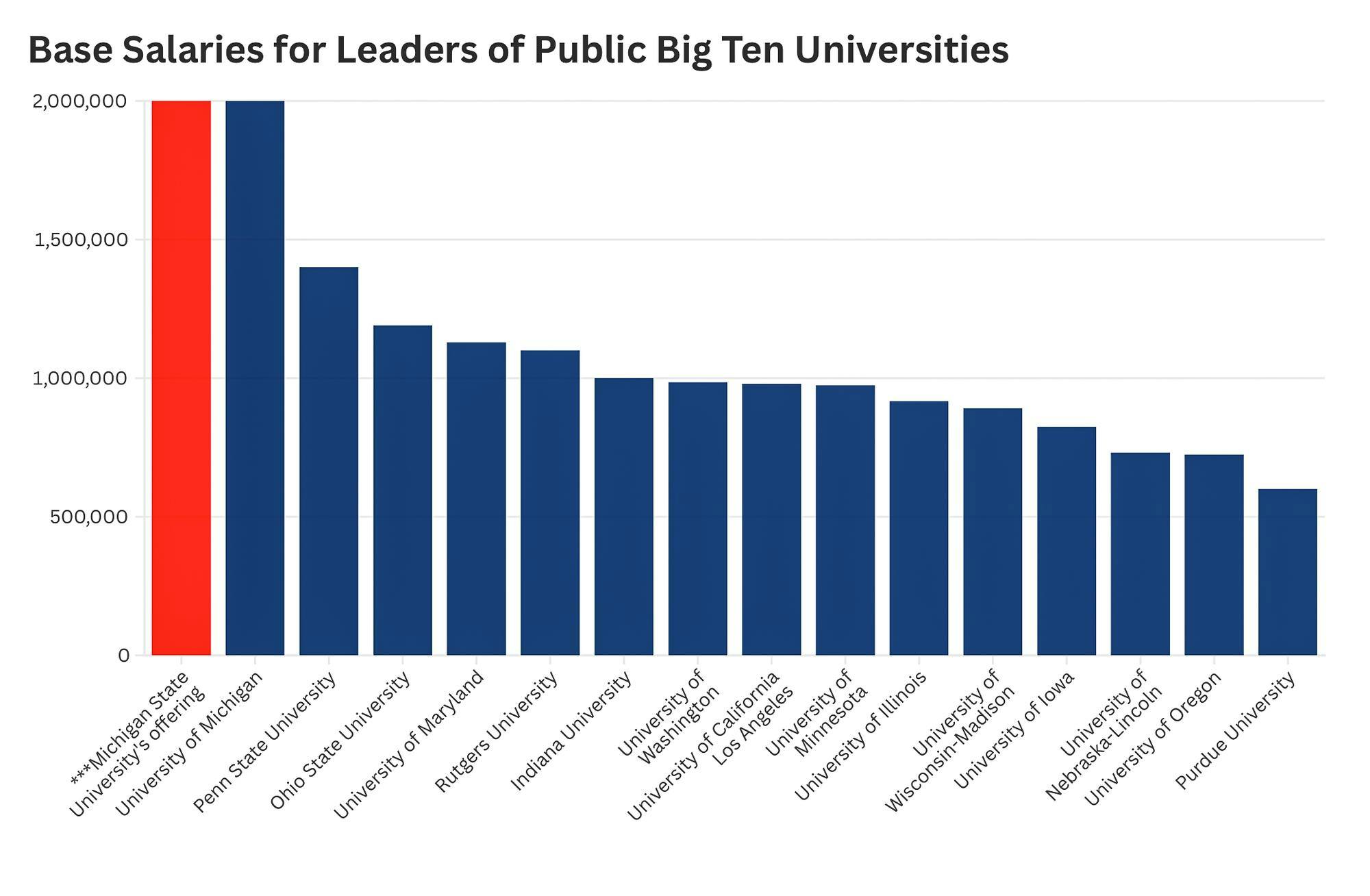
The $2 million base salary being offered to Guskiewicz is one of the largest across Big 10 public universities. The amount is comparable to what University of Michigan president Kent Syverud was set to earn before he decided not to take the job following a cancer diagnosis.
“The problem is Michigan State University and the University of Michigan are not comparable institutions," Finkelstein said. “I don't mean to insult the faculty or leadership, but they're not the same — by any stretch of the imagination.”
Behind, now MSU, and the University of Michigan sits Penn State University’s president, who earns $1.4 million yearly.
Guskiewicz has yet to complete his first contract before being awarded this raise by the board. He was appointed in December 2023 and assumed the role in March 2024, with his original contract set to expire in 2029.
“I think this is more about the board wanting to say they are as important as any of these other institutions and, therefore, they should pay their president what others are paying their presidents,” Finkelstein said.
The administration must still finalize the formal amended employment agreement contract.
Criticism Amid Budget Cuts
MSU announced in June 2025 that it would reduce its operating budget by 9% over the 2025-2026 and 2026-2027 fiscal years. On its "financial planning" webpage, the university says that the cuts will be executed meticulously, so as to “protect the Spartan student experience, including delivery of courses and instruction."
In October of the same year, the board approved a 1.5% raise for Guskiewicz. Faculty received 3% annual increases and university support staff received 1.9% pay raises. Executive managers received pay increases between 1% and 1.5%.
“While our raises have been far below basic cost-of-living adjustments during the past 10 years, they voted to give him a 100% raise,” Union of Tenure System Faculty President NiCole Buchanan said. “This feels irresponsible. This flies in the face of responsible governance.”
Buchanan said that every faculty member she has spoken to since the approval of Guskiewicz's raise has been “stunned” and “dismayed” by the board’s decision.
“This entire decision by the board really speaks to the values that are being held by the institution,” Buchanan said.
Wilde pointed to a study she conducted where she analyzed 50 public flagship university presidents in the country from 2009 to 2019. Total compensation for these presidents increased by 56%, from $22.5M to $35.1M. She compared that to professors' compensation within the same time frame.
“On average, full professors’ salaries (inflation-adjusted) at flagship universities have barely outpaced inflation, rising by an average of $646 per professor,” the study's findings read.
Speaker of the Michigan House of Representatives Matt Hall said he was “shocked” by Guskiewicz's raise in a press conference Wednesday night. “Just hope that this president performs,” Hall said.
Yet, Finkelstein said, across academic literature, looking at the relationship between the CEO of a corporate company and the returns to its shareholders, there is an “inverse relationship.”
“It's not a positive relationship, meaning that the more you pay your CEO, the more likely that your returns to shareholders will be lower,” Finkelstein said.
Discussion
Share and discuss “Doubling of MSU president’s salary sparks questions about university priorities” on social media.