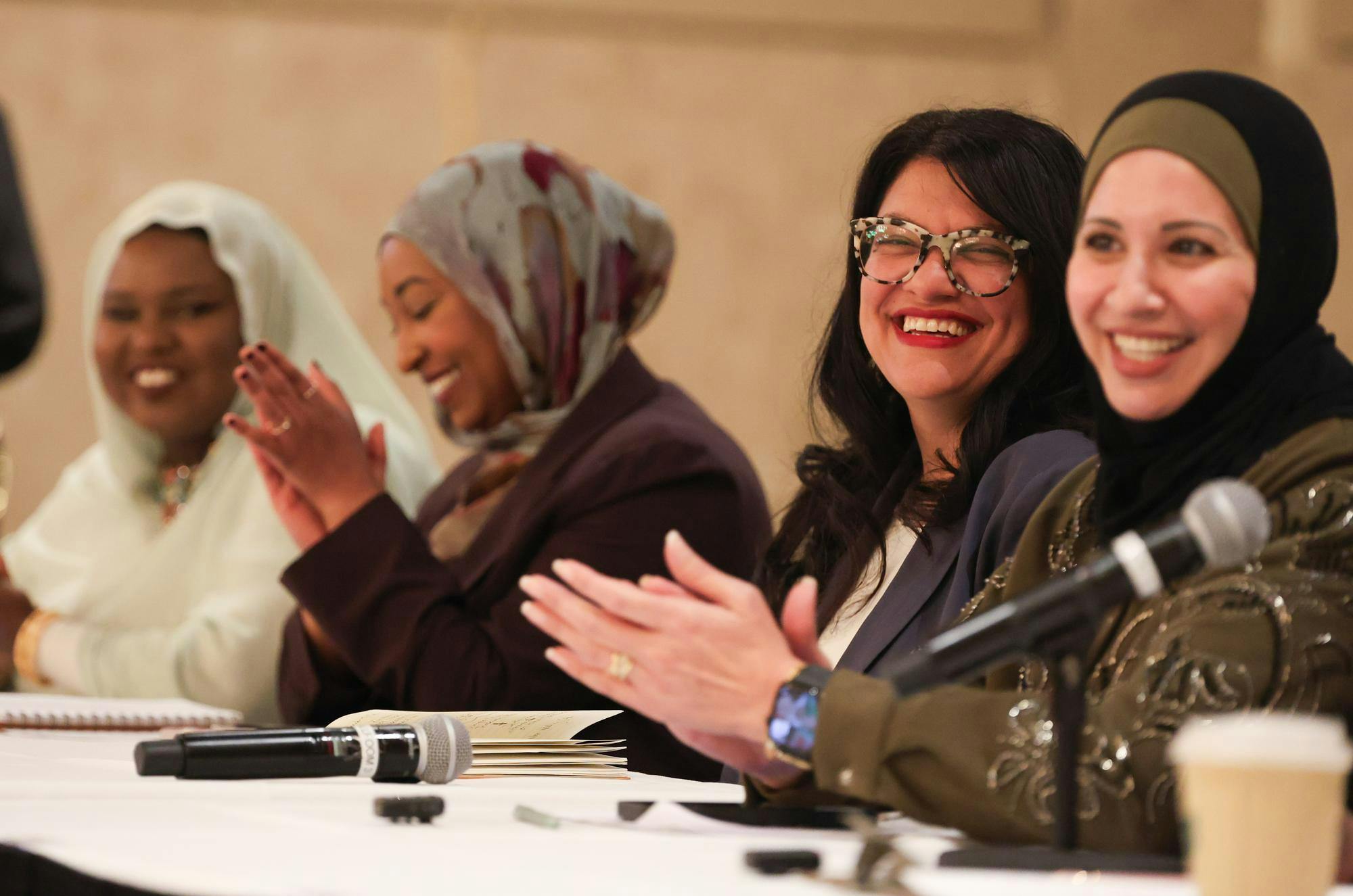
Rep. Rashida Tlaib, D-Mich., joined a consortium of panelists at Michigan State University Sunday afternoon to raise awareness of the Sudanese civil war, saying she would request the restoration of a U.S. envoy to the country.
The “Women at the Forefront” panel featured key figures in Arab American organizing across the country, including Khadega Mohammed, the first Sudanese American community engagement officer for the Arab American National Museum, and Suehaila Amen, the national organizing director for the Arab American Anti-Discrimination Committee.
The panel was part of a series of events held in the MSU Union over the weekend as part of the Sudanese Synergy Summit, a two-day conference meant to bring together the Sudanese diaspora. The summit was organized by the Najwa Foundation in conjunction with myriad MSU student organizations, including Sudanese Spartans and Students for Justice in Palestine. U.S. Senate candidate Abdul El-Sayed was an opening speaker for the panel.
Advocates for ending the civil war and subsequent genocide in Sudan have been closely associated with the pro-Palestinian movement in the U.S., who vouch for the end of weapon exchanges between the U.S., the United Arab Emirates and Israel.
Panelist Ashley Boulos, a journalist with independent media platform TMJ News Network and social media personality, referred to the countries as “shared oppressors.”
“Part of our solidarity is recognizing that these connections do exist and calling them out where they do exist,” Boulos said.
Meanwhile, anti-blackness in Arab American organizing has remained a deterrent for advocates like Mohammed, who recalled being referred to as an “abeed,” the Arab term for slave, at a protest and witnessing a group of kids using the n-word.
“It speaks to a reality that exists, but we have to keep showing up,” Mohammed said. “I just had to be honest about that. It’s difficult when you are in this black body.”
It is “incumbent” on Arab American organizers to recognize that “rooting out” anti-blackness in Arab culture and American culture is part of the same work, El-Sayed said in his opening speech.
“And who better to lead that work than the Sudanese community?” El-Sayed asked. “You all lead that work every single day.”
Advocacy surrounding the Sudanese conflict begins with increasing influence in both political and academic circles, Boulos said. It is instrumental to flaunt Sudanese heritage and culture to inspire younger generations, she said.
Panelist and Harvard law fellow Zeinab Bakhiet agreed with Boulos, referencing an activist group heading to Washington, D.C., in two weeks to support initiatives in Sudan that centered civilians and “accountability for atrocity.”
Nearly 12 million people are at risk of conflict-based sexual violence in Sudan, according to Bakhiet — a “horrifying” statistic. As a result, Bakhiet said, the ongoing war has led to the mass internal and external displacement of Sudanese citizens battling limited access to healthcare, education and food. Women face the brunt of this insecurity, Boulos added.
That's why it's important for Sudanese women to use their voices, as women tend to be the most “effective” within liberation movements, Tlaib said.
“There is this shared humanity out there when people see a mother holding their child or a woman talking about her story of sexual violence,” Tlaib said. ”The pain, the suffering makes people act in a way that's better than saying we need to pass this bill or we need to do this in Congress.”
The congresswoman also emphasized the importance of attending town halls and coffee chats with representatives beyond D.C. and Capitol Hill, saying that those in-person discussions tend to have more sway.
Bakhiet also requested that Tlaib restore the role of a U.S. envoy to Sudan.
“Let me call Trump right now,” Tlaib joked.
Later, Tlaib held up notes taken during the panel discussion at the behest of an audience member, in which she wrote that she would consult with Rep. Sara Jacobs, D-Calif., as well as Rep. Gregory Meeks, D-N.Y., who sits on the House Foreign Affairs Committee, to begin discussions over restoring a U.S. envoy to Sudan.
“You’re literally telling me to go do more and I’m gonna do more,” Tlaib said.
Support student media!
Please consider donating to The State News and help fund the future of journalism.
Discussion
Share and discuss “Rep. Rashida Tlaib calls for U.S. envoy to Sudan at MSU Union panel” on social media.