More than 13 months have passed since President Donald Trump signed a slew of executive orders restricting Diversity, Equity and Inclusion efforts at universities like Michigan State University.
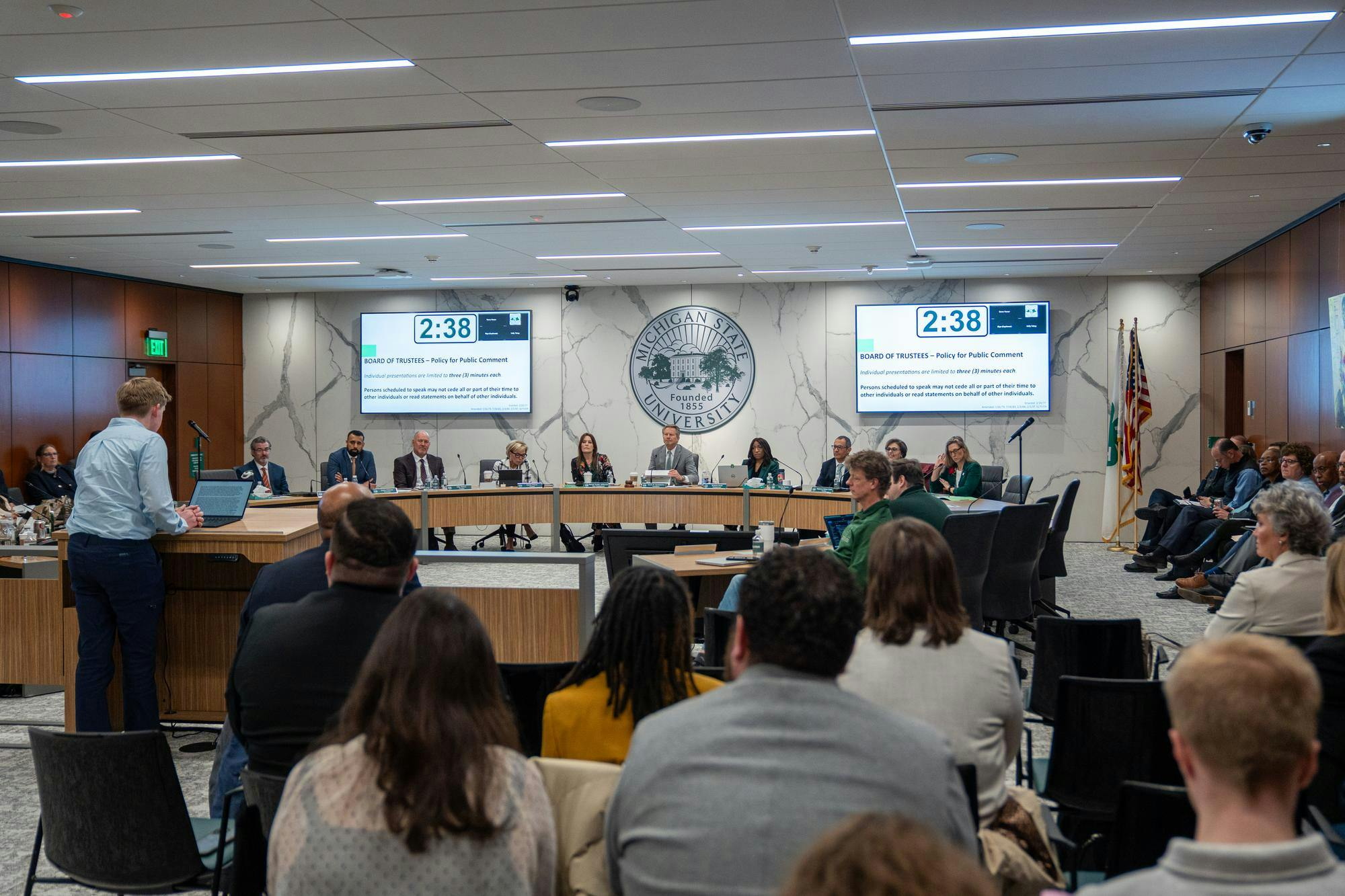
At Friday’s meeting of the university Board of Trustees, the discord that those orders and MSU’s subsequent handling of them has sown across the university community was evident.
MSU has removed language referencing DEI from many of its public facing documents, urged identity-oriented student groups to change the language of their constitutions and removed the word “diversity” from the title of its chief inclusion officer.
MSU has consistently responded to concerns from administrators and students to these changes by affirming that the work associated with these initiatives would remain. Doubts among the MSU community, however, continue to be expressed.
On the other hand, more conservative members of campus say they feel like the university isn’t doing enough to dismantle DEI efforts which they consider toxic to the student body. The result has been an intense back-and-forth over who has been and should be properly represented on campus, which played out in part on Friday.
‘We deserve so much better’
Tensions over DEI were first raised by Associated Students of MSU President Kathryn Harding, who said during her remarks that the student governing body was “strong-armed” into proposing a constitutional amendment ballot measure to change how “racial, ethnic and marginalized” student organizations describe themselves.
Harding said the Student Affairs Office and the Office of the General Counsel forced them to introduce that proposal, which passed and was subsequently approved by the student body during the spring elections. Those student groups, belonging to the Council of Racial and Ethnic Students & Council of Advocacy and Marginalized Students, are now described as “community based advocacy groups.”
“I want to be clear that this change has no effect on the voting powers of CORES & CAMS and will not have any functional effects,” Harding said. “However, I want the board and the community to know that my leadership and I were strong-armed with threats to the status of ASMSU’s tax-collecting status into presenting this language change to our general assembly, who reluctantly passed it through to a student body wide vote.”
Harding expressed relief that a conversation with the board regarding the future of ASMSU had the amendment failed never came to pass, but stressed that the administrator’s behavior sets an “extremely concerning precedent for the autonomy of student governance.”
“We deserve so much better than what we got from administration this year,” Harding said. “Our racial, ethnic, marginalized students, who we claim to be so proud to have on this campus, deserve so much better.”
MSU President Kevin Guskiewicz, in a press conference following the board meeting, said he wouldn’t “contradict what Kathryn Harding said” and emphasized that MSU has had several conversations surrounding these concerns over the last eight months.
Last year, Guskiewicz said the university underwent a review regarding compliance with executive orders that was “necessary.”
“And with that came some changes for RSOs (Registered Student Organizations) and ASMSU as to how funding would be requested. Some of the communication around that was not clear,” he said. “We've apologized for that (and) created clarity around it in terms of how we would move forward. I feel like we are in a much better place today than we were back in September.”
Board sympathy
Trustee Sandy Pierce acknowledged Harding’s grievances with the handling of the directive and said she appreciated Harding’s honesty. She also noted that the changes are, to some effect, largely superficial.
“I'm so sorry that you're required to change names, but I'm so proud that you haven't changed the work,” Pierce said. “Thank you for that.”
Trustee Rema Vassar, in her remarks, also addressed her past objections to MSU’s adjustments on DEI and echoed Harding’s concerns and said that “you all deserve better.”
Vassar has recently published four Op-eds addressing the state of DEI at MSU and higher education as a whole. In those pieces she called upon the university to walk back on many of the adjustments made in the past year and criticized the university for not supporting its marginalized students.
MSU’s response to those pieces was one of disappointment, pushing back on many of Vassar’s arguments and claiming that she mischaracterized how the university continues to support its marginalized communities.
Support student media!
Please consider donating to The State News and help fund the future of journalism.
“I wrote these pieces because I believe transparency and public accountability are essential to our fiduciary responsibilities and duties as trustees, I want to be clear about my continued commitment,” Vassar said.
She affirmed her support for marginalized students, staff and faculty, emphasizing that she will continue to advocate for them, bringing attention to the difficulties faced by them this year like the funding disruptions to CORES & CAMS groups.
MSU in the ‘crosshairs’
Not everyone, however, reciprocated how Harding and Vassar feel about the state of DEI on campus. Chairman for the MSU chapter of Young Americans for Freedom and College Republicans treasurer Aidan Haas saw things differently.
MSU YAF, with the aid of its national chapter and the blessing of a controversial Republican lawmaker, launched a probe into several College of Education classes earlier this semester seeking to uncover evidence of an ideological mandate. Haas, who has spearheaded this effort, said he hopes to use the investigation’s findings to clean up the college of “the blatant ideological brainwashing and discrimination taking place.”
“Not only are such practices harmful to our students, but they are now drawing increased attention, from MSU budget to MSU budget, which is now in the crosshairs of high-ranking state lawmakers,” Haas said, referencing the group’s plans to pass of their findings to the state House during budget negotiations.
Haas then directly addressed Vassar, taking issue with how she views DEI on campus.
“If it was up to you, Trustee Vassar, you would make sure student groups benefited solely based on their minority status,” Haas said.
Vassar, in her Op-eds, has pushed for greater representation for marginalized groups on campus through the reinstatement of DEI measures. Haas challenged her advocacy by asserting no group should be favored over another by the administration. He said that prioritizing the representation of student groups based on race is problematic.
“I would like to remind you, on behalf of the 7.3 million voters in Michigan, that they are who you are here to represent,” Haas said. “You do not sit on this board to push your personal woke agenda. And I can say with fair confidence that the people of this great state did not elect you to discriminate against a majority of students and advocate for only special groups to get extra funding.”
Efforts made by conservative leaders to connect with university leaders and discuss issues they have with the university have gone ignored, he said.
“We'd appreciate the time to be heard and the chance to contribute to our community,” Haas said.
Discussion
Share and discuss “MSU's handling of DEI looms over board meeting” on social media.