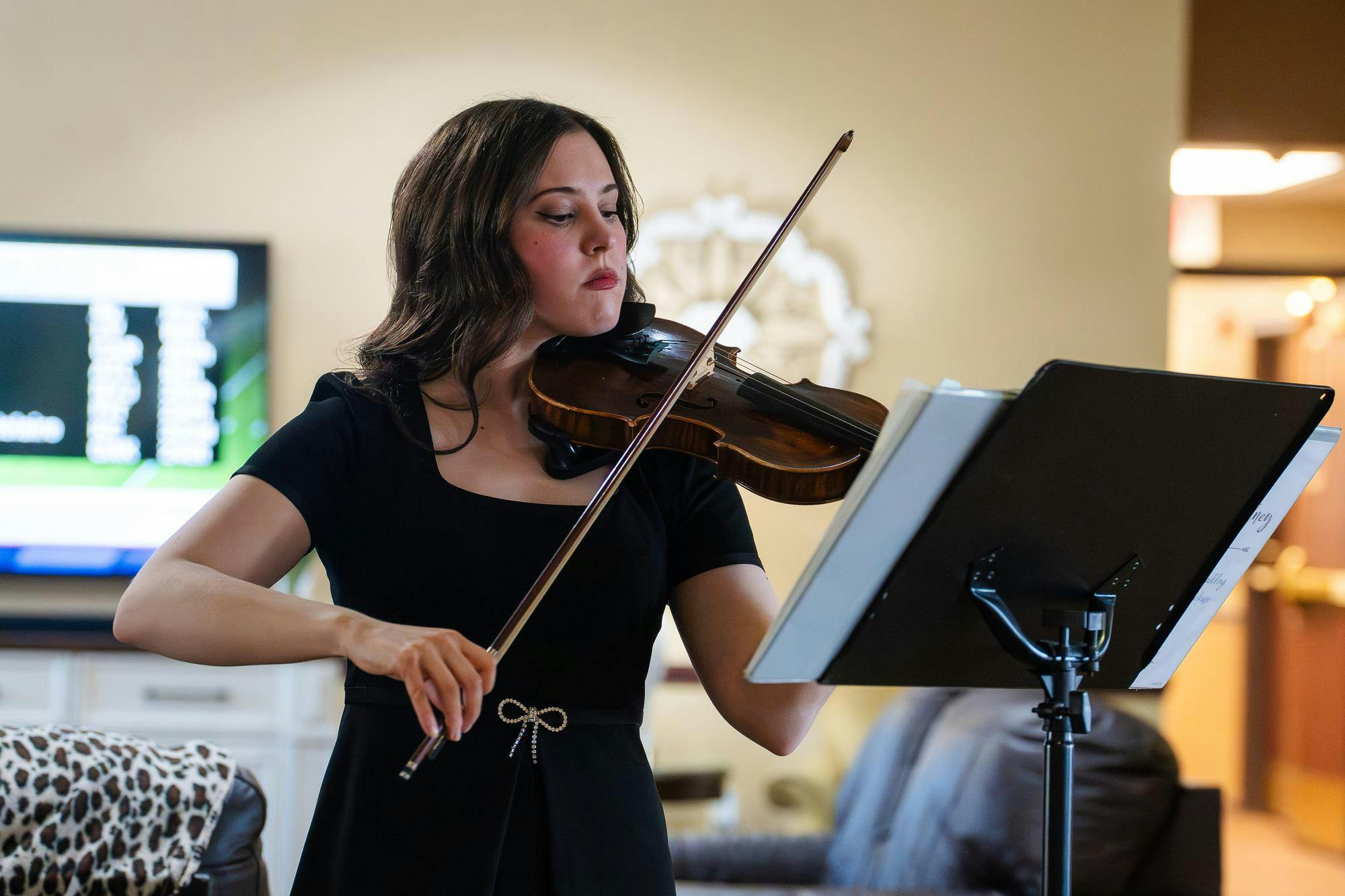
About five miles southeast of campus, a graduate medical student at Michigan State University performs for an unexpected audience in a quaint dining room. Over mahogany tables set with printed menus, chalices of water and small arrangements of orange and red flowers, wrinkled hands lift silverware, assistants glide in and out of the room and a familiar melody besets upon the crowd.
Beyond the pastel paper chains lining the dining area stands a young woman in a black concert dress, tights and Mary Jane heels, happily strumming her violin to the tune of Elvis Presley’s "Can’t Help Falling in Love," as inspired voices quietly sing along with her. Lines of amber light from two large windows carry through the room, woven through the vibrant pull of the weeping notes, each leaning into the next, crescendoing in and out, creating a breadth of warmth throughout the space.
Violinist and rising third-year medical student Sydney Penrose captivated the small audience at Bickford Assisted Living for an hourlong dinner set April 8. This was both the last performance of the spring 2026 semester for the Music for Dementia (MFD) organization at MSU and Penrose’s final performance there after starting the East Lansing chapter of the organization following her arrival at MSU in 2024.
As Penrose opened her set with the popular 1961 song, the energy in the room instantly perked up. Residents looked up from their dishes, and some stared in awe for several minutes before taking another bite. In between songs, sly private comments like, "I guess Michigan State has a pretty good program, huh?" lifted the corners of Penrose’s cheeks ever so slightly.
Many began to close their eyes about halfway through the set, some seemingly being lulled to sleep, and others simply taking meditative moments to themselves. One table was particularly happy to have her, singing along with every song they knew and absolutely beaming, even after most others had closed their eyes.
"They're happier," Life Enrichment Director Amelia Diaz said. "If there's behaviors before — maybe somebody's being combative, or they don't want to eat or take their medicine — usually after the music, they're more calm and they're more amped to do what we ask."
A medical technician at the facility, Telal Abass, noted that he appreciated Penrose’s approach to playing a wide variety of music, as staff members enjoy hearing contemporary songs mixed in with the oldies.
The impact on residents is simply unmatched, though. Abass said that after many of the musical performances held at the Bickford, patients not only tend to be in a better mood, but they may even start to "come back" through the music.
"They remember the music, but sometimes when they’re listening to the music, they remember other stories," Abass said. "[Stories] of when they were kids or when they were youth; they start to tell other stories at the same time."
This journey started for Penrose in early childhood. She began playing the violin at age four, influenced by her grandmother’s passion for the instrument and her desire to see it continue through her grandkids. Penrose started by volunteering at nursing homes growing up, and her childhood violin teacher held all their recitals and concerts there and at assisted-living facilities.
"Before medical school, I think the first way I realized that I could provide healing and happiness was through music, realistically. When I would perform, I'd play a song that the residents really liked, and I look out into the crowd and I see people smiling — I see people engaging. You can just tell that you made a palpable, tangible difference in their day," Penrose said. "I just discovered that I was capable of doing that, and I wanted to find a way to do it in a more full, comprehensive type of way. So, I think that's where I started to get more into pursuing medicine."
She chose to continue volunteering quite a bit through high school and while pursuing her undergraduate degree in biology at Oakland University, but once she started medical school at MSU, she sought a way to continue her passion with hopes of bridging the two worlds of music and medicine.
In her medical school applications, she wrote about exploring a more comprehensive, patient-centered approach to care that honors patient individuality and seeks to meet them where they are. By offering more personalized treatments based on the patient’s life, their likes, dislikes and other personal factors, she hopes to achieve more comprehensive care.
"I think music is that universal type of connector where everybody can relate, and everybody appreciates and enjoys it. Really, everybody can say, in a way, where music has impacted their life," Penrose said. “Bridging music and medicine, for me, offers a way to provide very meaningful care and really enrich my medical school experience."
In her search for an organization to collaborate with, she found Music for Dementia, a volunteer organization based in Michigan that originally started in Ann Arbor. The organization has chapters across Michigan, but at the time she was looking, there was not an East Lansing chapter.
In 2024, Penrose applied and had the privilege of starting and leading the East Lansing chapter of MFD as the chapter president. In September 2024, she organized the first concert at Bickford and was met with exceptional and dedicated service from the surrounding MSU and East Lansing communities. There were as many as 10 performers coming to perform for the 35 or so residents at the Okemos facility from then on.
Although the East Lansing chapter performs almost exclusively at Bickford, Penrose continues to branch out and play at other nursing homes in her free time.
"There are benefits to staying in a singular location because you have a chance to really get to know the residents and the workers there as well. I've made a lot of friends at the Bickford location, and we've had some great talks," Penrose said. "There's a lot of incredible people when you take a chance to sit down and listen to their stories. Getting to know them makes it all the more meaningful when you perform."
Support student media!
Please consider donating to The State News and help fund the future of journalism.
Some residents come up to Penrose afterwards to thank her, and some stay for longer chats, enjoying the opportunity to talk to someone outside of the facility and exchange stories. One resident chatted with her about a church choir group he participated in with a few other residents, and requested that she play one of their songs. Since then, she regularly plays them and has made sure to incorporate Carl Boberg’s "How Great Thou Art" into her last personalized performance for them.
That same resident made sure to thank Penrose before she left after her last performance, telling her more stories of how his daughter filled a shelf in the facility with prayer hymn books and how he would sing Christmas songs with his now passed wife. In their last interaction, they connected over the fact that both he and her parents went to Adrian College.
The Bickford director hears about all of these interactions from residents in the days following performances. She emphasized the importance of young people interacting with older generations and that she wishes more individuals were willing to be around them.
"It doesn't matter if they're performing or playing bingo, if they're outside or if they're just talking," Diaz said. "A lot of them don't get to see their families as much as we would like them to, so having that attachment outside of their family has been really important and very valuable."
For Penrose, in-person performances are important not only because of the connections made with patients, but also because of the novelty and excitement live music can bring. Facilities like Bickford tend to have lower stimulation, so many residents benefit from a bit of a break in their routine and something that invites them to actively engage.
Penrose hopes people would understand that this type of music therapy is more accessible — how and where it should be implemented — and wishes more patients had the opportunity to request it. She also wants fellow Spartans to know they’ll be welcomed warmly at facilities like these, even if they’re off campus or outside of East Lansing altogether, as many residents recognize and connect with the MSU name. Most of all, she hopes that the East Lansing chapter of MFD can continue to thrive even after she relocates to MSU’s Flint campus to finish her medical school degree.
"If you offer people within a club an opportunity to do more outside the borders of East Lansing, I know that they will want to do it because Spartans are doers," Penrose said. "I hope that we can continue to keep this going for years to come. We are in a position to continue to make a very positive impact on the community in a prolonged sort of fashion if we maintain this momentum. From what I was able to experience over the past two years of leadership, really feel like it's meaningful work. It matters, and it's making a big difference for community members."
Discussion
Share and discuss “MSU students uplift local dementia patients through music” on social media.