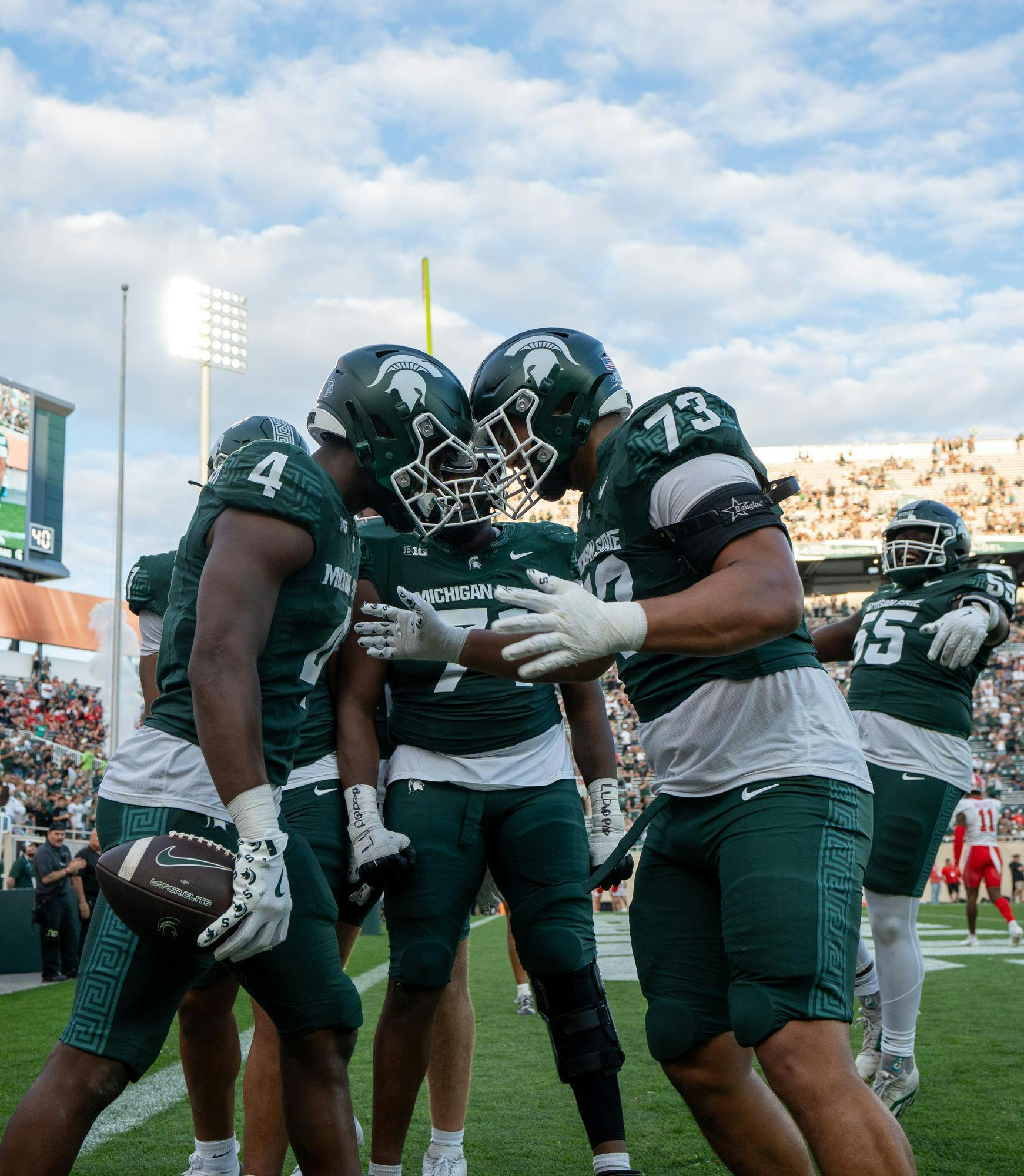
With over a century of history, one of the pillars Michigan State football has been built around is a physical, punishing run game — an identity that has been absent since 2021, the last time the program averaged over 4 yards per carry.
From Lorenzo White and Javon Ringer to Le'Veon Bell and Kenneth Walker III, MSU has consistently produced elite running backs — players whose success became etched into the identity of Spartan football.
All four earned first-team All-American honors and went on to be drafted into the NFL, a lineage redshirt senior running back Cam Edwards hopes to join.
“I want to be in the NFL, I want to be a great running back, I want to be the best running back in the Big Ten,” Edwards said at Thursday’s media availability.
A player transferring from Connecticut to a Big Ten school with aspirations of becoming the best in the conference speaks volumes about his confidence. But it’s a goal that may not be far-fetched given last season’s production.
In 2025, Edwards accumulated 1,240 rushing yards — ranking top-15 nationally — while averaging 5.9 yards per carry and scoring 15 touchdowns. It was a breakout season that made him one of the most attractive targets of MSU’s rebuild.
“He’s an explosive back who plays very physical football,” running back coach Devon Spalding said. “He’s hard to tackle, makes really good decisions and plays extremely hard.”
His ability to pick up yards on the ground through contact gets coaches’ attention, but his determination to make winning plays sets him apart.
“When he doesn’t have the ball in his hands, he’s always trying to go find extra blocks and trying to help the offense advance the ball down the field. He takes a lot of pride in playing the position,” Spalding said. “He wants to be great.”
From UConn to MSU, Edwards’ role won’t change drastically as the workhorse of the run game, expected to receive most of the carries. However, in East Lansing, he’ll have much more talent backing him up in certain game situations or when he simply needs a breather.
That support comes from a crowded running back room filled with players of all backgrounds, from seniors who transferred in this offseason to underclassmen recruited by former head coach Jonathan Smith and everything in between. The group includes multiple players with Power-4 experience, including redshirt senior Jaziun Patterson from Iowa and junior Brandon Tullis, who returns for his third season at MSU.
That depth has elevated competition within the room and raised the standard in practice.
“Everybody’s in here to compete, they’re all here to get a job,” Edwards said. “The room is really good competition wise, everybody is getting everybody to work harder.”
From a schematic standpoint, the versatility gives MSU flexibility in how it utilizes its backs.
“Whatever we want to do from a game plan purpose, we have a guy we can put out there to be able to get that done,” Spalding said. “We can create mismatches … we got guys we can get the ball on the perimeter with. We got guys that can cram it and go get three, four yards.”
Whether multiple running backs rotate on game days or simply push one another in practice, the MSU running backs — led by Edwards — are motivated to help reestablish a physical identity on the ground and ultimately win games.
“We do this thing in the offensive meeting, five H’s [Hometown, Heroes, Hardships, Highlights, Hopes],” Edwards said. “My hope was to win a Big Ten Championship and to win a National Championship. I’m here to win.”
Support student media!
Please consider donating to The State News and help fund the future of journalism.
Discussion
Share and discuss “MSU running back room sparks hope for run game revival in 2026” on social media.