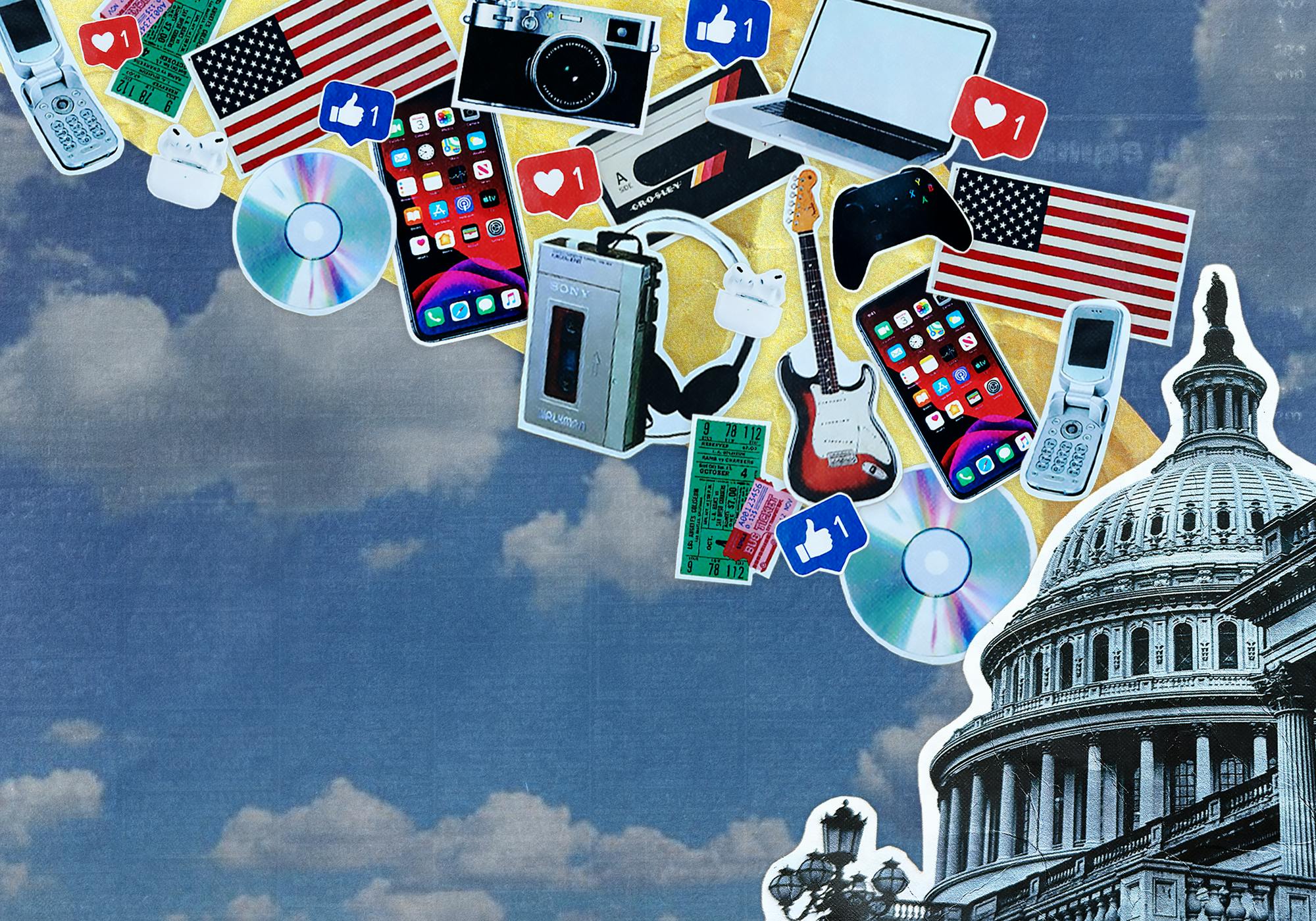
Why is Gen Z so obsessed with the outdated? A new web app allows users to browse YouTube as if they are channel surfing on a retro cable TV guide. Decades-old rock songs like “Freak on a Leash” by Korn and “Cherry Waves” by Deftones are going viral on TikTok. Demand for physical music, like vinyls and CDs, continues to surge.
These things aren’t just a result of Gen Z wanting to be different or nostalgic for a time that predates most of them. They have a greater common thread: they are all reactions to the most extreme aspects of our current society. Gen Z’s frustrations with a dysfunctional political system and a hyper-digitalized world have fostered a new counterculture.
Counterculture movements are social currents that lead people to reject societal norms and provide an alternative way of life. The most notable of these are from the 1960s and the 90s. Feeling affronted by the existing social structure and invigorated with activism, the youth that drove these movements sought to build their own alternative lifestyles, and revolutionary music, art, habits and practices came with that.
Gen Z is doing the same thing. Their frustrations with politics and society are evident in their cultural interests. Uniquely, this movement involves intentional technological regression in an attempt to be more present.
The political grievances of Gen Z extend beyond individual figures and events, reflecting a broad distrust in American institutions. A Harvard survey reveals that political officials, mainstream media and the government in general are seen as unreliable by many, and even detrimental to their well-being by some.
While feelings of political frustration have led some of Gen Z to activism, it has also led many to withdrawal. The extreme polarization and dysfunction of U.S. politics haven’t necessarily made young people excessively partisan; in fact, it has driven them away. Many feel a sense of hopelessness, frustrated with the current state of things, but see no way to enact change. Gen Z’s lack of direct political engagement is, in large part, a reflection of this.
This disillusionment has manifested culturally in a trend that is stronger than protest music among Gen Z: the resurgence of rock music, which is historically integral to counterculture movements. From the Rolling Stones to Nirvana, this genre has proved to be an effective outlet for feelings of angst, rebellion and dissatisfaction, and it grew the most of all genres in 2025.
Grunge and alternative rock bands like Deftones have gained popularity on TikTok, as well as newer bands like Untitled and Superheaven, leading a supposed grunge revival. This kind of music is always somewhat popular, though a minority preference, but it’s seeing a resurgence right now; more and more listeners are diverting from the mainstream.
These songs don’t purvey vitriol along explicit party lines; they instead express frustration with society. The bands leading the rock revival, like Deftones, center their music on atmosphere and escapism, using heavy distortion and ethereal guitar effects for ambiance. Raw, intense vocals range from aggressive and damning to breathy and vulnerable, fitting for the duality of grievances with the present and cynicism for the future. In other words, this music accurately portrays the feeling of “screaming into the void,” reflecting the exasperated, “I don’t do politics” mindset of a lot of Gen Z.
This modern counterculture is significantly less unified than past countercultures, which is confusing considering that digital communication makes it easier than ever to connect with others. But this is actually another big part of what is driving this movement: the feeling of isolation in the digital age, despite being more connected than ever.
Previous generations didn’t have to grapple with growing up immersed in the digital age; most don't remember a time before smartphones and laptops. It’s easier to connect, but algorithms that drive engagement by any means promote disagreement and echo chambers, further polarizing the already tense climate. Modern communication should theoretically bring people together, but it often can be an isolating, divisive force.
To cope with these constant, oppressive tech advances, Gen Z has sought a return to tangible media. Vinyl sales have been soaring in recent years, and recently, interest in CDs has been reinvigorated as well. Being immersed in the digital world has made young people more and more cognizant of “the ephemeral nature of digital media,” and the fatigue that comes from spending so much time online leaves many with the desire to unplug.
It’s not that they aren’t streaming music at all anymore, though. Physical music fulfills a different purpose, offering a slower, more intentional listening experience. The fact that Gen Z is spending extra money on music they could otherwise get in their streaming subscriptions signifies that they are coming to really value the practice of disconnecting and purposeful consumption, which is a rebellion against the suffocatingly online, ultra-convenient digital world.
Gen Z is embracing the analog lifestyle in countless other ways as a means to living more deliberately. As I mentioned earlier, Channel Surfer is a new web app that adapts YouTube into a retro cable TV interface. While finite, pre-selected options when browsing video content are a thing of the past, some users crave the simplicity of surfing limited choices of live media.
Monthly “snail mail” clubs, where participants subscribe to receive hand-picked physical stationery, have become popular. These afford the user with slow, grounding creative expression. Other things like craft groups and shared “take one, leave one” trinket boxes have been emerging, fostering opportunities to unplug while restoring local connections that have deteriorated with the digital age. This return to casual artistry is reminiscent of the DIY ethics in 90s counterculture.
Feeling suffocated by a dysfunctional political system and a hyper-digitalized world, Gen Z has begun seeking an alternative lifestyle, and a modern counterculture has been born as a result.
All of these trends of retrogressing in the name of unplugging have yet to actually dominate our culture, though they are present. Not everyone will delete social media, rock will probably never be the biggest genre again and it’s not like Spotify will be going out of business soon.
These tendencies are also far from unheard of; many young people have gotten off social media and held fringe preferences for rock music long before now. But the minority that favored these things is getting larger, and these trends are reaching the mainstream. More and more are feeling frustrated with the current state of society and seeking ways to unplug and be present. It’s a greater current that reflects Gen Z’s increasing disillusionment with the most unprecedented aspects of our time.
Isabella Cucchetti is a sophomore studying Political Theory and Constitutional Democracy and is a columnist at The State News. The views in this article are her own and independent of The State News.
Support student media!
Please consider donating to The State News and help fund the future of journalism.
Discussion
Share and discuss “OPINION: Gen Z’s political frustrations are causing an analog counterculture” on social media.