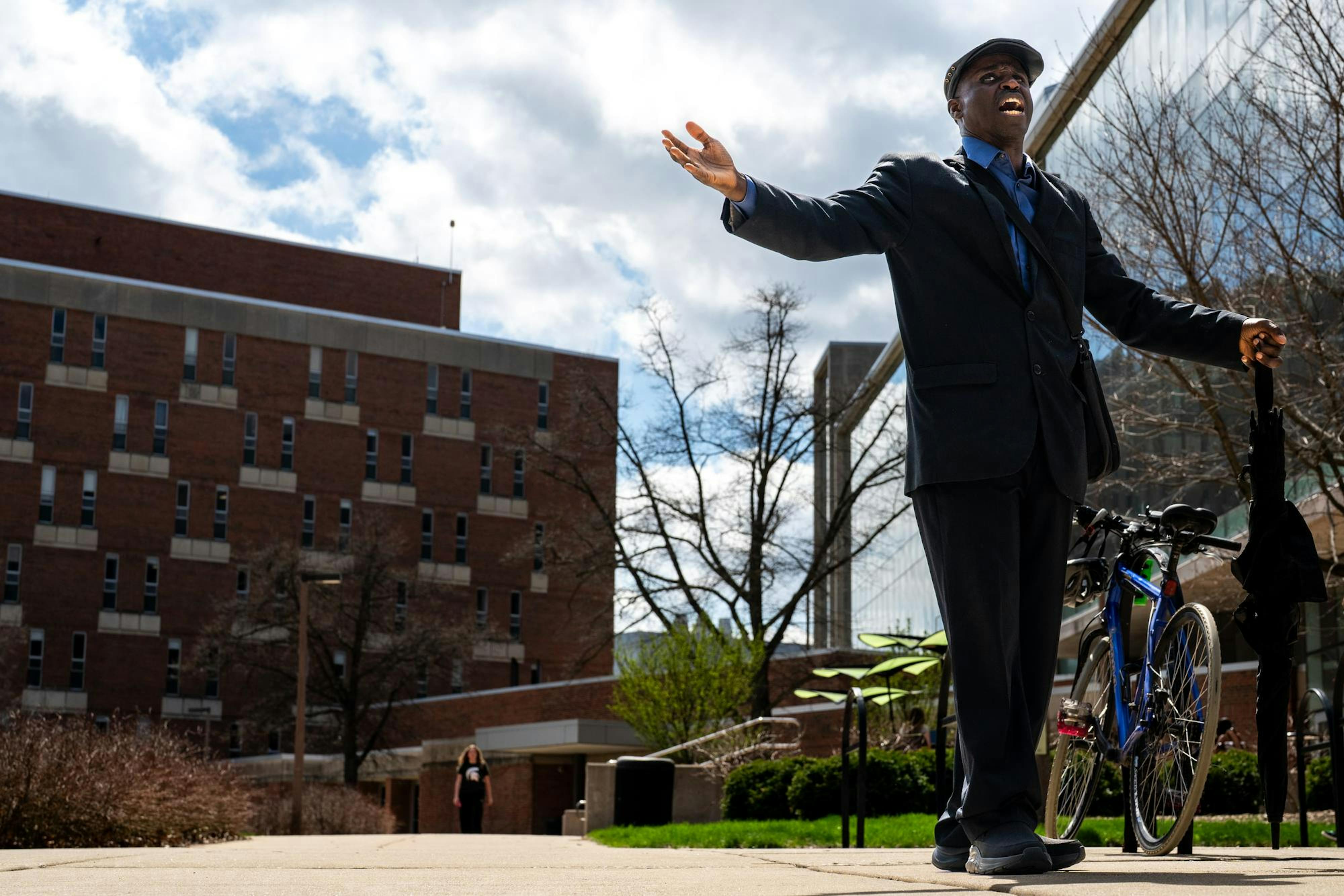
The infamous Wells Hall Preacher began a recent Monday afternoon sermon with the classics: video games, masturbation and fornication.
As hordes of students passed through the courtyard, en route to the 12:40 p.m. classes soon starting inside, he asked who among them had engaged in such sins.
No one answered.
He soon pivoted. After the conspicuous introduction, the preacher worked his message into a riff on modern higher education.
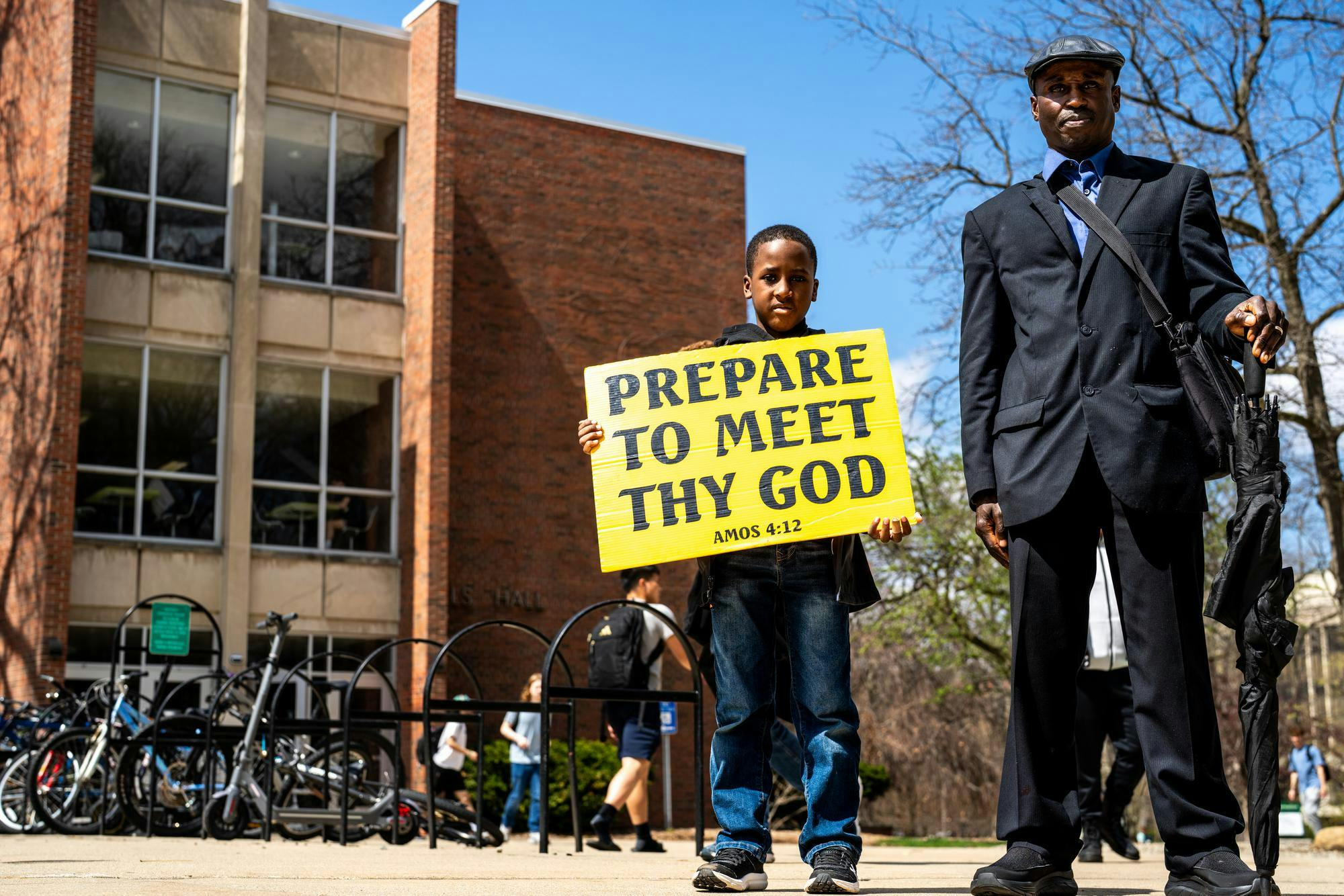
Every day, he explained, his passersby choose whether they will be “diligent students” who carefully study and get top marks, or “party-hardy MSU student-animals.” They also face a starker choice, spelled out on the bright yellow sign in the hands of his nearby 10-year-old son: “HEAVEN OR HELL?”
In their classes, students will read sinners like Nietzsche and Marx, he said. “But Jesus never sinned!” In today’s supposedly ever-accommodating academy, students may then prove their knowledge on extra length, online exams or papers allowed endless deadline extensions. But, he bellowed, “there will be no open-book retake exams when you stand before God!”
“Most of you have parents paying for your education, or are taking out loans!” he said. “Which you will be sorry you took out later. Most of you, at least.”
One solution would be to attend a nearby community college: “LCC offers free tuition!” he said. But, he suggested a better deal can be found elsewhere: “Christ offers free eternal life!”
That refrain, too, didn’t seem to capture the attention of passing students.
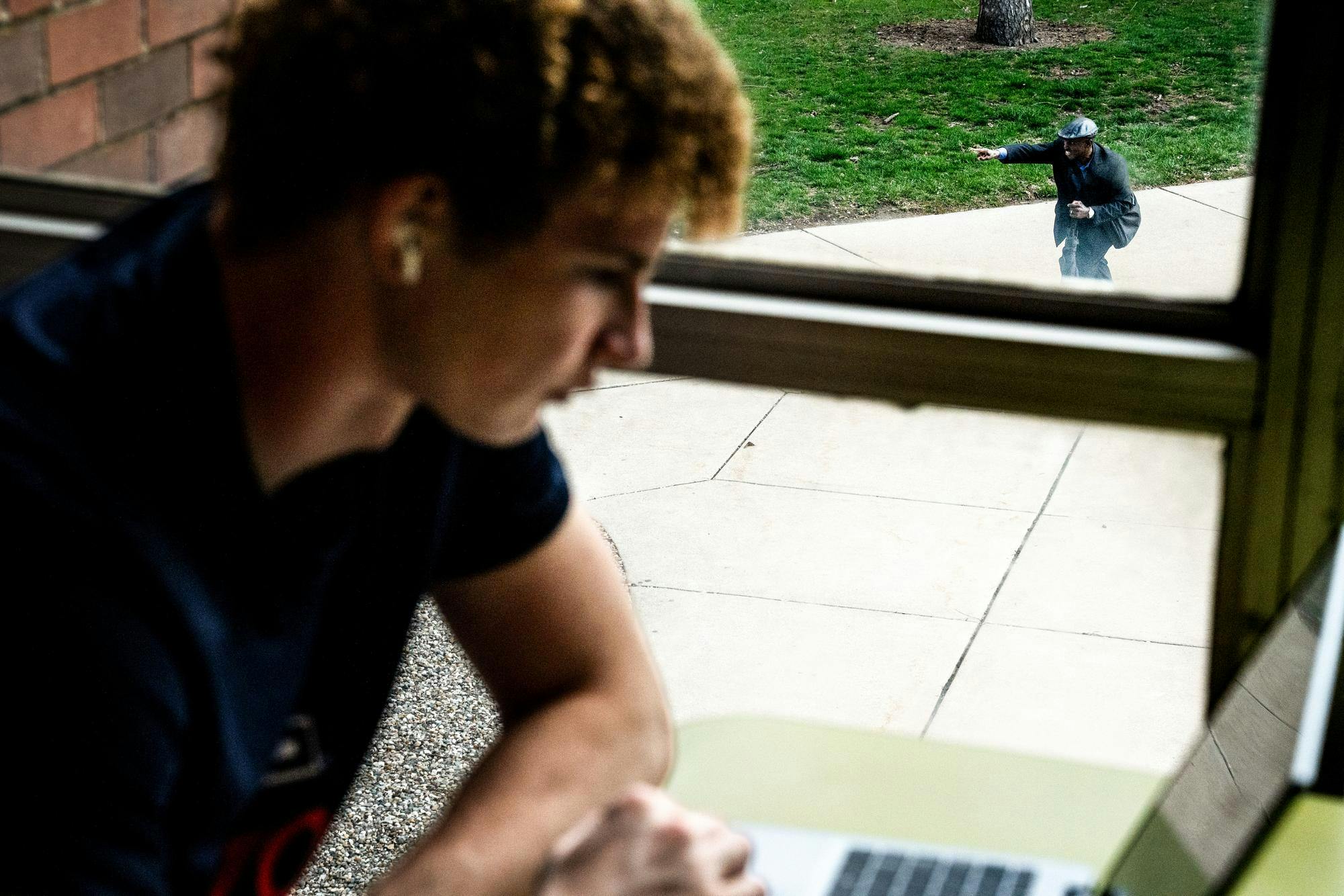
Most tried to avoid eye-contact, crossing without a word. A few glanced at him before promptly peering back down at their phones. One let out a cloying “Amen!” before sharing a smirk and chuckle with his companion.
It was far from the fervent reception he once inspired.
In his heyday, the preacher’s presence on campuses across the country could draw hundreds of critics, who tried to shout him down and stop his sermons with creative, and sometimes violent, protests. He says he’s been banned from campuses and jailed. His effect on public perceptions of Christianity was once compared to that of Al-Qaeda on Islam.
In the decades since, he’s certainly preached persistently, but he now does so on a campus that has greatly shifted around him. He has come to appear as a mere oddity. For the average student, he’s a quirky character you often pass in his tiny corner of a storied campus.
He’s far from the only proselytizer ever found behind Wells. The hub of campus speech — dubbed “People’s Park” — has been home to all manner of protestors and petitioners, plus multiple political encampments. And he’s not even the only preacher to attempt mass evangelism in the grassy meadow.
With his decades of sermons, though, he’s earned an ubiquity all the imitators lack. If you’ve attended Michigan State University, odds are you’ve passed his preaching en route to the obligatory econ lectures and foreign-language recitations that meet in the building from which he gets his name.
There are a few who know him beyond the notorious persona. Both behind Wells and at his church in South Lansing, some sympathetic students say he’s a misunderstood source of soul-saving guidance.
But most only observe from afar. For other local preachers, he raises vexing questions about how to best evangelize. And for his campus critics, he may be a nuisance, but one that goes ignored. Often, he’s simply the butt of wry jokes.
Soon, he may fade even further from the contentious relevance he once enjoyed. The preacher says he is winding down his campus sermons to spend more time leading his church and supporting Republicans in the upcoming midterms.
What happened? It’s a long story.
To piece it together, I scoured the archives of student newspapers at various campuses visited by the preacher; read hundreds of pages of his own writing; talked to many of those who have observed his sermons at MSU; met with him for a series of lengthy interviews; attended a Sunday service at his church in South Lansing; and, of course, spent hours observing his infamous preaching behind Wells.
Support student media! Please consider donating to The State News and help fund the future of journalism.
Ever a storyteller, he hinted at the beginning of such a tale during one recent sermon. As the rush to classes died down, he made one last appeal to passing students: “The majority of people who do repent do it in their college years!”
“I did it,” he said, “as a senior here, 35 years ago..."
‘Into an inferno’
Before the preacher agreed to talk to me, he asked to pray.
“We pray for this interview, Lord God,” he said. “We’ve had hundreds of interviews over the years, and most times, reporters will not say what you say. They’ll take it out of context, to serve their purpose and their agenda.”
“So we pray this will not be like that,” he said, asking God to ensure that my story will instead “just glorify you, reflect your will and bless the people of MSU.” He asked God to bless me too.
“May he guide you in this story for the newspaper,” he said.
As I would soon learn, he spoke from experience. Before he was the campus fixture known as the Wells Hall Preacher, he was a student-journalist named Michael Venyah.
After growing up in East Lansing, he left home to attend the University of Southern California. His junior year, he studied abroad and worked for a local newspaper in Canterbury, England. His brother’s struggle with Type 1 diabetes brought him back home to finish his education; he transferred to MSU for his final year of undergrad in 1990.
A glimpse of that Venyah can be found in the archives of the University Reporter-Intelligencer, an short-lived alternative student newspaper. He wrote under a byline that said he was a “correspondent concerned with social ills and what can be done to eradicate them.”
His first piece was a column decrying “skinheads” in the language of the Black radical tradition. He wrote: “The sixties are over; Martin Luther King, Malcolm X, long gone. We must now fight our own fight to possess the constitutional right of ‘the pursuit of happiness.’ We must use our collective intelligence to weaken the enemy, instead of asking his mercy. We must strike back, with equal force, whenever struck. We must remove the heel which grinds our dreams of freedom into nightmarish oppression.”
His second story was a dispatch from a speech on MSU’s campus by the leader of the Nation of Islam, Louis Farrakhan, whose rhetoric combined black nationalism and Islamic teachings. Venyah wrote that, though controversy was “hyped by the media” and “whispered nervously on city buses … it was nowhere to be found” at the speech.
When he wasn’t working back then — Venyah was sinning, he told me as we chatted behind Wells on a recent afternoon. Lowering his voice to a near whisper, he explained how he fornicated, drank and experimented with various drugs. He said he studied all the world’s religions, but was a proud atheist.
By the spring of his senior year, Venyah felt like something was missing. There was a hole inside him, he said, one material pleasures and well-read atheism couldn’t fill. The longing left him receptive when, that April, a friend of his mother invited him to come to church with her.
Venyah’s repentance was swift. He told me that as soon as he started listening to the preacher that fateful Sunday, “I knew right then I needed to respond.” He realized that he had “sinned against God” and would have to repent.
After the service, the preacher took Venyah to another room. “He said, ‘Okay, I pray for you to be filled with the Holy Spirit,’” Venyah told me. “I’d never heard of that before! But I just said, ‘Whatever God has, I want to serve him’.” As he left the church, “I said to those who were with me: ‘That’s it. Michael Venyah is dead. Now Jesus Christ lives in his life.’”
The Wells Hall Preacher was born soon after. Venyah left school to pursue preaching full time. By 1996, he was ordained.
He met his wife, Tamika, the next year — though he said he never imagined then that they would someday marry.
Venyah was an associate pastor at a local church, and she was a student at MSU looking to get involved in the congregation. At first, he was a mentor to her, he told me. She was an active member of the church’s evangelism group and, in general, “very faithful.”
Six years later, the pastor of the church told Venyah something that surprised him: “He’d had a dream where me and Tamika got married.”
“I didn’t think anything of it,” Venyah told me. “We weren’t interested in each other. We were just brother and sister in Christ.”
So Venyah was surprised again when he heard about another dream: “the Lord also gave Tamika’s mother a dream of us getting married.” He and her mother had met only once, about a year before the dream, when Venyah preached at the funeral of his soon-to-be-wife’s father.
In the nine months after those dreams, Venyah “sought the Lord” in hopes of figuring out why they were happening, and what they meant. He prayed and fasted on-and-off until he got an answer.
“The Lord confirmed that Tamika was to be my wife,” he told me.
So, equipped with that divine clarity, he pulled her aside at that Sunday’s service, and said “I’d like to speak to you about something after church.”
“She’s since told me she was fearful,” Venyah said with a laugh. “I was her authority, so she thought I was going to rebuke her or reprimand her.”
Rather, he merely relayed to her what the Lord had said, asking her to be engaged for marriage.
“She said, ‘I’m in a daze!’ Can I speak with you tomorrow?” Venyah told me.
They met the next day at the Panera Bread in Frandor. There, she gave Venyah a long letter saying he was a man of “Godly character” who she would like to marry. They were engaged for a year, then got married in July 2003.
They’ve been preaching together ever since. Just after they got married, the pair bought a 21-by-7 RV and started traveling the country, spreading the word on college campuses. They’ve also carried out missions in 20 countries, according to Venyah’s website. Their six children — now between 10 and 20 years old — were along for the ride.
The children are homeschooled and, in Venyah’s telling, always eager to join in their parents’ preaching. On the recent afternoons I spent with Venyah, his 10-year-old son, Phillip, was standing by his side. He smiled and nodded as his father explained how much he loved to join the campus visits. On the days I spent with them, Phillip alternated between holding bright yellow signs reading “HEAVEN OR HELL?” and ”PREPARE TO MEET THY GOD.”
Venyah says this preaching is the only work he or his wife have ever done. How have they managed to feed six children, fuel the RV, travel the world and purchase their East Lansing home without any other employment? Venyah told me they have simply been blessed. As he’s traversed the country and preached at various churches, people have made contributions to support his family. As he tells it, God has ensured that he is supported in his evangelism. (I suppose Venyah’s LinkedIn backs this up. It lists only one work experience: “servant of the LORD JESUS CHRIST.”)
In 2016, speaking with the student newspaper at the University of Maryland, Venyah said his time at colleges can feel like trips into a burning building. He is braving hotbeds of progressivism and sin in order to give “students a choice to avoid the fires of hell,” he said. It’s akin to how a “fireman would rush into an inferno and say there is a fire around those inside and give them a choice to leave.”
In a series of larger-than-life tales, Venyah told me he sometimes couldn’t escape the flames.
He says he has been physically attacked. While on a mission in Germany, for instance, Venyah said he was literally stoned by a mob that was upset by his preaching. (Perhaps, after the fall of the Nazis, the nation has over-corrected to “virulent, hardened atheism,” he supposed.) And, while preaching at the bottom of a large hill on the campus of UCLA, Venyah said a cyclist careened downward reaching out to punch him in the face as they passed by. He felt the blow detach his cornea, he said, but soon enough felt God repair the wound so he could keep preaching.
He also says police have been a persistent foe. Like in the spring of 2004, when he snuck onto the floor of the Breslin Center between graduation ceremonies. He briefly preached to the hundreds of families and friends awaiting the next ceremony, before campus police chased him out of the building. (He says the cops caught up to him months later while he preached at a track meet, and gave him a trespass that temporarily kept him off campus.) Things went farther at Mississippi State University, where Venyah says he was once jailed.
The campus was the home of his preaching on and off for years, and, in his recollection, he was beloved by campus police and some university administrators, who he says encouraged him to keep spreading the gospel among the student body. A pair of campus cops were thus reluctant, he told me, to execute a warrant for his arrest in 2005. A student had accused him of harassment, and the officers told him there was nothing they could do.
On the ride to the station and during his booking, Venyah says he kept preaching, trying to save the souls of each campus cop he passed. He told me this impressed the officers so much that they offered him a choice — a cell to himself, or a bustling holding room of recent arrestees, who would be captive to his preaching. Venyah chose the latter, and got to work. He smiled as he told me how he stood before the men, and yelled out his message.
Before he was let go, later that same day, an accused murderer pulled him aside. The man thanked him, Venyah told me, for giving him the first hope he had felt in a long time.
‘Grave danger’
After my first conversation with Venyah, I wondered if there was some simple way to figure out if someone is up to the task of joining him in God’s embrace. Luckily, I found a page on his website that offers a brief questionnaire of “Biblical Requirements for Affiliation” with his church, Soulwinners Ministries International.
It starts with 16 basic filters. Three ask if you consume alcohol, two ensure you are not a “striker” or “brawler;” others check if you have been divorced and make sure you are generally hospitable to guests.
Then, onto the questions “concerning your personal life.” Among them is, again, “Do you drink alcohol?” As well as, “How much time do you spend in prayer every day?” “Do you engage in pornography?” “Have you ever been put in jail or prison?” It asks if “you molest children” and also: “Have you ever been sexually molested?”
“Do you meet all of the Lord’s requirements?” the form asks. “If you do not, please immediately repent to the Lord. … If you are meeting the Lord's Biblical requirements, we welcome you to continue studying the following documents for affiliation with Soulwinners Ministries International.”
Among those documents are a set of pamphlets written by Venyah, which he is known for handing out during his sermons behind Wells. One claims to explain, “Why listening to rap music will send you to HELL!!!!!!!!” It asks, “Did you know that listening to Tupac, Snoop Dogg, Ludacris, Jay-Z, Scarface, will cause you to burn forever in the Lake of Fire?” (A dated list, but one gets the gist.)
Another, invoking a sort of evangelical Dr. Seuss, sneeringly asks students if they are “up for an orgy, or just some good love from your significant other? How about some cold brews to get you in the mood? A keg, a few j's, snow and ice line to blow away? Dust from fallen angels wings to fly? Acid hits to skillet your mind on fry? Or, gin-fizz-chill, straight from the still, vodka-shot, hit the spot, comrade?”
Venyah is also vehemently opposed to homosexuality. It’s a core tenet of his theology and a frequent part of his campus sermons.
“There’s a lot of masturbators here, especially the homos, the perverts,” he said on his first day back to Mississippi State’s campus in 2007, according to an article in its student newspaper ominously titled, “Venyah Returns.” Standing with his wife and then-two-year-old son, Paul, Venyah proclaimed: “They watch these pervert videos and touch themselves. You say, ‘Jesus come in my heart,’ and then you sodomize, you go and poke some man in the rear. Understand about this: A penis does not go in an anus. An anus is meant to push out waste material.”
A couple months later, he was back in East Lansing, staging a protest at a local Pride festival, wearing a bright red shirt that said “NO HOMOS GO TO HEAVEN.” Venyah held a Bible in one hand, and used the other to point at a passerby.
“I can tell by your eyes you are a sodomite, young man,” he yelled, according to a State News report. “You are in grave danger!”
‘Evil incarnate’
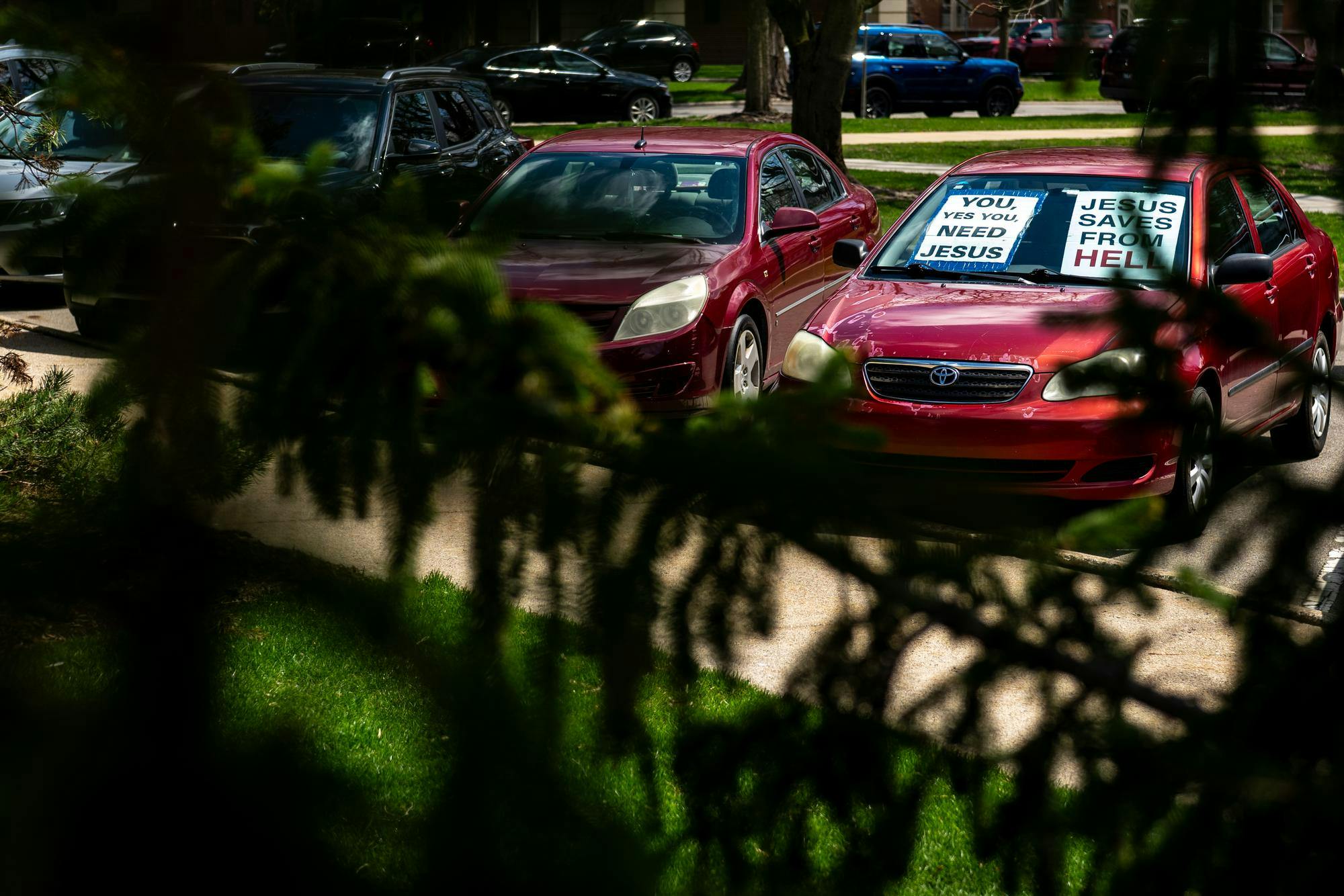
Decades ago, Venyah’s appearances drew major pushback. Student newspaper reports from campuses across the country suggest that, throughout the 2000s, his preaching regularly drew scores of protesters. They often tried to shout Venyah down, once simply chanting “asshole!” to drown out his preaching. Another one-time tactic involved Queer students kissing and dry-humping in front of Venyah to upset him. Reports say students have also attempted to draw on Venyah, tried to spank him, and flicked cigarette ashes on his head.
In decades-old blogs and Facebook comments, frustrated MSU students brainstormed and schemed up plans for protests should Venyah, or other preachers like him, appear again. In 2006, a church in South Lansing even created a new website dedicated solely to “appeal to the people who have been annoyed or frustrated by the preachers outside of Wells.” An involved student told The State News it would “give information about the preachers and say what about the preachers’ message is right and tell more about what they seem to be missing, which is the good news and salvation.”
Another student told The State News at the time that she grew so frustrated with the campus preachers that she donned a pair of rubber wings and fake horns, and stood before them with a sign that read: “I am an MSU student. Therefore I am Evil incarnate.”
For some, pushing back on the preachers was a source of connection and solidarity.
“When else do we have a chance to unite in one feeling, whether it be for or against something?” asked a column published in the Mississippi State paper the next year. “It's just nice to know that we're all, the majority anyway, on one side.” The columnist wrote about how she was upset years before when Venyah called her a “slut,” but has since come to enjoy his dramatic visits. “In Venyah's book, I'm damned, and so are you,” she wrote. “Michael Venyah apparently wants heaven to himself, and I say, if there's a heaven, let's leave it to him.”
After Venyah’s appearance at the University of Michigan in 2006 — on the same day as a “catch an illegal immigrant day” planned by a campus conservatives club — a student wrote in the campus newspaper that all manner of local progressives were brought together and shaken out of a period of apathy by the events and subsequent protests. (For what it’s worth, Venyah says Ann Arbor is “far more sinful” than East Lansing. In fact, he told me the university was “formed by witchcraft.” How does he know that? “Just from what I’ve heard,” he told me. “I wasn’t there at the founding. But, from the way people act there, I wouldn’t doubt it.”)
Others, though, were driven to do things they later regretted by Venyah’s sermons.
A campus newspaper report about the protests in Ann Arbor tells of a student who, frustrated with a tirade about anal sex, jumped out from a crowd of protesters and yelled: “You know what else it says is OK in the Bible? It says slavery is OK!” The student then suggested that onlookers should bind the preacher in chains and “drag him out of here.”
Late that night, the student told the paper he regretted the outburst. He was so angry, the student said, and caught in the heat of the moment. “Slavery's inherently wrong. I mean it entirely sarcastically. It's a ridiculous concept."
"It angered me what that guy was doing,” the student said. “I'm not gay, but if there was a gay person there, it would have offended them."
‘Just Jesus’
Some have suggested that Venyah’s preaching is a performance; that he’s acting as a character from which he could hypothetically break.
In 2007, a student newspaper columnist at Mississippi State wrote that interviewing Venyah “felt as though I was interviewing Borat or Stephen Colbert,” who was then playing an absurd version of himself four nights a week on The Colbert Report.
I’m not sure I feel the same way. Venyah is certainly a larger-than-life person. But if it’s all an act, he never broke it in the hours I spent with him. In fact, he was actually so disciplined in his commitment to preaching that he made for a rather tricky subject.
Ask him just about any question about himself or his life, and you’ll get a similar response. How do you not get hot preaching in a suit on 80 degree days? “It’s to represent Jesus.” Why did you move back to East Lansing if you felt so at home at Mississippi State? “The Lord told me: ‘Go back to Michigan.’” Why did you later take a brief hiatus from preaching at MSU before returning last year? "The Lord Jesus told me to resume." How do you not lose your voice screaming for hours on end? “By the grace of our Lord Jesus Christ.”
“You never do, like, a cough drop?” I asked on follow-up.
“No,” Venyah said. “Just Jesus, really.”
The idea of me even writing about Venyah in the first place made him uncomfortable. I pleaded with him that he’s a well-known campus figure worth profiling, but he questioned my focus at every turn.
“I am requesting that the focus be on the Person Who matters: JESUS,” he texted me after I visited him one afternoon with some follow-up questions about his personal life.
When I first contacted Venyah, he tried to skirt my requests to interview and observe him altogether, saying adamantly that he was extremely busy studying the Bible and tending to his family. Then, when he did make the time, he used much of it not explaining himself for my story, but trying to get me, and the State News’ photographer, to repent for our sins. He then insisted that this story’s purpose should be to convert you — the reader — by including various Biblical messages in its text.
Venyah said I had a choice, between “including the Gospel Message of Jesus Christ, which can afford readers eternal life, or writing about me, which cannot accomplish the same.”
This all leads me away from the idea that Venyah is performing some sort of character. Because in that framing, he’s in it for sheer attention; gazes from passersby would be enough. What I observed, instead, is that Venyah is after a more personal engagement from the students he shouts at.
On the afternoons I spent with him, few seemed to pay him any notice as he bellowed endlessly about fornication and lust. But on the rare occasion someone engaged, even for a moment, even in jest or opposition — Venyah reveled in the action.
Watch him long enough during the lengthy tirades into open air, and you’ll see his focus fade just a bit. But look closely when someone approaches, and Venyah is rejuvenated. His eyes light up, and his posture straightens. Only when he had caught a student in a one-on-one conversation — even if they were only captive while they struggled to unlock their bike — would I see him truly smile.
Over the years, some of Venyah’s critics too have noticed how much he seems to relish interpersonal interactions amid his sermons, whether they are supportive or confrontational. It’s led them to a different strategy for pushing back: don’t protest, just ignore him.
One student said as much in a 2006 State News column titled: “Vengeance against preachers not sweet.” He recounted how "satisfied" he felt stepping out from a crowd and having a heated argument with a preacher, which he claims to have won. Then he “started wondering what would happen the next day?” Of course, he concluded, the preachers “would be back again, with wounded egos and a greater ax to grind with the world.”
“Now I felt ashamed for making it worse,” he wrote.
A 2008 column by a Queer student at the University of Houston tells of someone who managed to meet Venyah with restraint. She wrote that, while walking with her girlfriend on campus, holding hands, Venyah yelled out that they were “wicked” and damned because of their sinful "homo-sex." Though the remark was hurtful, she chose not to fight.
“All I could do was laugh, be proud, and lean over and kiss my girl,” she wrote.
But Venyah’s critics are not just those who write his ideas off altogether — he can also be a thorn for other Christians.
A student at the University of Michigan observed as much in 2008, after spending some of his free afternoons dressed as Jesus, arguing with Venyah through a sock puppet.
The charade was “fun” for an agnostic like himself, the student told the campus newspaper. But it made him realize that Venyah might present a dilemma to Christians on campus. Those most familiar with and passionate about the Bible should actually be those most offended by his sermons, the student said, because preachers like Venyah function as “anti-advertising for what they're trying to spread.”
‘The rest of the team’
The first mention of Venyah in the Mississippi State campus paper is a column penned by a Christian student that attempts to disprove the preacher’s claims with a litany of Biblical citations.
The student was running on campus one day when she heard Venyah yell out: “You’re a whore! You’re going to hell!” She momentarily wondered if he was talking to her.
One of Venyah’s companions soon clarified: “That’s right, I’m talking to you in the white shirt.”
“Being a Christian myself,” she wrote in the column, “what I can’t figure out is how this group of so-called Christians not only condones this type of judgmental, hateful behavior, but encourages it.” She then recounts how she debated Venyah about scripture, hoping to change his ways.
It’s hard to imagine she got through to him. In the 21 years since her column was published, plenty more like it have been penned in the pages of student newspapers across the country, each retelling just about the same story: Christian student fights with Venyah and hopes he adjusts his approach. Each new entry in that long history suggests their efforts are fruitless.
But the pickle remains for Christians who bump up against him at MSU today.
“There’s someone who says they’re on your team, and they’re acting this way,” said Daniel Foster, a board member at the Crossway Multinational Church in East Lansing. “So, what does the rest of the team think?”
If he walked past Venyah, Foster told me he might feel compelled to engage in a debate about his method of preaching. But, he said that “in similar conversations elsewhere in the world,” Foster has found that preachers like Venyah “don’t want to talk to other Christians.”
“They’re sort of like, ‘I’m not here for you,’” he said. “They probably know that it won’t serve their purposes, or the theatrics of it all.”
Foster told me there’s two ways to look at that instinct. The more charitable reading is that it’s hard to convert non-believers, and showing them how much debate and division there is even under the umbrella of “Christian” could complicate the pitch. A more cynical interpretation, Foster suggested, could be that a preacher like Venyah is only concerned with maximizing the sheer number of souls saved, so debating an already-established Christian on the finer points is moot. “Maybe you’re like, ‘This one’s already saved. So I don’t have to worry about it.’”
Some have been even less charitable when trying to place Venyah in the broader ecosystem of Christian thinkers. In a 2006 letter to the editor of the campus newspaper, a Muslim student at the University of Michigan compared Venyah’s relationship to Christians to some terrorist groups' relationship to Muslims. He wrote that the debate about Venyah’s preaching was a “situation analogous to the unfortunate use of Al-Qaeda and the like as representatives of the peaceful religion of Islam.”
The problem for East Lansing’s Christians today — is what to do about it.
When Tim Stokes first encountered Venyah behind Wells a few years ago, his first instinct was to argue. He was a proudly Christian student on a mostly secular campus, he told me, and Venyah was misrepresenting his beliefs.
But before long, Stokes realized that Venyah was deeply convicted about his way of preaching, and wasn’t going to accept that someone saw things differently. He imagines that Venyah is “convinced that his way is the best thing to do, and if people don’t listen, it’s just because their hearts are hard.”
Stokes graduated from MSU in 2023 and now works as the college ministry director at the nearby River Terrace Church. In an effort to get more students involved in the congregation, he’s done some campus evangelism of his own.
At the start of the academic year, Stokes sat in front of Akers Hall with a sign that read: “Ask me anything.” Some passersby “trolled” him, some asked silly questions — “MJ or LeBron?” or “What’s your favorite animal?” — and others asked meta ones about why he was there. But, some conversations touched on deeper issues, like faith, politics or Stokes’ regrets. He offered each person who stopped a cold drink and an invitation to an upcoming barbecue at the church, he told me.
In two days, he handed out over 100 invitations. Two students eventually came to the barbecue. One now comes to church services, and has gotten their friends involved too.
It’s part of Stokes’ broader philosophy, wherein preaching forms one part of a larger transaction. If you approach someone cold and start telling them to repent, you’re just “taking” from them – their time and their energy — and not giving anything in return. So Stokes starts with giving, he said, with something like a cold Gatorade, or an invite to a barbecue, or a funny conversation about animals. In college, he and his friends organized events called “free prayer and free hugs.”
“I think just being welcoming and super warm is really attractive,” he told me. “People will listen to you if they feel like you respect and value them.”
He wonders if Venyah would have more success if he considered softening his approach.
“I think God can work any way,” he told me. “So, yeah, maybe someone might walk past and just be really convicted by what (Venyah) says. But I think there’s also quite a bit of frustration and negative experiences that people have from that.”
It’s not uncommon for churches to use largely secular activities to drive engagement. Sharon Ketchum, a minister at the Unity Spiritual Center of Lansing, told me the church uses “side-door” activities — like yoga classes or game nights — in hopes of eventually getting people through the main-door: Sunday service. Foster told me he works with a lot of international scholars who learn about American Christianity for the first time when they come to the U.S. to study at MSU. Even if they’re interested in Christianity from the start, he said it’s most effective to build a relationship with them outside of religion — he teaches English-language classes and plays board games — before you start preaching.
“You have to have a strong arm around someone before you punch them in the gut,” said Haley Hansen, an associate pastor at The Peoples Church. She told me a mentor taught her that phrase in seminary, as he tried to explain that preaching is a two-way street. As she sees it, “a sermon can’t be preached unless someone is ready to receive it,” because the gospel is both good news and hard news.
Part of that hard news, she said, is that God loves Venyah too. Though he frustrates her, Hansen said the real question for Christians should be, “How do I love this guy in the way that God loves him?”
The only way to change his views or his methods, then, would be to have a relationship with him, rather than yelling back at him in the Wells courtyard, she said. Until that happens, Hansen told me she worries about students who only encounter Christianity through his sermons.
“I grieve it,” she said. “Some people’s very limited experience of Christianity is of hatred.”
Venyah, though, would tell you that his message is resonating with some Christian students, even with his harshest retorts, and even amid theological disagreement. They may be reluctant to admit that they’ve been swayed by his preaching, he told me, but he insists they’re out there. I believe I saw as much on one of the afternoons I spent with him.
After the usual rush to make 12:40 p.m. classes passed, I watched a student approach Venyah familiarly, before saying hello and shaking his hand. Venyah gave him a card advertising his church services, and they parted ways.
I ran after the student in hopes of talking to him. I introduced myself, explained my story, and opened my notebook. The student started to nervously sway.
“He’s a nice guy,” he tersely told me, eyes darting between me and the ground between us.
I asked if the student had attended his church. He told me he hadn’t — “I’m actually Catholic” — but he believes Venyah is “trying to spread the good word” in his own way. “He’s a nice guy,” the student repeated.
“I’m not interested if you’re trying to write a hit piece,” he said.
I told him that wasn’t what I was writing, and thanked him for his time. He walked away.
Ten minutes later, I was watching Venyah from afar as he launched into a new sermon, when I realized: The student had come back, and was standing behind me.
He asked again why I was writing about Venyah, and if it’s a “hit piece.” I told him the same thing I’d told my editors: every student knows of the Wells Hall Preacher, but no one actually knows about the Wells Hall Preacher.
“Okay,” he said. “I just want to make sure my words aren’t used in a hit piece.”
‘The autopen administration’
On one hand, it can seem like a tough time to be the Wells Hall Preacher, Venyah suggested. He told me how “the homosexual, lesbian, LGBTQIA agenda is more virulent and accepted" than ever before. “So is Islam,” he added.
But at the same time, Venyah says he feels more comfortable at MSU today than ever before. In the first decades he spent on college campuses, he remembers being constantly bothered by protesters and police. Now, Venyah told me the opposition simply isn’t so fierce. He feels accepted.
That didn’t quite make sense to me. If the nation is becoming more intolerant of Venyah’s strict worldview, how is MSU growing more tolerant? Venyah told me it isn’t so simple.
The Bible says “where sin abounds, grace doth more abound,” he said. So when the Lord is “irked” by a society — “or a campus” — moving farther from him, God works to urge people more forcefully towards repentance. Venyah supposed that could be the reason this academic year has felt like one of his best ever.
Or, maybe that’s just one reason.
“I think it’s the Lord’s grace,” Venyah told me. “But, I also think it’s the assassination of Charlie Kirk.”
The killing of the popular conservative activist “stamped the consciences of many in this country,” Venyah told me. “Many students saw that when someone is out here, especially in the name of Christ, proclaiming truth and the exchange of ideas … their life can be extinguished.”
“No one would like to be killed,” Venyah told me. “So students really opened up to consider what is going on with the polarization of America.”
And, in general, he feels that the nation is more open to his beliefs under the administration of President Donald Trump. Under the Obama and Biden Administrations — “Or should I say the autopen administration,” Venyah joked — he said his views were less tolerated.
Venyah said he believes that Biden’s election in 2020 was fraudulent. But he’s now come to see that illegitimate presidency had a purpose: illustrating to Trump just how deep the corruption in the federal government was. Like a “cancer under the skin,” he said it had to be detected before it could be eradicated.
Republicans winning in this year’s midterms will be crucial to continuing that work, he told me. He doesn’t know if they will, but, if history is any indication, he may receive a sign. Venyah told me that he remembers the precise moment — 3:12 p.m. on Oct. 29, 2024 — when God told him three words: “Trump has won.”
To focus on the midterms, Venyah told me he’s put off any international missions and his usual tour of campuses so he can be part of ensuring a purple Michigan votes red this November.
His forays into explicitly electoral politics could make him evermore controversial among MSU’s largely liberal student body, but Venyah said it’s too important to avoid. He told me that when a student recently told him to “shut up” while discussing Trump, he replied: “No, I love you too much to shut up.”
“I’m telling the truth about Christ, but also about the social, geopolitical environment in this country, and in this world.”
But, at the same time, today’s college students are seeing less and less of Venyah. A decade ago, he kept a busy schedule of campus appearances: Mondays were for MSU, Tuesdays were for Western Michigan University, Wednesdays were for Central Michigan University and Thursdays he visited Grand Valley State University. Now, he only preaches on a campus once a week: his Monday afternoons behind Wells Hall.
The transition can be summarized with Venyah’s rhyming motto for the year — “2026: Discipleship that Sticks.” Instead of spending his days yelling out to endless mobs of college students, Venyah told me he wants to focus on mentoring his most dedicated disciples.
So, his street-preaching is being scaled back. In the fall, he’s hoping to transition his work on campus from sermons behind Wells to a university-sanctioned Registered Student Organization, which can meet regularly for a more formalized sort of service. Venyah told me he has students interested in sponsoring the club, but needs a faculty advisor.
Stepping back from campus preaching has also given Venyah more time to focus on his church.
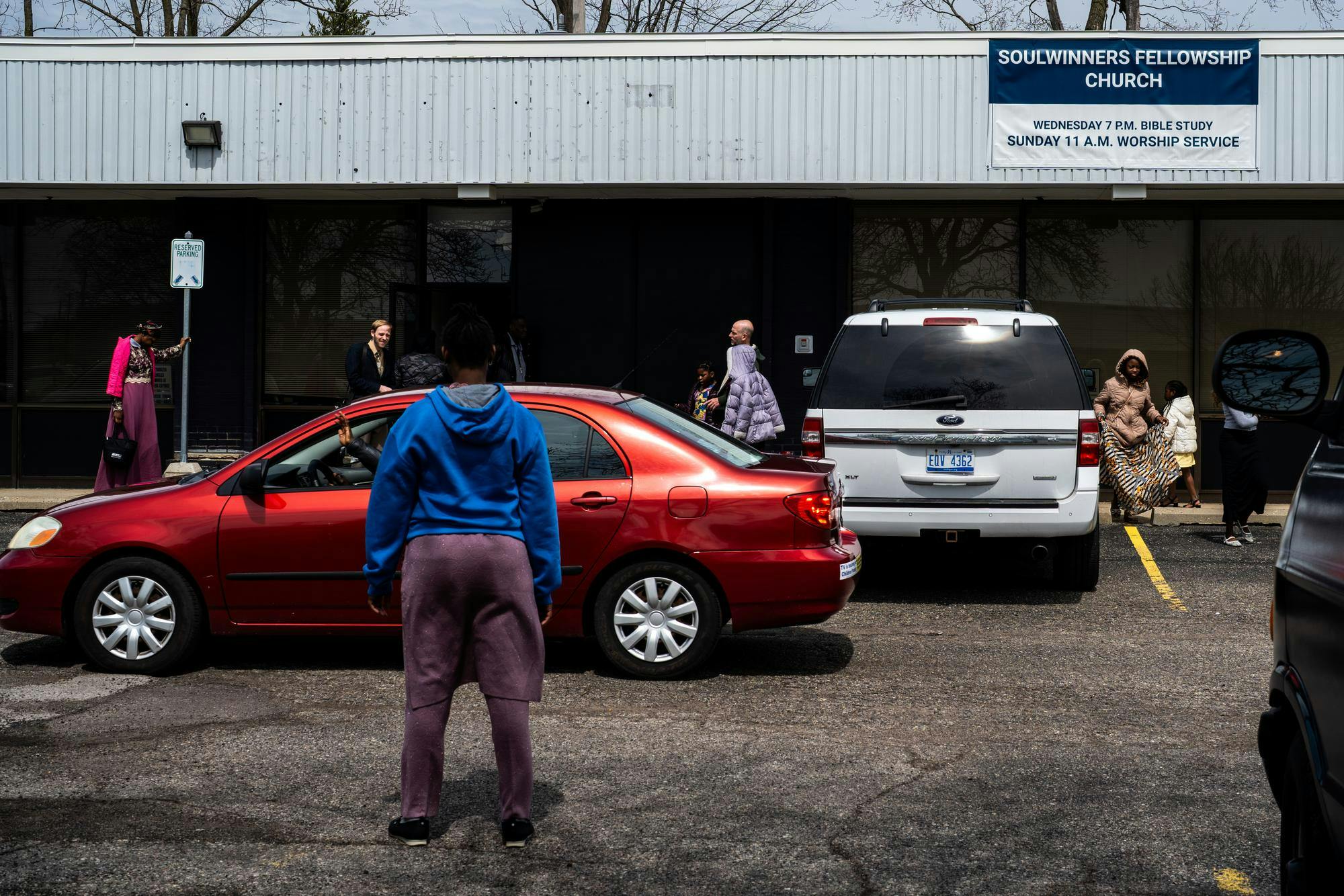
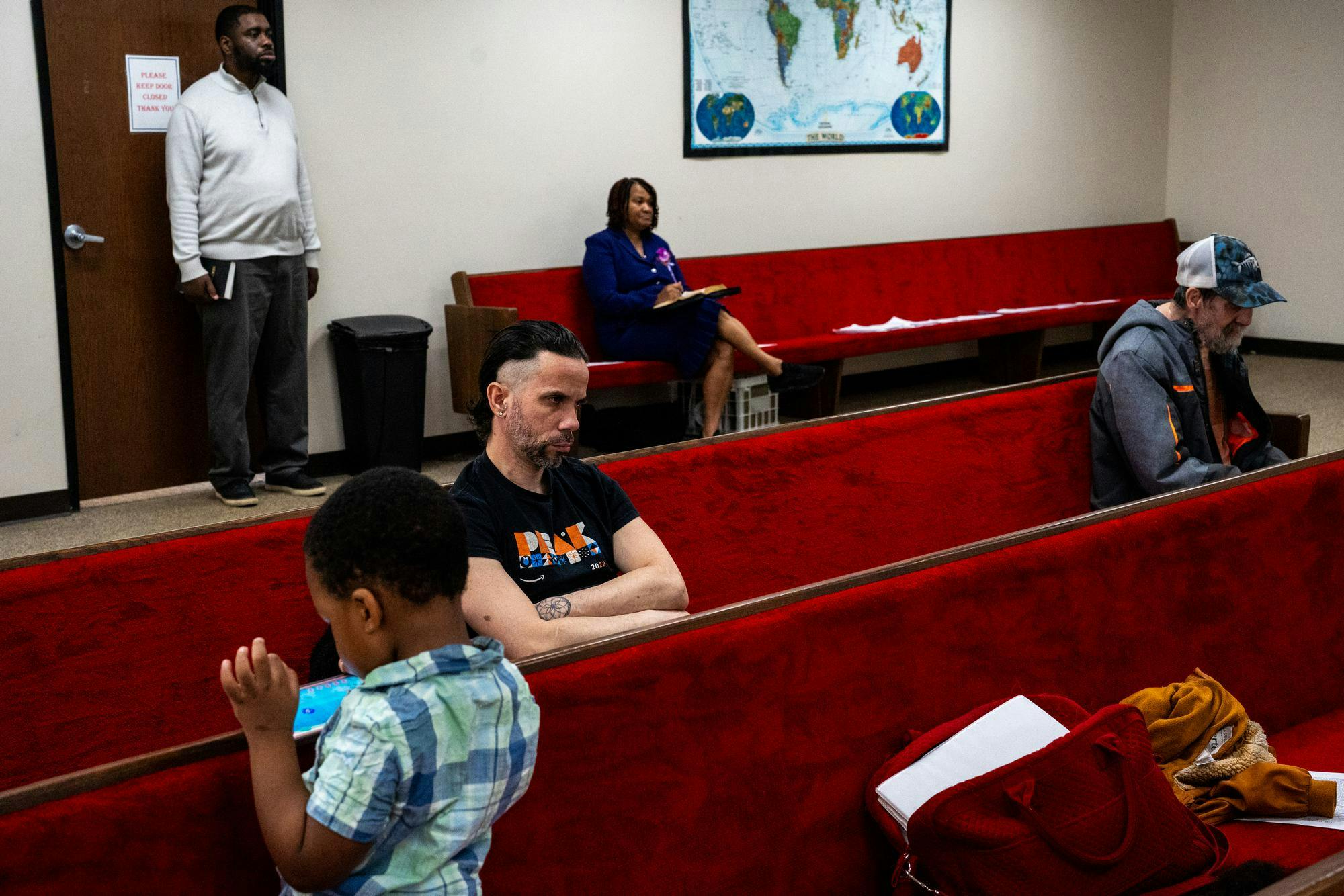
The congregation meets at a strip-mall in South Lansing. Its other listed tenants include a laundromat, boxing gym, dispensary and another church, which appeared to be vacant on a recent Sunday morning. They meet four times a week: there is the main worship service, dubbed “Sunday Celebration;” a Bible study, “Wednesday Watering;” prayer meeting and Christian movie night, “Friday Fire;” plus a day of general evangelism and home visits, “Saturday Salvation.”
Venyah told me that this year, nine MSU students have attended his services after meeting him behind Wells. Eager to see for myself, I decided to make it ten.
‘Clap if you want to’
The service started in song.
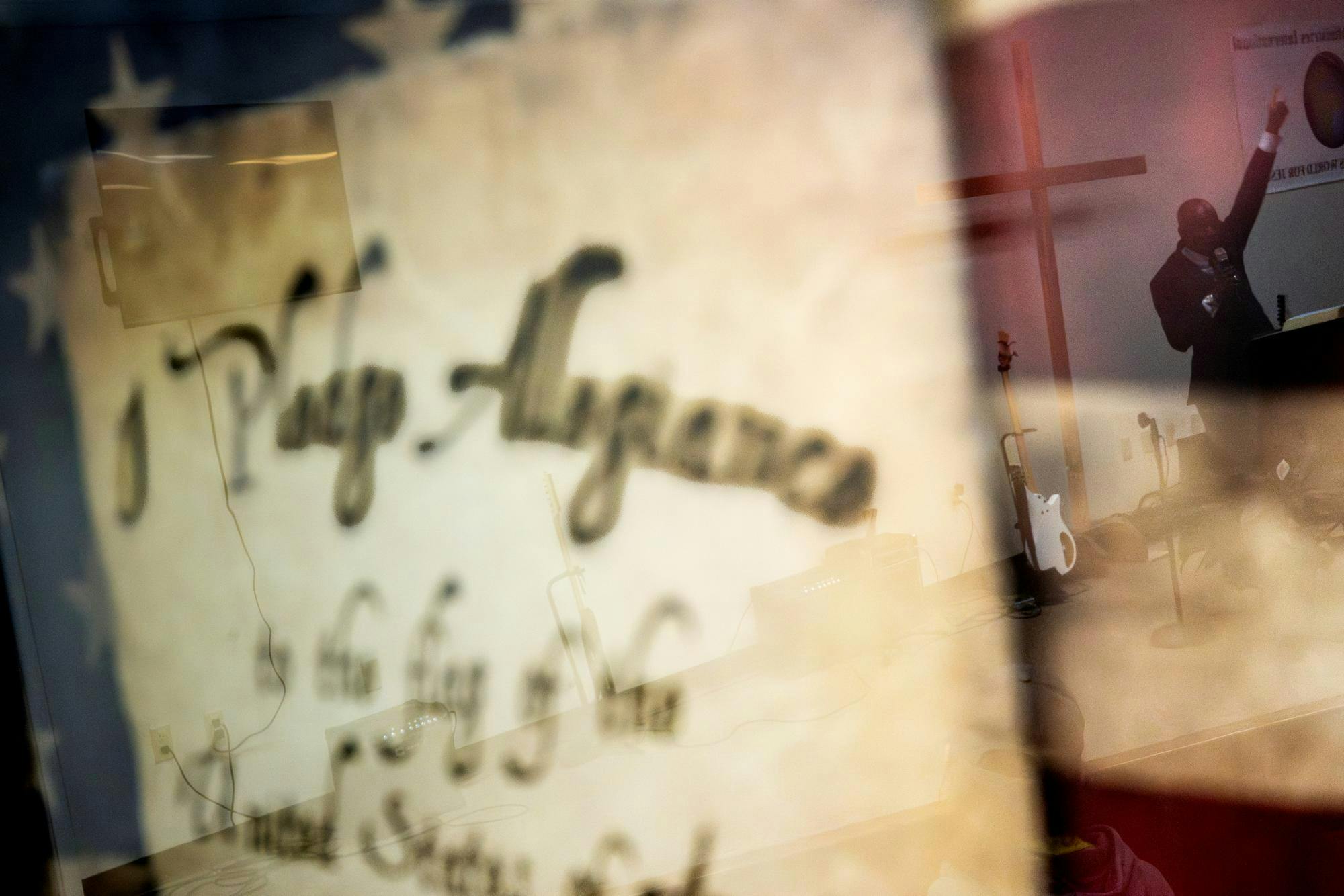
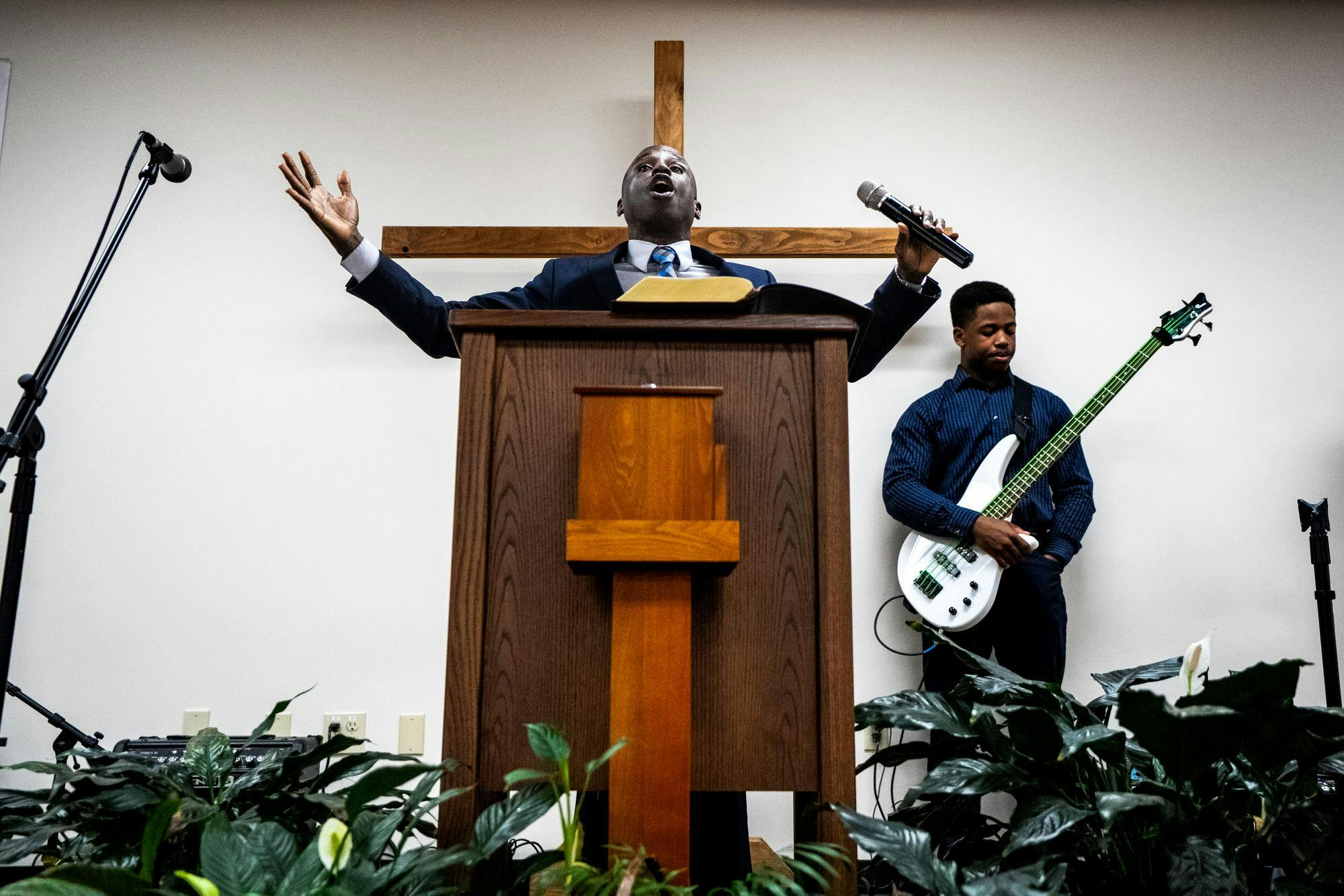
Though Venyah has decried rock 'n' roll — What do “Kurt Cobain, Jimi Hendrix, Jim Morrison, and Janis Joplin, have most in common?” one of his pamphlets asks: “They are being tormented in Hell” — its influence on his music is rather striking. It’s in his electric guitar’s jagged edges and shiny finish, the neon plastic strings on his son’s bass, and the melodically modulated, uptempo ending of his medley of popular worship songs.
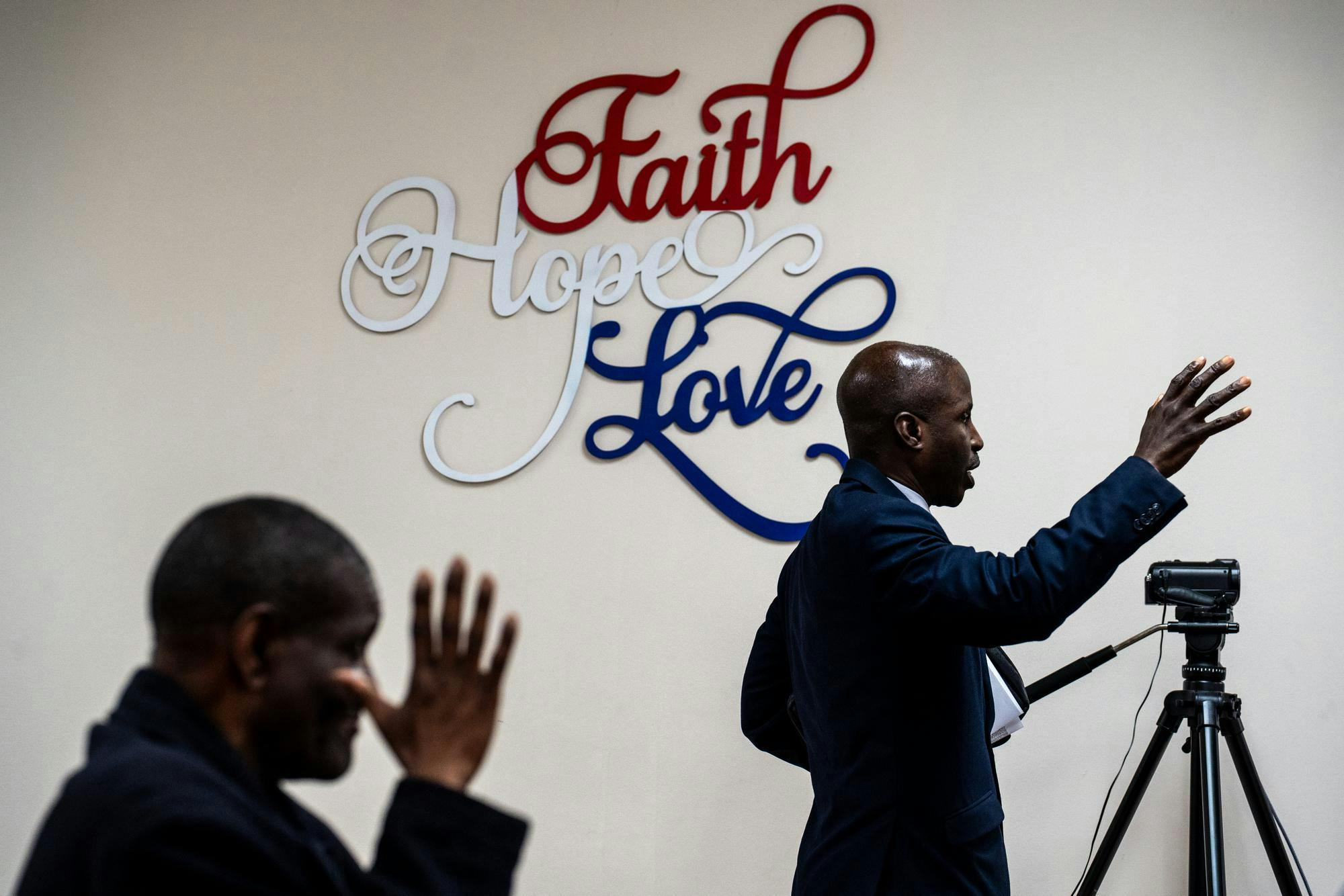
As Venyah stretched to hit the notes, the 30 or so congregants swayed and murmured along. More were apparently watching a live stream taken from a camcorder in the back of the room, Venyah told me. Sometimes, they bring a Swahili translator to accommodate their followers who watch from East Africa.
After the music, Venyah’s wife read off the announcements and asked for testimonies. Venyah smiled as a woman sitting in the back stood up to speak.
“The people that see me today, they look at me and say I’ve changed,” she said tearfully. “My friends don’t treat me like they used to. I don’t go to the places I used to go. I don’t smoke the drugs I used to smoke. I don’t sing the songs I used to sing.”
“Amen,” Venyah said.
“And I still dance,” the woman said, “but I’ve got a new partner!”
“And that’s Jesus!” Venyah shouted.
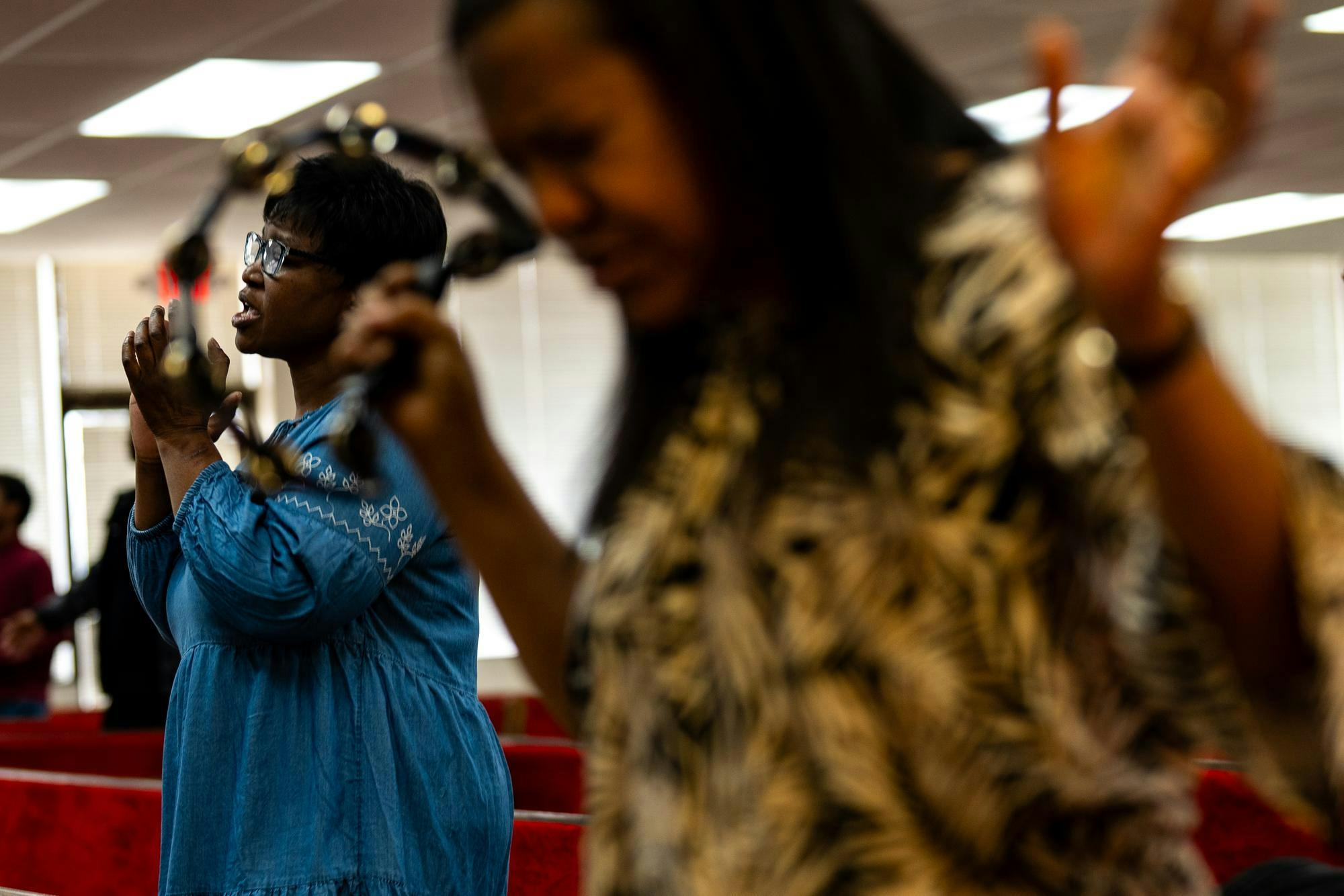
Tamika, his wife, then read off the rest of the announcements — Christian movie night is back! — and implored members to "continue to thank the Lord for our president.”
“Keep praying for his administration, keep praying for ICE. Pray for their safety, and pray that they can fulfill God’s agenda for this country. Pray we all can make the USA godly and great again!” she said to a round of applause.
Then, Venyah began his sermon.
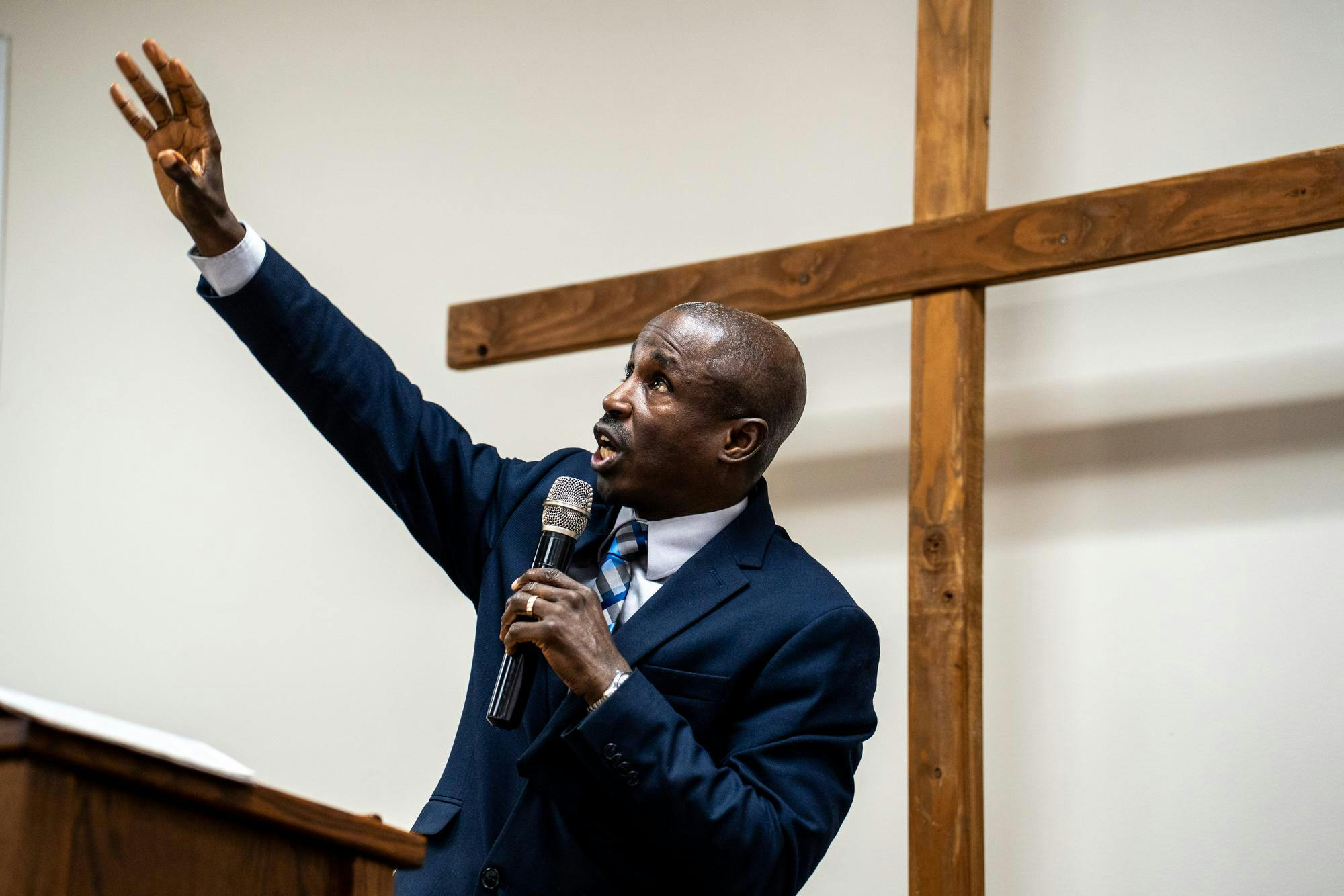
The version of Venyah preaching at his church was not quite the one I’d seen behind Wells Hall. Those sermons occupy only one level: as boisterous and conspicuous as possible, in hopes of luring in uninterested passersby. But in church, Venyah accesses a far broader dynamic range. He was reserved as he drew congregants in for somber moments, then riled them up as he built to exaggerated refrains, raising his voice and his arms in a dramatic performance of the scripture he cited.
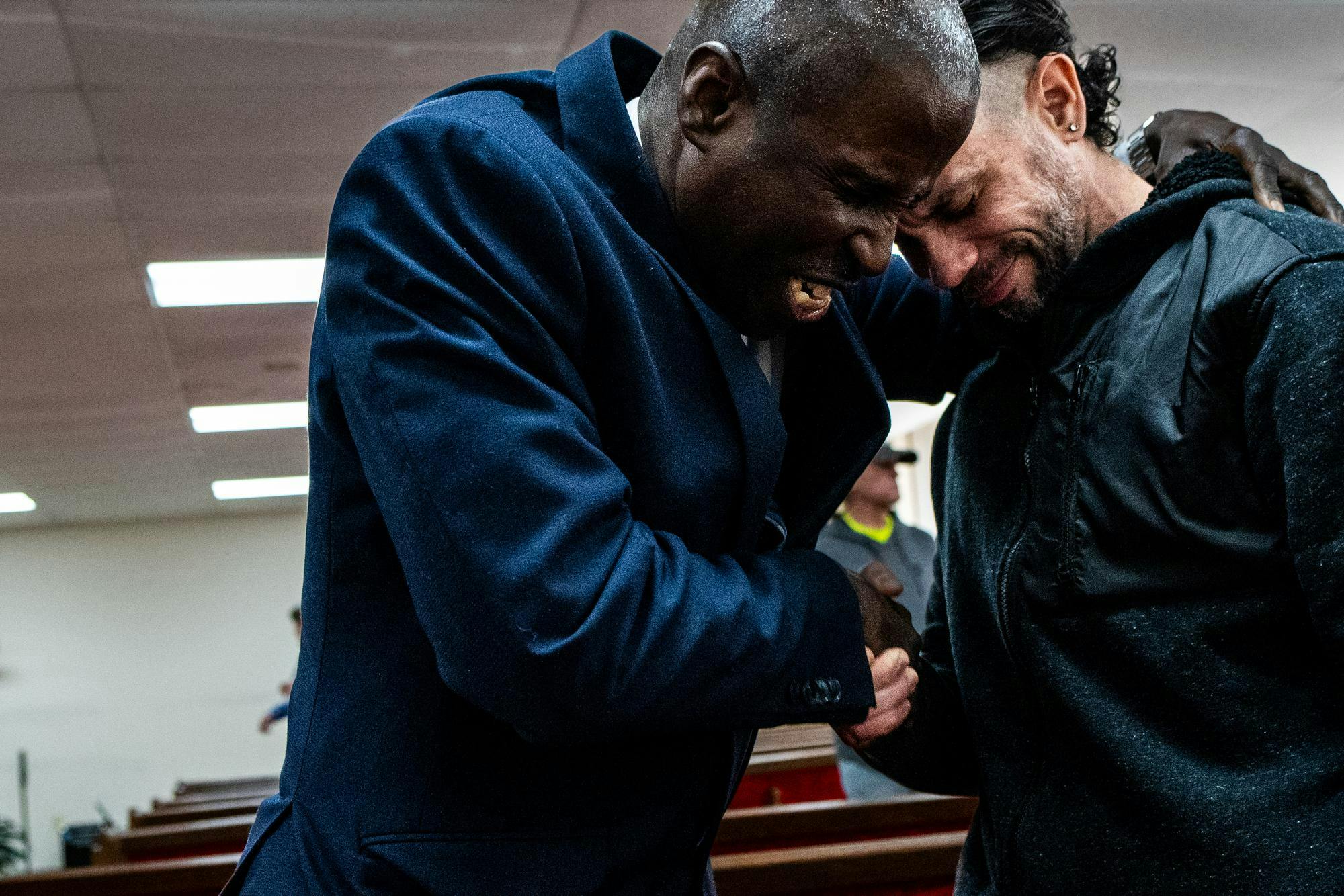
“Can you say Amen!” he shouted, as he reeled from a particularly forceful plea. Catching his breath, he grinned and added: “That’s a good place to clap if you want to!”
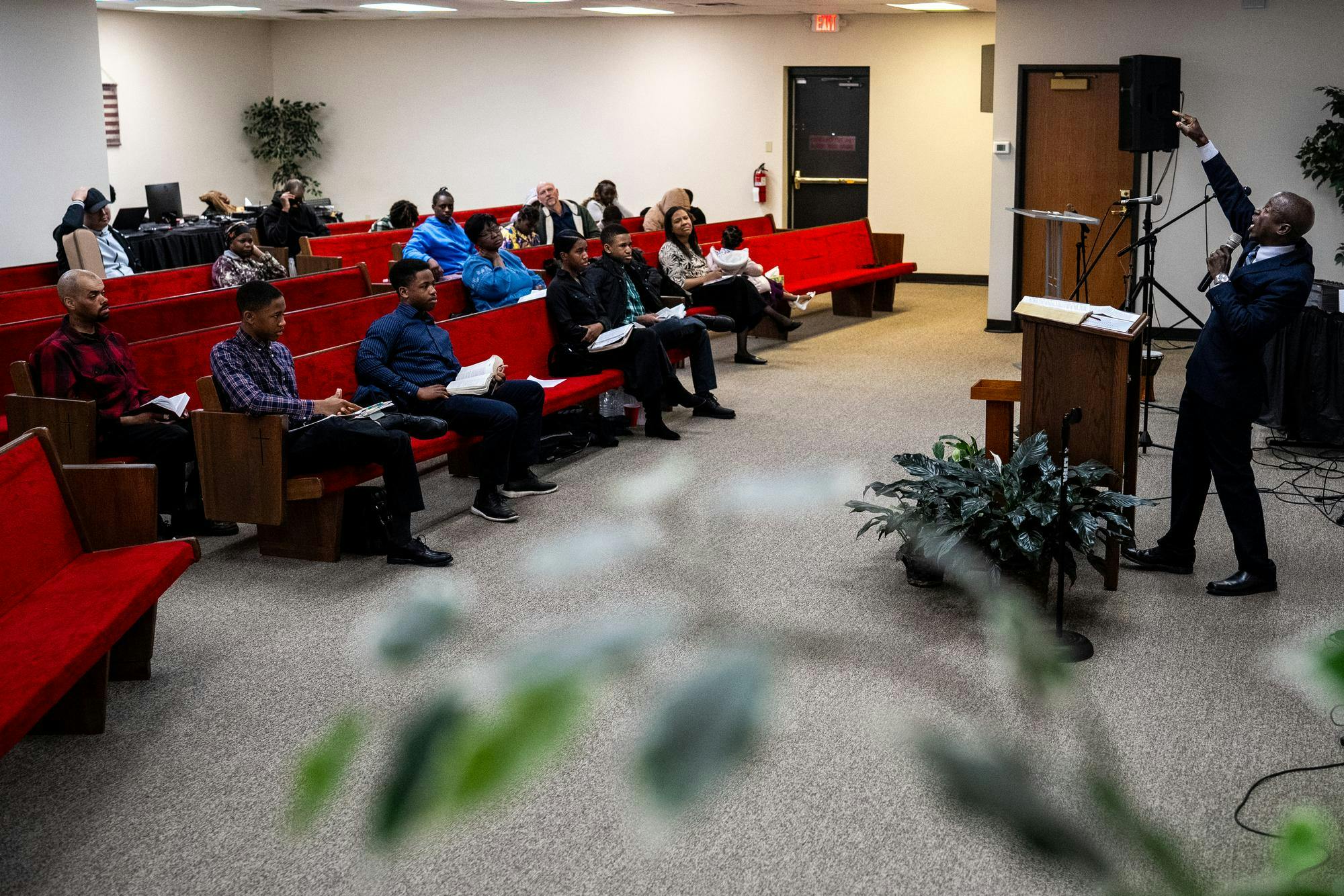
Midway through, Venyah also paused his preaching to bring attention to the tithe envelopes on the back of each pew. He instructed the congregants on how to correctly make out their checks, if they so choose. Then, as his wife collected the offerings, he gave some guidance on the appropriate contribution.
“You say, ‘Pastor, what should we give?’ Well, the Lord says we should give a tenth. In Hebrew, tithe means tenth,” he explained. “We should give a tenth of that which we receive.”
After the service, I talked to Jeffrey Smith, one of two MSU students in attendance that day. Venyah told me he drives them from campus for his service, because they’re underclassmen who don’t have cars.
Smith told me that he first met Venyah behind Wells in September. “Specifically, after Charlie Kirk’s passing,” he said. The news forced him to think more about his faith, seeing the sudden death of someone who “was really devoted to Christ.” After Venyah mentioned the assassination in his campus sermons, Smith decided to go to his church.
The preaching struck him as “very real,” Smith told me. He likes that Venyah’s sermons are “Biblically sound,” adhering closely to the Bible as written, but broken down in analogies and examples students can understand. And, Smith said he appreciates how loud and bold Venyah is; how he never self-censors.
“He does not care what people think,” Smith said. “He just doesn't. He only cares about what the Lord thinks.”
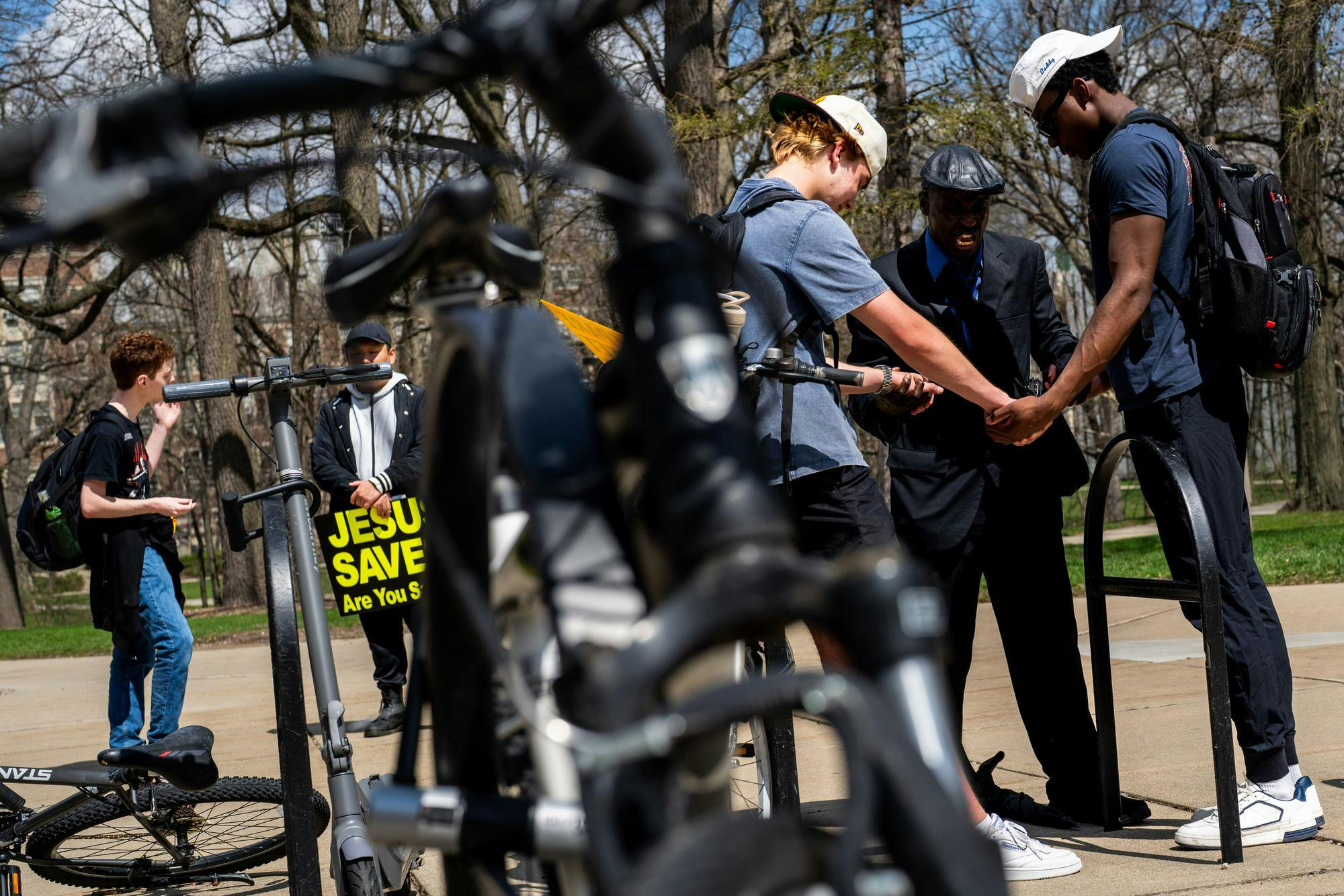
The next time I saw Venyah was the following Monday. I found him behind Wells Hall, deep in conversation with two students.
“No,” he said, pointing to one of the students. “You need to tell those things to those people if you actually love them.”
The conversation appeared quite friendly. Venyah was grinning as widely as I’d ever seen, and the students reclined against the nearby bike rack, laughing and gesturing playfully as they asked Venyah questions.
Before they parted ways, I watched as Venyah and the students held hands, lowering their heads in prayer.
“They weren’t worried for hell, but they saw they deserved it,” Venyah told me just after they left. “But they repented right there, asked Christ to save them, and now they’re born again. So now, physically, they’re young. They’re probably, born again, about 20 minutes old.”
Venyah said the students are “scheduled to come to church on Sunday.” I found them and asked if they were really going to attend.
“Actually yeah,” said one of the students, special education freshman Henry Fluecke. “Lowkey this Sunday.”
‘No control’
The first mention of a “Wells Hall Preacher” in The State News’ digital archive is not an explanation of his theology, or a condemnation of his rhetoric, or advice to ignore him, or praise of his soul-saving guidance.
It’s just a joke.
In a humorous advice piece, a columnist offered facetious tips for Spartan fans dejected by the men’s basketball team’s 2001 loss in the Final Four. Among the proposed methods to ensure a better result next year: “The week before big games, visit the campus of the opposing team and try to get them to break various commandments, thus unleashing God's wrath upon them.”
“Other schools are more susceptible to temptation because they don't have the Wells Hall Preachers to keep them in line like we do,” it read.
In subsequent years, another State News columnist joked that she would “make eye contact” with Venyah if she was “feeling particularly gutsy” and wanted “a dozen or so problems relating to my heathen past of sin.” Another used him as a retort to an angry letter to the editor: “With such words, what makes you any better than our beloved Wells Hall Preacher?”
In 2013, the persistent preaching was included in State News’ humorous “15 things you won’t miss about MSU” list. In 2022, his likeness was co-opted by a since-deleted account on X that satirized campus life. In 2020, a new student took to MSU’s subreddit to ask “What’s with the weird ass man standing outside of wells hall telling everyone they’re going to hell?”
“Welcome to campus,” reads the top response.
“NPC of the new player’s spawn village,” says another.
Such is perhaps the most widely-shared conception of Venyah at MSU today: not an enemy to fight, nor a thought-leader to respect, but an oddball to laugh at.
That irreverence was on full display as I observed Venyah’s recent sermons. Most students passed by without so much as looking up from their phones. A few offered glances that ranged from blank to mildly disapproving. (The so-called Gen Z stare, perhaps?) Those that did chirp back did not offer genuine disagreement. They were sardonic.
“That’s just a book, man!” yelled one student, as Venyah pointed to his Bible and explained various sins. After Venyah told another that he’d be going to hell, the student replied: “That’s fine, I’ll go to hell. It’s chill.”
Some offered support, but seemingly only in jest. After passing Venyah, one student smirked and told his companion, “I said ‘God bless’ and then he said ‘God bless’ back.”
“That’s so funny,” his companion replied.
It’s an awkward question, but I had to ask Venyah: do you know you’re sometimes a big joke?
He wasn’t fazed by it. After thinking for a moment, Venyah told me that, maybe he was often being razzed by the passing students. But he didn’t care.
Street preachers have always been made fun of, and young people especially are prone to peer pressure and group mockery, Venyah told me. Even if his message truly resonated with a student, Venyah said he suspects they may be embarrassed to admit it to their friends.
“I have no control over people’s response,” Venyah said. He also has no idea what his real success rate is.
Other proselytizers who frequent the Wells courtyard told me they have tactics for this. Political science freshman Anderson Metcalf, who stood in front of an anti-abortion sign featuring gruesome photos of an aborted fetus on a recent afternoon, told me he “averages about 1-5 mind-changes per day.” His group, Protect Life Michigan, measures them with an exit survey, he said.
Venyah has no such method, though he told me he doesn’t mind the uncertainty. His son smiled and nodded along as he told me they call their work “spiritual fishing” or “farming.” They can go behind Wells and plant seeds in young minds, but they’ll never be able to control how or if they grow and blossom; what matters is that they’re planting them in the first place.
It’s not a new refrain for Venyah.
I found a nearly 20-year-old story in the archives of the University of Michigan’s student newspaper where Venyah was asked how he felt about a day of preaching.
The day in question couldn't be more different than his recent outings. His afternoon sermon in Ann Arbor was met with mass protests; the ones I watched were met with mass apathy.
Still, he said just about the same thing then that he says today: he had a 100% success rate, because “everyone that is here today now knows they are living in sin.”
Of course, he also vowed to return.
“Because you are all so ignorant and hell-bound,” he said, “we have no choice but to come back tomorrow.”