Academic governance is what keeps every voice on campus heard, these committee members say.
They just wish that the student body felt the same way.
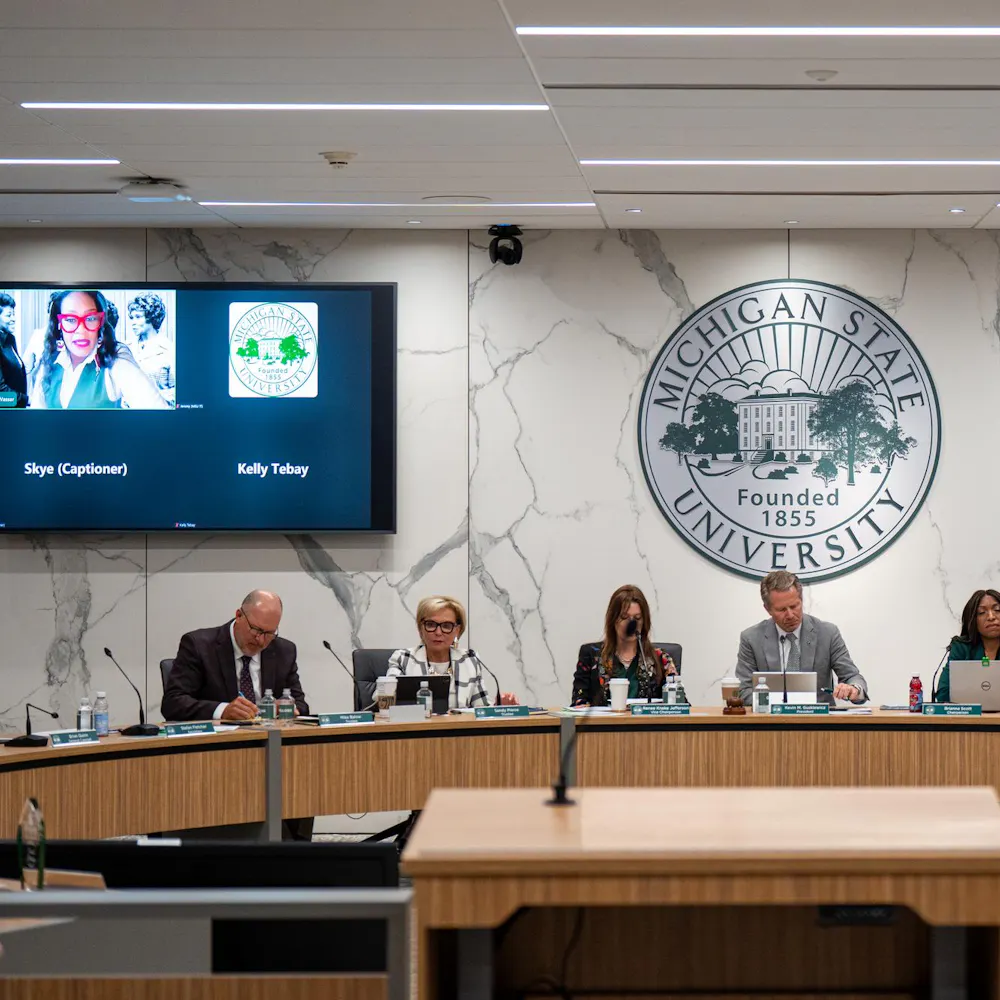
Student representation in academic governance is at a low this year, with nearly half of the seats reserved for undergraduates on MSU committees empty. Graduate students see similar numbers. The result, student leaders and faculty members say, is that student voices aren’t being heard. In one case, student vacancies have rendered a hearing board defunct, forcing another committee to take up its work.
Meanwhile, student leaders, faculty members and administrators struggle to understand the problem: are university committees too time-consuming? Too bureaucratic? Too boring? Do students even know they exist?
“What can we do to make it more appealing to you?” asked Elizabeth Gardner, chair of the University Committee on Academic Governance. “What can we do to welcome you, welcome your input on these committees? What can faculty do in that space? Because we clearly need you. So, what can we do?”
Faculty members like Gardner urge students to bring concerns to university committees — a pitch that's currently being put to the test as MSU leaders work to establish the Advisory Committee for Responsible Investing, created in response to months of at-times-disruptive student activism calling for the university to divest from Israeli bonds.
But some protesters are already skeptical. In their eyes, the university is attempting to quell protest and channel concerns into a body that is too rigid and bureaucratic to create meaningful change. (MSU has said it does not actively have money going towards Israel, and that pulling out from specific investments is unfeasible.)
While most university committees deal with issues that aren’t as “politically charged” as what’s usually brought up during the public comment section of MSU board meetings, Gardner said, there’s still something to be said for voicing their frustrations at a more local level, she said.
“Sometimes, it's a lot easier to start here than start up there,” Gardner said.
The vacancies
ASMSU, the undergraduate student government, has approximately 60 total seats to fill across all major university committees, according to sophomore Tony Pham, vice president of ASMSU’s Department of Academic Governance. So far, only 33 of those seats have been filled.
The biggest vacancies are on the University Council, the governance body that handles matters affecting the entire university. So far, only 12 of the 42 spots for undergraduate students are filled.
Students are missing from several smaller committees where student input is, in theory, key. Three of the five allotted undergrad seats on the University Committee on Curriculum are empty, as are three of four seats on the University Committee on Undergraduate Education.
There’s also at least one student missing from each of the following: the University Committee on Honors Programs, the University Committee on International Studies and Programs, the University Committee on the Libraries, the Athletic Council and the University Committee on Faculty Tenure.
Similarly, only 36 of the 55 total seats allotted to graduate students across major university committees were filled as of September 2025, according to doctoral student Nicholas Heilman, Vice President of Internal Affairs for the Council of Graduate Students. Heilman did not respond to requests for more recent data or a breakdown of which committees the vacancies were in.
But nowhere are student vacancies more glaring than MSU’s hearing boards, where students accused of violating certain non-academic university policies go to plead their case in front of a jury of their peers.
There are 28 spots for undergraduate and graduate students across the four hearing boards. Only 11 have been filled.
One of them, the Residence Hall Association Hearing Board, which oversees minor campus housing violations, is completely empty. None of the six undergrad spots that make up the board have been filled. Matters that would go to the board are instead heard by the All-Student University Hearing Board or the Student Faculty Staff Hearing Board, according to MSU Spokesperson Amber McCann.
Support student media!
Please consider donating to The State News and help fund the future of journalism.
The consequences
The vacancies mean that the perspective of the university’s largest constituent can be left out of important conversations. It’s an issue that comes up “constantly,” said Stacia Moroski-Rigney, the Assistant Provost in the Office of Accreditation, Assessment, Curriculum, and Compliance and an ex-officio member of the University Curriculum Committee.
“It's wonderful when we can have a student say, you know, ‘I don't understand this part of this course description,’ or, ‘I feel like if you worded it up this way, it would be more helpful for students to understand what really is meant to happen there,’” said Moroski-Rigney, who is also an ex-officio member of the University Committee for Academic Governance. “Anytime there's a student vacancy on a committee, it does have an impact.”
When students do engage, faculty learn a lot, Gardner said. Recently, she said, ASMSU presented a resolution to the University Council that called for faculty to release class syllabi. Many faculty hadn’t realized it was a concern, she said.
“We need to consider the students,” Gardner said. “But we can't consider the students if they don't engage.”
Getting students to join
The biggest challenge, several people told The State News, is making students aware that opportunities on university committees are out there.
The average MSU student doesn't know that hearing boards exist “until they are accused of violating the conduct rules and have to show up to one,” said Aarya Mohey, who is on the Student Appeals Board.
In fact, Mohey didn’t know about student opportunities in academic governance until an alumnus happened to mention his time on a hearing board.
To him, academic governance is a unique way to get involved in the university and work on his public speaking and decision-making skills. When they get a case, he spends about half an hour reading it and an hour discussing it with the board.
But time commitments for students on university committees vary widely, Moroski-Rigney said. Students can expect to spend up to 15 hours a month on the University Curriculum Committee, while other committees might require far fewer.
Another barrier to entry is that committees are “very bureaucratic,” Moroski-Rigney said. It's hard for anyone to drop in and understand everything “without meaningful mentorship and onboarding.”
To promote academic governance, Moroski-Rigney said committees try their best to orient new members. Leaders in the university and student groups are also working to better promote the openings.
"The university is actively considering ways to increase awareness of the boards and existing openings to help generate interest and applications from the MSU community,” McCann, the spokesperson, said.
The Residence Halls Association has had “one of the most active and involved sessions in years," thanks to a concerted effort to market opportunities to get involved in the organization and the university, says Mikia Lawrence. Alongside strong participation in hall governments, all but one of its allotted student seats on university committees have been filled. (That’s with the except of the vacant RHA Hearing Board, now considered inactive, whose membership is also coordinated by the Office of Student Support and Accountability.)
Pham, the vice president of ASMSU's Department of Academic Governance, said he’s committed to “revitalizing the department and restoring it to its former strength.” His office is focusing on expanding outreach, improving the application process and improving onboarding for student appointees.
Applying to serve on a hearing board starts with filling out a short form, as does applying for seats on university committees through ASMSU.
Discussion
Share and discuss “MSU committees are an effective way to get your voice heard, members say. So why aren’t students joining?” on social media.