Thousands of hours of footage all gather dust, except in the fond but distant memories of 144 contestants and production members who have participated in MSU Survivor over its eight seasons and four years.
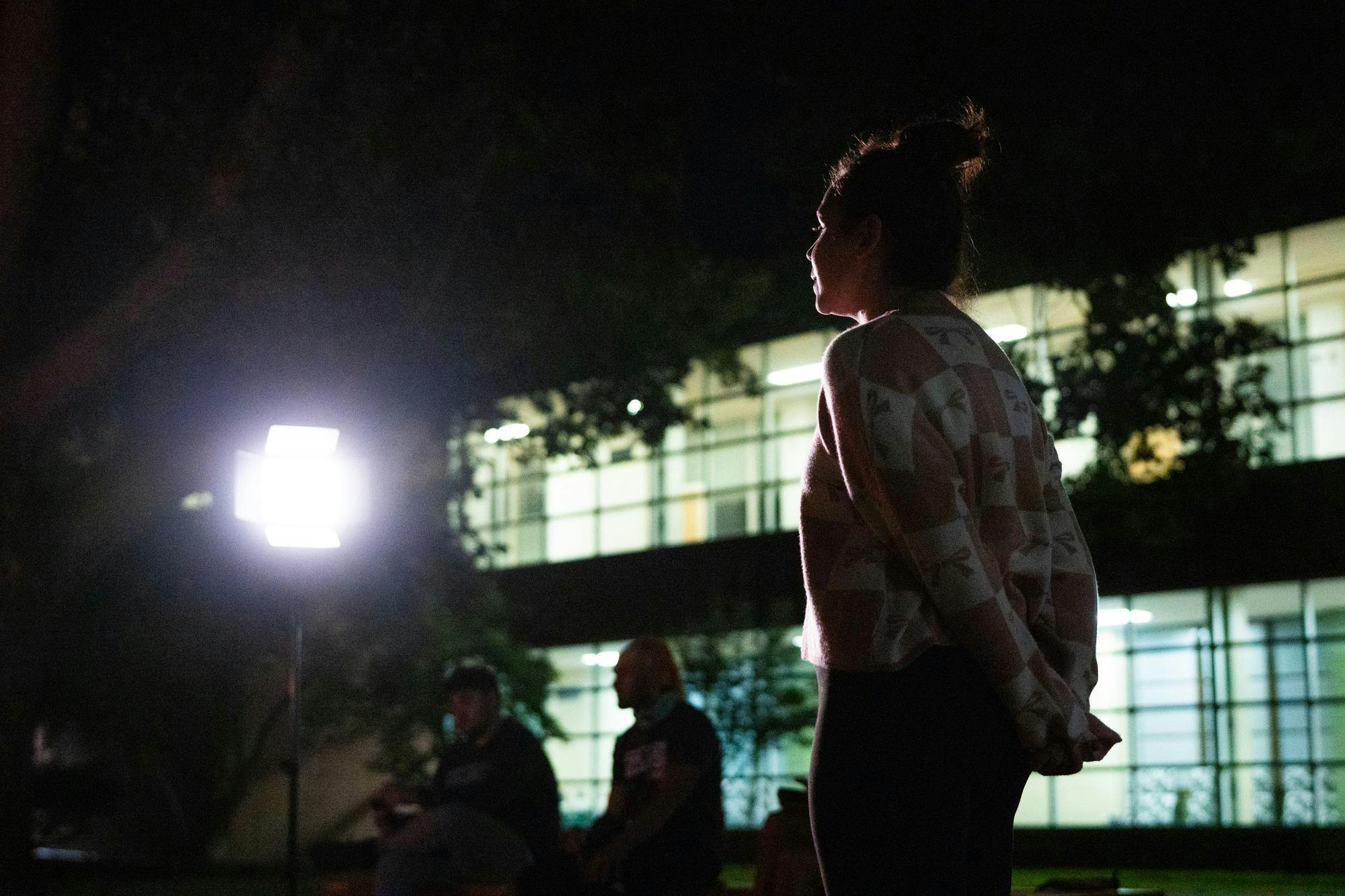
Modeled after the long-running CBS reality competition show “Survivor,” the student-run club transforms MSU’s campus into its own strategic battleground, recreating the experience of their favorite show for themselves. Over the course of a semester, 18 students with diverse academic backgrounds compete in challenges, form alliances and vote one another out while a production team of peers captures the story as it unfolds.
Torin Caplan, a 2024 digital storytelling alumnus, was a contestant in season two and helped with production thereafter. He ended up winning the season, which makes him one of seven MSU Survivor champions thus far.
“I would be very disappointed if it never comes out, but maybe one day. There are highs and lows for every single player that are just stored on a hard drive right now,” Caplan said. “The general sentiment of everyone who played my season, who played the season before, they all just really want it to come out because it’s such a cool journey they could share with their friends and family.”
Caplan emphasized how unique the experience was, noting that few people ever have their interactions filmed for months on end. At one point, contestants even climbed and clung to the top of campus pillars for eight hours straight in the name of competition.
On top of hours of footage from regular filming, there are hours of “confessionals” footage, where each player films themselves on their phone alone, telling their true thoughts about situations, strategies for the game and sharing extra information to help the story grow.
Michael Wilson, a 2023 digital storytelling alumnus and former executive producer of season one, recently revisited the old footage and found himself drawn to a scene featuring his friend. Watching it back now, the words carry a weight they didn’t have before.
“I was just talking to Francisco a few days ago about some real-life stuff. And I'm pulling up quotes from his video and just re-quoting it to him. It had a big impact on him,” Wilson said. “It kind of helped him through a certain situation. So, it's really cool to have been part of that.”
Wilson released shortened episodes from the first season of MSU Survivor on YouTube in Nov. 2025. After months of freelancing after graduation, he didn’t get the results he hoped for and wanted to use the footage to practice his craft and bolster his portfolio.
“I fell into this depressive state, and I started going through this old footage, and it kind of brought me some joy,” Wilson said. “I made those 18 kids a promise that we would film this and publish it like a real show, so I wanted to follow through on that promise.”
While the founders of MSU Survivor had dreamt of a higher production level, for the past two years, the e-board of the club hasn’t had film expertise. They’ve tried to pick up the missing pieces by shooting on phones and simplifying production.
Kristian Chorkey, an actuarial science and statistics junior, former e-board member, and current president of the club, has taken it upon himself to learn the technicalities of editing since losing strong ties with the film department after season three.
Chorkey said he tries to at least release sections of new episodes for participants to view in their club’s Discord server. However, with roughly two terabytes of footage in just one season, editing full episodes is a tall task, especially for one person alone.
Journalism freshman Hannah Foster wanted to help with production, but didn’t know if they needed more crew, so she asked someone she knew was involved, who told her they "desperately need an editor" and "nothing happens with the footage."
Foster plans to edit footage starting from season five, because it's the oldest season with the most readily available footage, and move to the current season once the semester is over. Kristian is giving her full creative liberty and as much time as she needs to edit the project.
“They’re not really looking for filmmakers,” Foster said. “I was expecting them to have professional equipment and editors. I'm probably gonna have to teach myself a lot of stuff.”
Though Foster considered stepping in with her own camera equipment, she hesitated, concerned that the responsibility might leave her carrying production alone.
Since it started, MSU Survivor has run its game development smoothly, while its production efforts have lacked the same level of structure and consistency. Some attribute this to poorly organized production roles, low student motivation, a lack of advertising, or simply the challenge of producing a show like Survivor being too great for students.
Digital storytelling senior Colton Bennett was a contestant on season seven and a long-time member of the club, and while he highlighted his love for the experience, Bennett admitted that the reason production hasn’t reached its full potential is because of how it's been organized since its inception.
“The through line of any new member who joins this club is picking up the pieces of the people who came before, because we can only do so much with the kind of bad start we had,” Bennett said.
Support student media!
Please consider donating to The State News and help fund the future of journalism.
From the beginning, production has operated on the assumption that students would gravitate to an open-format project. Without a clear structure, the workload consistently fell to a few individuals each semester, leaving all members feeling the strain of that imbalance.
Originally, MSU Survivor was pitched to Telecasters, who said it was too much to take on. Some have suggested it be pitched as a class where students could edit Survivor footage, or that a faculty member sponsor the club to answer film-related questions and help fill skill gaps.
“If they keep up what they’re doing, the production side might even die out within a couple years,” Foster said. “If I keep pushing and we actually succeed in getting more people to help on the film side, it could definitely be good.”
With steady leadership at the helm, the show’s future depends not just on survival, but on collaboration. If students contribute their vision, time and trust, the club will evolve.
“It is one of the few opportunities that student filmmakers have to record something live consistently. In classes, you get very limited opportunities to record things live and have that experience,” Bennett said. “Even if you're just holding a cell phone, you still develop those basic instincts.”
Wilson carries the season one footage drive with him at all times for safekeeping, with the intent to edit the remaining episodes in his spare time.
“I have big dreams for this club,” Wilson said. “The worst thing that can happen is this gets locked away, and people put their time and effort into something that never gets seen at all.”
Discussion
Share and discuss “The lost episodes of MSU Survivor” on social media.