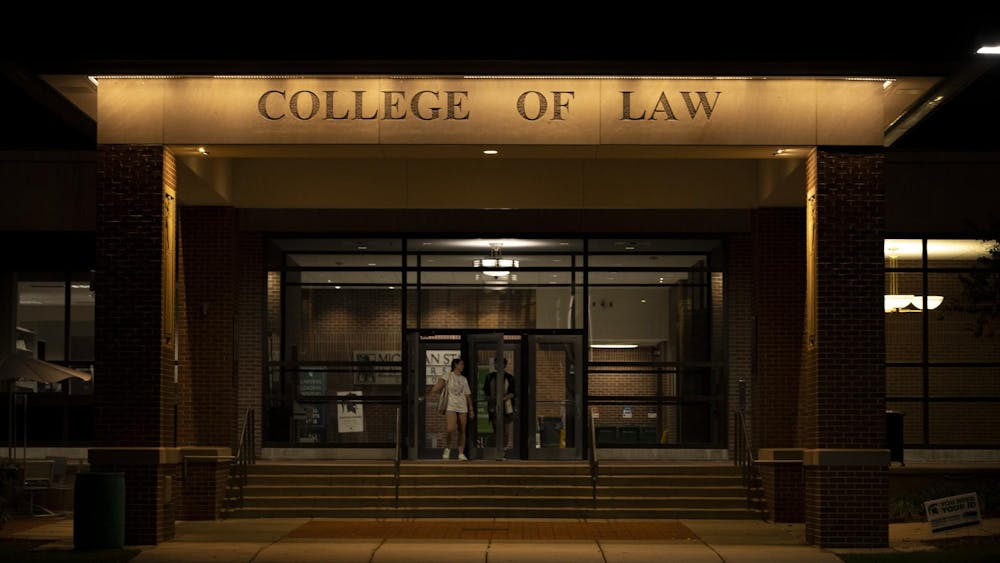
For more than 15 years, the Immigration Law Clinic at Michigan State University has served community members, students and faculty, advocating for vulnerable immigrant populations, abused, abandoned and neglected children, crime and trafficking victims and people fleeing persecution. Students who participate in the clinic practice complex, high-stakes fields of immigration law while representing real clients.
Co-founded by law professors David and Veronica Thronson in 2010, the clinic is an academic program that second- and third-year College of Law students apply to join, receiving six academic credits for their work.
"When they are enrolled in the clinic, we take cases from the community, and those cases, those clients are basically the textbook," Veronica Thronson said. "The students do everything that an attorney will do, and I supervise them with all the work. When we take clients from the community, clients have to agree that a law student is going to be working on their cases, supervised by an attorney."
Unlike private law firms, the clinic does not charge for its services, allowing attorneys and students to focus entirely on the quality of representation rather than speed or profit.
"There's no profit motive to do this fast and cut corners," David Thronson said. "We're going to do it right and do the best representation that's possible. Students really get to learn what that looks like."
But over the last decade and a half, the clinic has operated amid heightened fear and confusion surrounding immigration enforcement and federal policy changes, including travel bans implemented during both the first and current Trump administrations. Those policies have directly affected some MSU international students, faculty and community members served by the clinic.
"Immigration law has never been easy, regardless of who is in power," Veronica Thronson said. "One of the things that is very hard for the students to understand is the level of cruelty that we have in this new administration."
She said one of the most difficult lessons for students is realizing how complex and constantly changing immigration law is, making it challenging even for experienced attorneys to navigate.
David Thronson added that while classroom instruction provides a broad overview of immigration law, clinic work exposes students to how interconnected and complicated legal provisions become in real cases.
He also underscored the severity of the cases handled by the clinic, noting that many involve life-or-death consequences.
"That's hard, obviously for the clients who are the ones on the line, but also hard for students and attorneys who are working, having them feeling that pressure of what happens as they move," he said. "The clinic's a chance for students to do that in a unique setting where they've got an expert supervising them. They get to be the lawyer."
He pointed out that immigration enforcement has looked different under different administrations, including under former President Barack Obama.
"In some ways, the haphazard enforcement across the board that we saw under the first Trump administration and we see now means that some of the cases they're bringing forward are weaker," he said. "President Obama still holds the record for deporting the most people. He was very efficient at doing it — and they chose cases and went after people who had no defense, who had just arrived or had serious criminal records. That made the actual case very hard to defend because they were picking people who were, under our law, removable from the United States."
David Thronson said current enforcement is more random, meaning many people being detained have lived in the U.S. for years, have no criminal records and possess strong community ties.
"Almost all the people being arrested, despite any rhetoric you hear on the news, do not have criminal records," he said. "It's a minuscule percentage that are charged as criminals with being removable. They have defenses, they've been here long enough and have equities and ties. That actually means that their cases can prevail."
Veronica Thronson said the current travel ban has significantly affected many of the clinic’s clients, citing Afghan families whose approved petitions cannot be completed because of the closure of the American embassy in Kabul and travel restrictions.
"We also have students who are of immigrant families whose families are affected," she said. "We have a couple of students who are not able to travel because they are concerned that the government is not going to let them back in."
As part of the course, students are expected to complete approximately 20 hours of work per week. When emergencies arise, Veronica and David Thronson take on additional cases themselves.
With concerns over Immigration and Customs Enforcement appearing on campus or in East Lansing over the past year, David Thronson said MSU leadership has taken steps to support international students and faculty and has joined national advocacy efforts aimed at protecting international education.
"Some of what we see that's hard about what's happening now is that the government is taking a lot of people who had lawful status and saying, 'We're going to end it just abruptly,'" he said.
Support student media! Please consider donating to The State News and help fund the future of journalism.
He said the clinic provides "red cards," commonly used in immigration rights trainings. It is provided in several languages to educate people on their legal rights on when they're approached by an immigration officer.
Explaining that East Lansing identifies as a sanctuary city, he emphasized that the designation does not allow local governments or universities to block federal enforcement.
"Among the things we say, is that the university and the town of East Lansing — which has designated itself a sanctuary — cannot stop federal law enforcement," he said. "They don't attempt to. They simply say sanctuary means we are not going to go out of our way to use our own resources to help you enforce a law that's your responsibility. That's all they can say."
University faculty and staff are also not personally responsible for complying with demands for information, he said.
"One of the things we tell people on campus who are worried not about themselves, but others or records they hold, is that they're not authorized to make that choice," he said. "They can go to the general counsel's office. They can call us. They can call their supervisors."
He added that individuals should remain calm and respond lawfully if approached by immigration officers, stressing that panic can worsen already stressful situations.
He also criticized the public discourse surrounding immigration, noting that debates are often uninformed.
"It’s the least informed debate we have going on in this nation," he said. "We have an obligation to learn that this is important. It changes lives, it changes communities."
Veronica Thronson echoed that responsibility, emphasizing the clinic’s educational mission that have existed since its founding.
"You learn by doing," she said. "If someone is saying something that is not true, you have that responsibility to correct them and say, 'No, that is not how immigration law works.' I really hope that that is what we are doing as part of the teaching here at the law school and in the clinic."