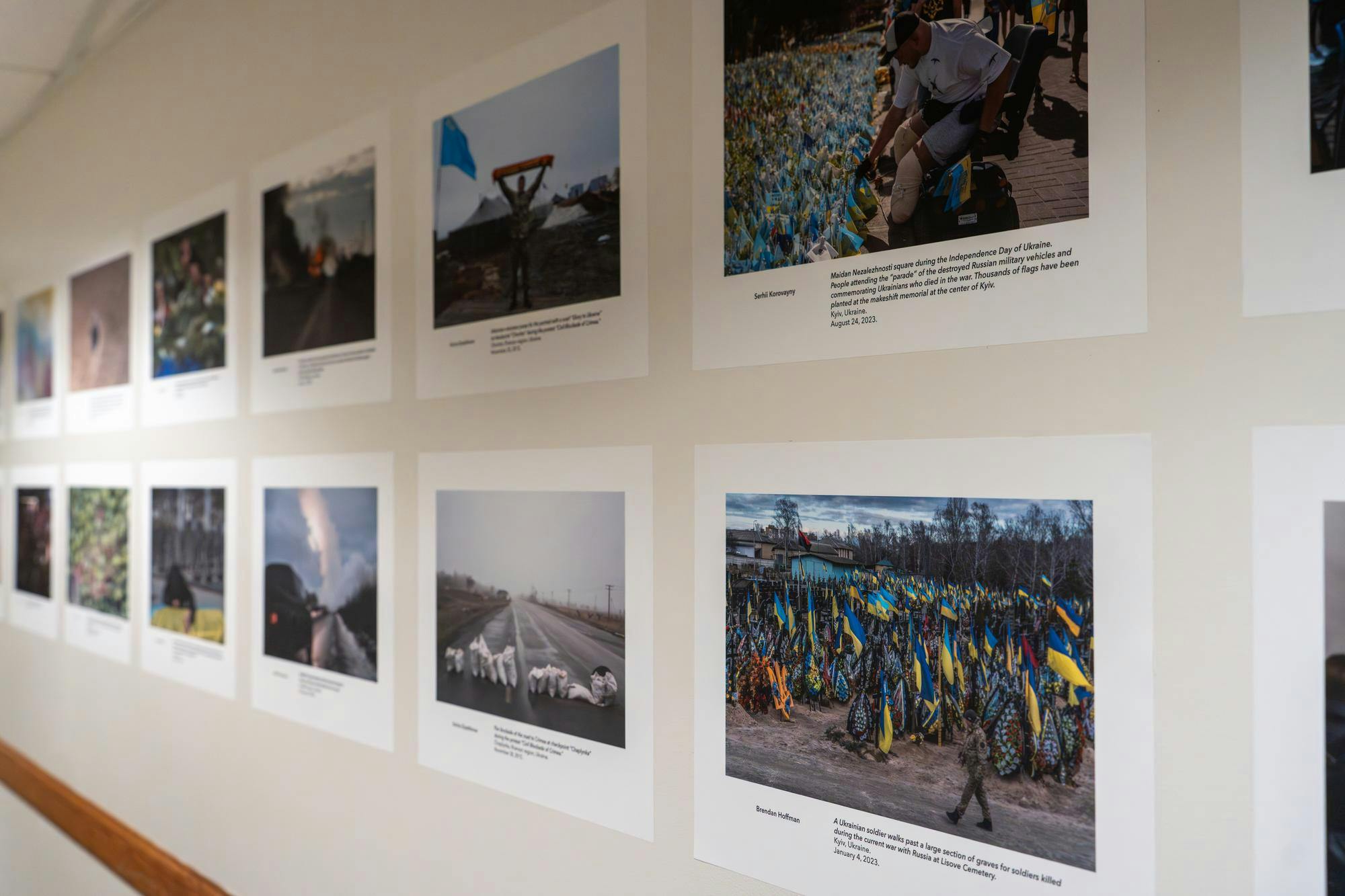
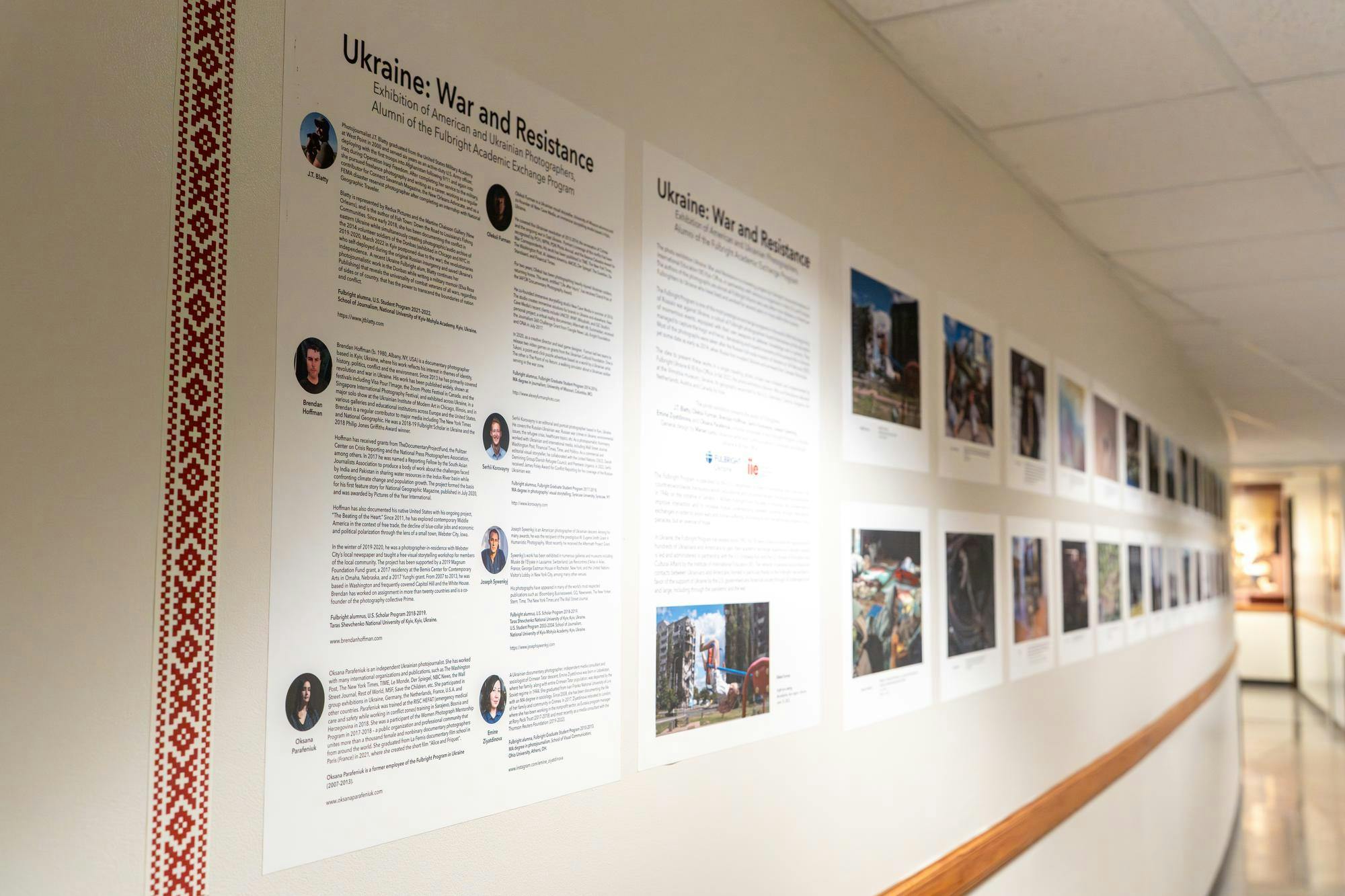
Photographs at the "Ukraine: War and Resistance" photo exhibition inside MSU's Snyder Hall in East Lansing, Michigan, on Tuesday, Feb. 24, 2026.
In a world so easily dominated by the constant onslaught of new media and events, it can be hard to maintain focus on long-term events as they get swept under the rug to make way for the new thing. Michigan State University graduate student and Fulbright scholar Anna Smolko uses photography to show the events happening in her home of Kyiv, Ukraine, not allowing the issue to be swept under the rug.
"I was living in Kyiv when the full-scale invasion of Russia began. After coming to the U.S., I felt a strong responsibility to continue raising awareness about the war," Smolko said. "I regularly give talks in the East Lansing community about Ukraine and participated in the Global Festival. Last year, in the same space, I organized the exhibition Unissued Diplomas, which honored Ukrainian students who were killed by Russia’s invasion."
The photos were taken by American and Ukrainian Fulbright scholars and show the war, as well as resilience, dignity and resistance seen in Ukrainian communities. The more awful realities of war were not only captured but also the resistance Ukrainian communities put forth for themselves and the public to show it would take more than an invasion to defeat them. This resistance is one wing, while the other holds nobility as well as resilience. The photographs are a form of art, showing these three traits in the communities.
There were also speakers, but they weren’t guest speakers in the traditional sense. Smolko spoke briefly about who would give statements to accompany the opening of the exhibit.
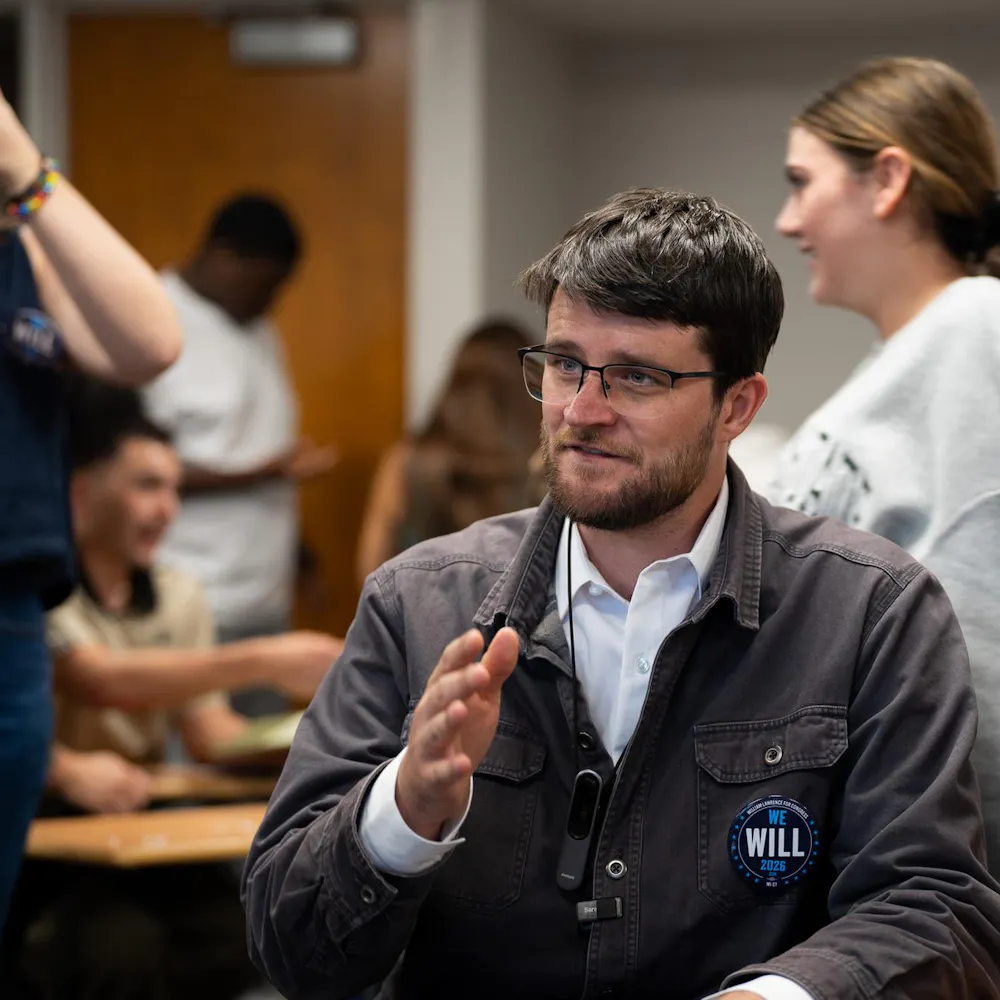
Associate history professor Matthew Pauly and Fulbright alumni were introduced to the audience by Smolko to speak on "the central issues of this war and its broader significance." Director of the Center for European and Eurasian studies Volodymyr Tarabara also spoke as a supporter of the exhibit.
"The genesis of this exhibit lies with the amazing Fulbright staff in Kyiv who compiled these pictures, is my understanding — the pictures of alumni of the Fulbright Program, Americans and Ukrainians who have most received Fulbright — who have all received Fulbright fellowships. It is a community of sorts — you never cease to be a Fulbrighter, and being a Fulbrighter from America to Ukraine is a special thing. Part of this community includes Ukrainians who come to the United States, and so I think this is an amazing thing. I would say, without a doubt, a thousand times over, continue supporting Ukraine — I would say continue supporting public diplomacy," Pauly said.
The exhibit opened on Feb. 24, which was not a randomly chosen date.
"I reached out and worked with MSU’s Center for European and Eurasian Studies and the Graduate School Office of Wellbeing to bring it here. It was important for me to open it on February 24 to commemorate the fourth year of Russia’s unjustified invasion of Ukraine, which is still ongoing," Smolko said.
The names of the Fulbright alumni photographers were listed outside, on the last of several posters in a row on the wall of the exhibit.
"What makes it unique is that these are scholars who found themselves witnessing and recording history in real time. We also included a VR component, 'War Up Close,' which allows visitors at the opening to immerse themselves in 360° documentation of war-affected areas."
Providing access to photos taken by recipients of Fulbright grants and a VR immersion allows visitors to see the Russia-Ukraine conflict in a way they would not otherwise be able to.
"The exhibition shows different sides of the war: soldiers killed, wounded and alive; grieving families; destroyed cities; but also resilience, love and everyday life continuing despite everything," Smolko said.
"The photos that are out there in the hallway better show just the incredible destruction that has happened since. I wasn't in Ukraine when the full-scale invasion began — I had a graduate student there, a graduate student who continues to write on Ukrainian history and has published on Ukraine and Ukrainian history," Pauly said. "He was evacuated because he was a Fulbrighter, like all of us, doing work at Ukrainian archives up until right before the whole escalation."
For students who are interesting in learning more about the event, Tarabara provided resources.
"MSU Center for European and Eurasian Studies (CEES) is supporting the event," Tarabara said. "You can find additional information on CEES-coordinated prior events related to Russia's war in Ukraine."
Support student media!
Please consider donating to The State News and help fund the future of journalism.