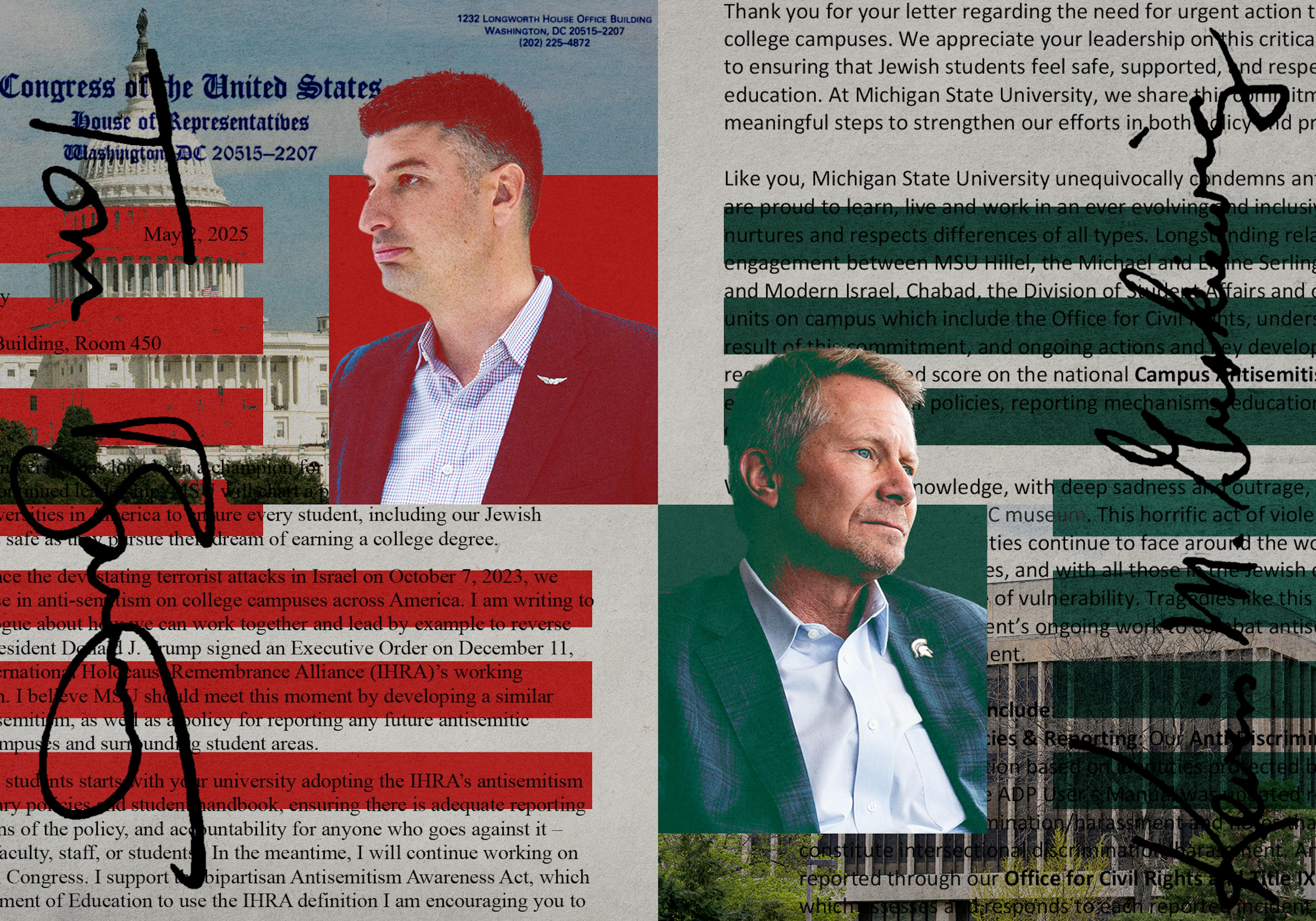
A Republican congressman is asking Michigan State University to adopt a contentious definition of antisemitism.
In a May letter obtained by The State News through a public records request, Rep. Tom Barrett — whose district includes MSU’s East Lansing campus — urged President Kevin Guskiewicz to formally incorporate the International Holocaust Remembrance Alliance’s "working definition of antisemitism."
The group’s guidance is known for parsing ways in which criticisms of Israel can be considered discriminatory against Jews. That distinction has become salient in MSU campus politics recently, with the student government’s calling on the university earlier this semester to cancel a lecture from an Israeli scholar on the nation’s modern theater landscape.
On the one hand, MSU has reason to be amenable to Barrett: the leader of his party, President Donald Trump, has used a perceived tolerance of campus antisemitism as a justification to slash federal funding to universities. Though MSU has largely stayed above the fray in that regard, running afoul of Barrett could make MSU’s standing with the federal government more precarious.
At the same time, heeding his request could spark backlash. Critics of the IHRA’s definition claim it can be used to suppress legitimate criticisms of Israel, and in so doing, chill free speech.
In an interview, Guskiewicz said a team of administrators tasked with guaranteeing inclusion and civil rights protections for students is weighing Barrett’s request. As it does so, he argued that MSU is doing its part to make the campus safe for Jewish students, while noting, "We can always get better."
‘An important topic’
Given the discord between the academy and the conservative movement, the letter from Barrett — a Trump-aligned Republican who flipped a key Michigan congressional district red in last year’s election — is remarkable for its generally friendly tenor.
Barrett begins by noting that MSU "has long been a champion for the rights of all students," and concludes by thanking Guskiewicz "for all you and MSU do to make the world a better place."
But it also contains an ask: amid "rising antisemitism" on college campuses since militant group Hamas’ Oct. 7, 2023, attack on Israel, Barrett wanted MSU to "meet this moment" by adopting the International Holocaust Remembrance Alliance’s definition of antisemitism.
That group’s conception of discrimination against Jews has split opinions, mainly for its guidance on when criticisms of the state of Israel constitute antisemitism. Critics argue that institutions incorporating the IHRA’s definition could use it to suppress legitimate criticisms of the Middle Eastern country.
On its website, the IHRA says criticisms of Israel that treat the country as a "Jewish collectivity" can constitute antisemitism. However, it stipulates that "criticism of Israel similar to that leveled against any other country cannot be regarded as antisemitism." The guidance also includes examples of statements that ostensibly criticize Israel, but could be considered antisemitic.
Among those examples are "Accusing Jewish citizens of being more loyal to Israel, or to the alleged priorities of Jews worldwide, than to the interests of their own nations;" "Applying double standards by requiring of it a behavior not expected or demanded of any other democratic nation;" and, "Drawing comparisons of contemporary Israeli policy to that of the Nazis."
Columbia University, as part of a deal it struck with the Trump Administration to have its research funding restored, agreed, among other things, to formally incorporate the IHRA’s definition into its policies. Harvard University also adopted the definition as part of a settlement of claims that the school had allowed antisemitism to go unchecked on campus.
Barrett also noted in his letter to MSU that Trump signed an executive order in 2019 aimed at "embracing" the IHRA’s definition, and that he personally supports pending legislation that would require the U.S. Department of Education to use it.
In a lengthy response to Barrett, which was shared with The State News by an MSU spokesperson, Guskiewicz made a non-committal acknowledgement of the congressman’s request.
"We also recognize the growing national conversation around adopting the IHRA working definition of antisemitism, as referenced in your letter and in the proposed Antisemitism Awareness Act now before Congress," he wrote. "MSU currently addresses antisemitism under our comprehensive civil rights and anti-discrimination frameworks. We are also actively evaluating additional mechanisms for further establishing and elevating a definition of antisemitism, including components of the IHRA definition, to better educate and inform our campus about this important topic."
In an interview earlier this month, Guskiewicz said a "team" of administrators had specifically discussed the component of the IHRA’s definition that addresses criticisms of Israel.
"That’s one of the challenges that many folks have with that definition is around the difference between anti-Zionism and antisemitism," he said.
Guskiewicz added that "while we've not formally adopted that definition, we have put in place a lot of educational materials and messaging around this that I feel good about, and I’ve heard that from others, that they’re pleased with the direction we’re heading."
Support student media! Please consider donating to The State News and help fund the future of journalism.
Asked for clarification on the team Guskiewicz spoke of, spokesperson Amber McCann said it's not a recently formed group, but rather the "ongoing collaborative efforts of multiple units at the university whose primary roles and shared responsibilities include inclusion, community support and safety, student wellbeing, and ensuring robust civil rights protections."
The group has no set meeting schedule, she added, because the work is related to relevant administrators' day-to-day work.
McCann also gave a list of "examples of some of the work produced from ongoing efforts at MSU." Among them is an infographic that stipulates the differences between protected campus speech and "potential discriminatory harassment" that could necessitate disciplinary action, as well as how to report it to the university; she also pointed to an optional online asynchronous training course for new students and faculty called "MSU Foundations: Our Spartan Community," which aims to "foster a sense of belonging," according to its website, and includes a module titled "Spartan Identities: Different Together."
One example McCann cited demonstrates the trickiness for MSU in publicly discussing antisemitism as Barrett pushes it to incorporate IHRA's definition. Included in her list was MSU's "Conversations on Antisemitism and Islamophobia" series. Though an installment of the series last month was open to students, the university blocked a student journalist at The State News from attending and covering it, citing its "Campus Media Guidelines" and refusing to provide the location of the event.
‘Related but not the same’
Jewish Student Union Vice President of External Affairs Tyler Pohl said the line between what’s antisemitic and what’s a legitimate criticism of Israel can be elusive, but with a caveat.
"I think it’s a really blurred line and I think it gets crossed very quickly," he said.
It’s a question that’s recently come to the forefront of campus discourse.
In September, the Associated Students of MSU voted to urge MSU to cancel a scheduled lecture on modern Israeli theater in part because the speaker once served in the nation’s defense forces (Conscription is required of most Jewish Israelis over the age of 18). The measure passed with 14 votes in support, five abstentions, and one vote against — from the Jewish Student Union’s representative.
Proponents of the resolution framed it as a way to protect Palestinian and Arab students from being retraumatized, and keep MSU at a distance from a country they accuse of committing genocide. Critics, though, said writing off a whole group of people because of the actions of their government is simply antisemitic.
Pohl falls in the latter camp. Still, he said he’d want any new definition of antisemitism at MSU to allow space for criticism of Israel.
"It’s a difficult question, because they’re related, but they’re not the same," he said. "I think the main focus on an antisemitism definition should be a definition of antisemitism, and then maybe at the end a footnote about how anti-Zionism plays a part in antisemitic rhetoric."
Trustee Mike Balow said he’s not sure exactly what the correct definition of antisemitism should be, but believes MSU "can find one that generally works for our students." Such a definition, he said, should allow for legitimate criticisms of any country, including Israel, while separating "what would be considered antisemitism."
Broadly, Balow said MSU is doing its part to make campus comfortable and safe for students of various identities, but thinks "we probably need to look at doing more on campus to prevent what many see as hate speech."
"The impression I get from the Jewish students is that they just kind of don’t say anything: ‘Because of the geopolitical situation, I don’t even want to talk about the fact that I’m Jewish, and keep my head down,'" he said. "And that makes me very sad because I don’t think any student group should feel that way."
Nearly six months after sending his letter, Barrett, for his part, is still waiting on MSU to heed his request.
"I’m grateful for the constructive dialogue I’ve had with Michigan State University’s President Kevin Guskiewicz regarding antisemitism on campus," he said in a statement to The State News. "Of course, there is always more work to do to keep Jewish students safe from harassment and discrimination while protecting free speech on campus. As we work towards that common goal, I remain hopeful that MSU will lead by example and adopt the widely accepted definition of antisemitism immediately."
Concerns from other legislators
Other federal legislators have communicated concerns about antisemitism on MSU’s campus in recent years, according to letters released by MSU in response to a public records request.
Their questions were spurred by ‘encampment’ protests in spring 2024, which occurred on campuses across the country, and sought to pressure universities into cutting ties with Israel and weapons manufacturers.
Amid tense scenes of confrontation at those demonstrations, Guskiewicz was hailed by the national media as having a singularly solid grip on campus discord. Outlets lauded him for walking up to demonstrators, and calmly hearing out their concerns, while other college leaders were seen as escalating tensions by mobilizing police.
Some politicians were skeptical nonetheless.
Mike Bost, a Republican who represents southern Illinois, chairs the House Committee on Veterans Affairs. In his role, he wrote in a letter to Gov. Gretchen Whitmer in July 2024, he’s tasked with overseeing universities that distribute federal tuition assistance for veterans.
The legislation that created such funding — known as the GI Bill — ensured "hard-fought" religious and racial protections to ensure people could participate in the program "free from bias," Bost wrote in the letter. For him, the encampment protests at MSU suggested such protections were missing.
"As many of us have witnessed, the protests and rioting on Michigan State University campus against the State of Israel and the Jewish race have spiraled to the point of targeting our Jewish student community, including veterans, making it nearly impossible for Jewish students to receive the safe, quality, valuable college education they — regardless of their faith — deserve."
So, Bost asked Whitmer to direct the Michigan State Approving Agency to "examine" whether "recent actions or inactions" by MSU had "undermined" its ability to "provide a safe environment and a quality education through the GI Bill for Jewish student veterans." State approving agencies are required, under the GI Bill, to ensure educational institutions that distribute federal aid for veterans comply with federal law and regulations.
"I would also remind you that the funding for the State Approving Agency comes from an agreement with the U.S. Department of Veterans Affairs," the letter said.
It concluded that while it was "unusual" for the Veterans Affairs committee to request a review of a specific university, allegations that MSU allowed antisemitism to take hold on campus rendered it necessary.
Stacey LaRouche, Whitmer’s press secretary, did not respond at the time of publication to a question on whether Whitmer ultimately ordered Bost’s requested investigation. Bost’s office did not respond to requests for comment.
Rudy Yakym, a Republican representing Indiana in the House of Representatives, went straight to MSU with his worries.
In early September 2024, he wrote to Guskiewicz seeking to "understand your institution’s policies with respect to encampments." Such questions were warranted to avoid a "repeat of the worst aspects of this past spring’s encampments," he said.
Among other inquiries, Yakym asked what steps MSU had taken to "investigate violations" of institutional policies by students and faculty that participated in the encampment protests. He also wanted to know if the university had changed its "policy regarding masking," given that "many encampment participants evaded accountability by wearing masks."
Yakym’s office did not respond to requests for comment.
MSU Spokesperson Amber McCann said the university didn’t respond to Yakym’s letter. The university assumed it was sent to "multiple recipients for awareness" because it wasn’t "personalized" for the university and "did not seek a reply."
In fact, the letter ended with "Thank you for your prompt attention to this important issue, and I look forward to your response."
General Assignment Reporter Somer Sodeman and Senior Reporter Alex Walters contributed reporting.