The event was organized by Students for Justice in Palestine and the Hurriya Coalition, a group of student organizations formed after Oct. 7, 2023, calling for MSU to divest over $230,000 from the state of Israel.
Official reports have placed the death toll at 60,000, event speaker Ahmad Hasan said, but fail to account for the limitations that make those estimates inaccurate.
“Who counts the deaths? Hospitals count the deaths, and where are the hospitals? Rubble. There is no operating, fully functional hospital in Gaza right now,” he said.
Since October of 2024, the Gaza Health Ministry death toll has only accounted for identified bodies, but is deemed a reliable source of information by the World Health Organization and the U.N.
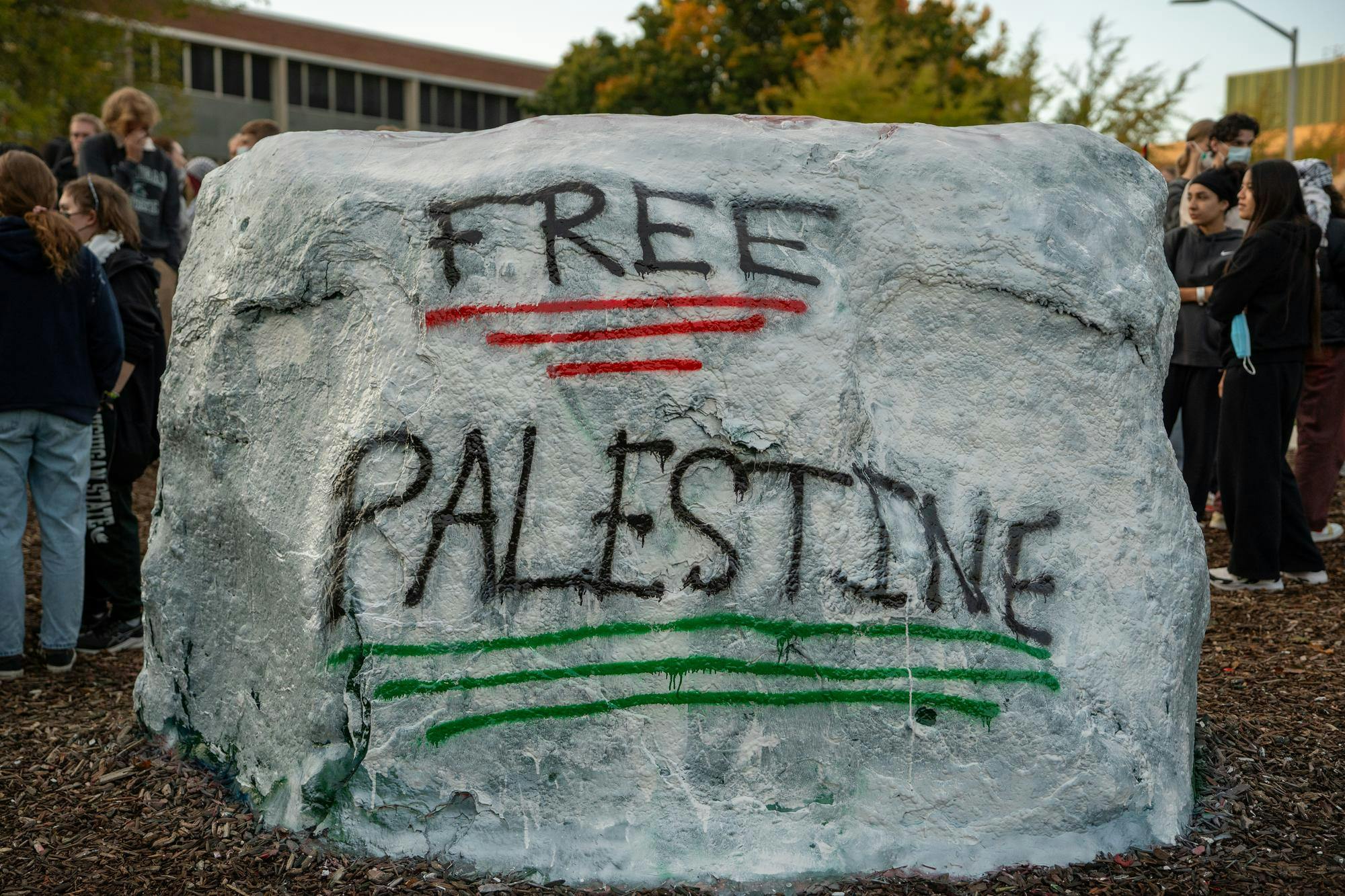
Students painted the Palestinian flag onto the face of The Rock, marked by 680,000 as a reminder of what they say represent the total lives lost and an image of a person facing away from onlookers, arms cuffed behind their back. The figure was identified as Handala by Hasan, a popular cartoon character recognized as a symbol of Palestinian identity.
“At first, he was drawn with his face facing the audience, but people have abandoned Palestine, so now his face is behind,” Hasan said. “Handala represents the youth of Palestine, and he will not turn until Palestine is free.”
The back of The Rock was painted with the slogan, “Free Palestine!” Participants then marched towards Beaumont Tower for speeches and group prayer.
Hasan spoke on behalf of Shaza Abu Dayeh, a Palestinian in Gaza, reading a message that chronicled her experiences after Oct. 7. Before Israel launched its military campaign after the events of Oct. 7, Abu Dayeh had dreams of becoming a psychologist and sign language specialist, but war has instead turned her into a "survivor" and “narrator of unbearable pain.”
“We have been displaced four times, carrying our terror in our hands, running from one place to another, searching for shelter that does not exist,” Hasan read of Abu Dayeh’s message. “Every time we thought we had found a safe haven, we discovered that safety in Gaza is nothing but an illusion.”
Her dreams, her childhood home and everything she worked for have since been buried under rubble — a tale many other Palestinians echo.
“Gaza is no longer just a place on the map,” Abu Dayeh wrote. “It has become a bleeding wound on the conscious of humanity.”
For neuroscience junior Mia Zaben, the plight in Palestine is personal. Zaben was born in a refugee camp in Lebanon, a place that became her home out of “necessity.”
As Palestinian refugees, Zaben’s family were treated like outsiders. They couldn’t own homes, work “normal” jobs or pursue certain types of education. At night, Zaben dreamed of Palestine, a land she had never seen, and freedom.
“Dreams were often the only thing that we felt were truly ours,” Zaben said.
After being granted the “luxury” of studying in the U.S., Zaben only became more aware of the discrepancies between the life she got to live versus the lives of other Palestinian children. The discrepancies are not born of who they are as a people, but where they’re allowed to be.
“I never got to grow up in Palestine, but Palestine grew inside of me,” Zaben said. “It lives in my memories, even though they are borrowed from other stories. It lives in my heart, even though I've never walked this land, and I hope that one day the next generation of Palestinian children will not have to tell stories like mine, because they will be living freely in the place that we have all been dreaming of.”
Arab Cultural Society president Gaby Nasr’s family was displaced from Palestine in 1967 to Jordan during the Six-Day War. As a Palestinian Christian, she carries “the same ache, the same memories and the same longing” for her homeland that other displaced families do, Nasr said.
But the event isn’t just about grief, it's also about “presence,” she said. “It's about choosing to keep showing up when the world tells us our pain is too political, when our lives are too complicated, our freedom is too far.”
Support student media!
Please consider donating to The State News and help fund the future of journalism.
Fellow ACS board member Abe Jaafar thanked other cultural organizations for supporting the efforts of pro-Palestinian movements on campus, “extend(ing) a hand” to Jewish students.
“The Jewish people are our brothers and sisters, bonded to us by faith and history of peace,” Jaafar said. “I especially call on those who refuse to let this genocide be carried out in the name of Judaism to stand and fight with us. We must come together and build a united front across all of our struggles.”
In a speech to the crowd, SJP member Nasim Barghouti refuted the idea that the conflict in Gaza was “too complicated” and that students should “stay out of politics.”
“What is complicated about genocide?” he asked. “What is political about demanding that children should not be bombed? What is radical about wanting to see Palestinians live freely on their own land? When they tell us that the students' voices don't matter, history reminds us that these revolutions began with the youth, began with the students from Cairo, from Berkeley to Gaza. It has always been the youth who can, who will, change history. We will do it again for Palestine. We will do it again for Gaza.”
The devastation in Gaza has been formally recognized as a genocide by multiple civil rights groups, including Amnesty International and Doctors Without Borders — claims Israel denies, citing self-defense in an attempt to reclaim hostages taken on Oct. 7, 2023.
Students then marched from Beaumont Tower to MSU president Kevin Guskiewicz’s residence at Cowles House, chanting for MSU to divest from Israel.
Social relations and policy senior David Hogan said the fight for divestment from the state of Israel was never going to be “easy” or “short,” but that they will “stay here for as long as we need to.” When MSU divested from apartheid South Africa in 1978, students had organized for 10 years.
Still, there seems to be an “inverse shift” occurring within the university. Despite media becoming more pro-Palestine or “jaded” about Israel’s military actions, Hogan said, the university’s administration continues to ramp up against pro-Palestinian student protestors. Recently, a member of the Hurriya coalition received disciplinary charges after a public confrontation with Guskiewicz.
“The administration is still the big holdout, and I don't think they're going to be taking it any easier on us,” Hogan said.
Discussion
Share and discuss “Pro-Palestinian students honor lives lost during two year anniversary of war in Gaza” on social media.