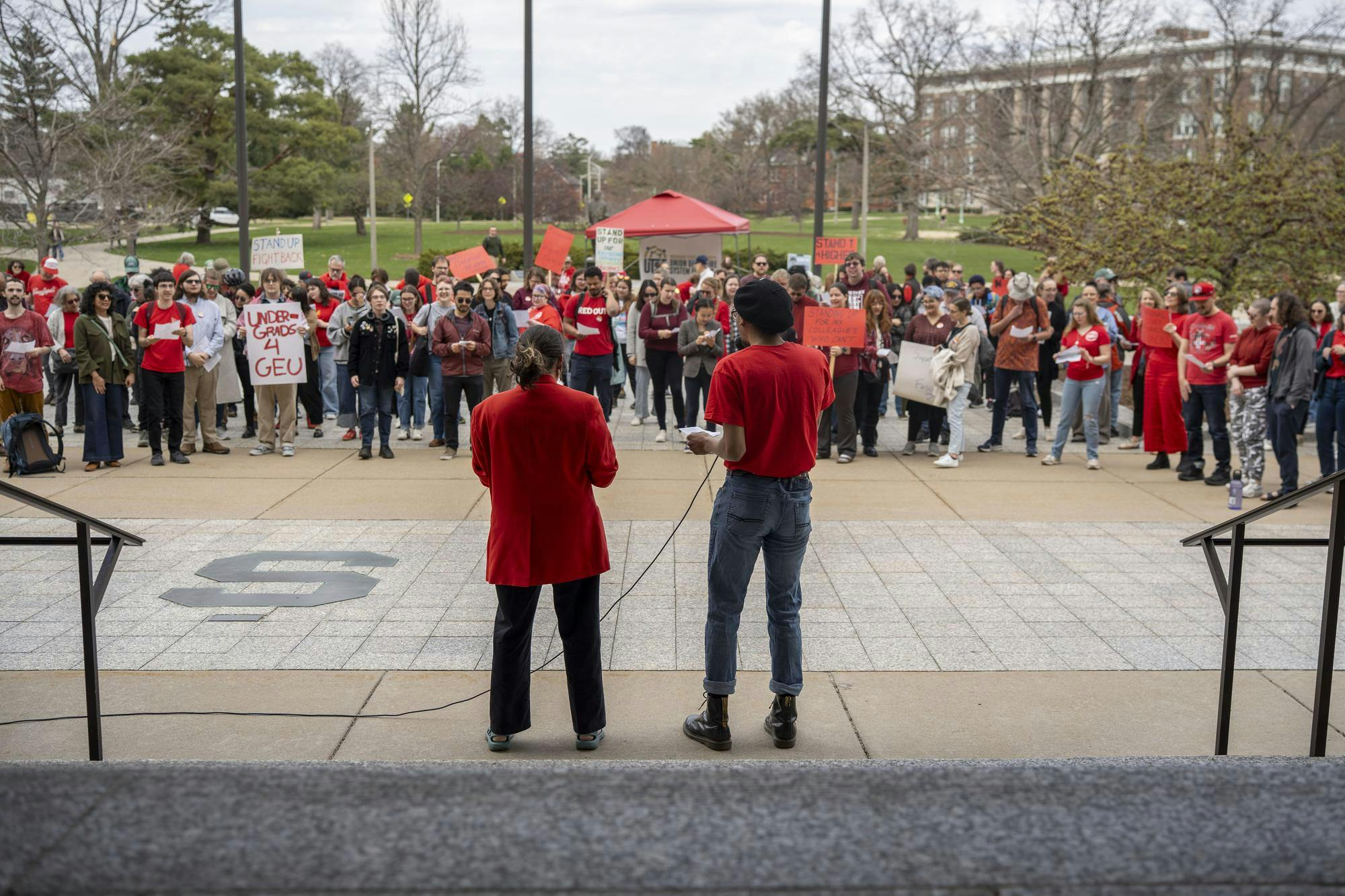
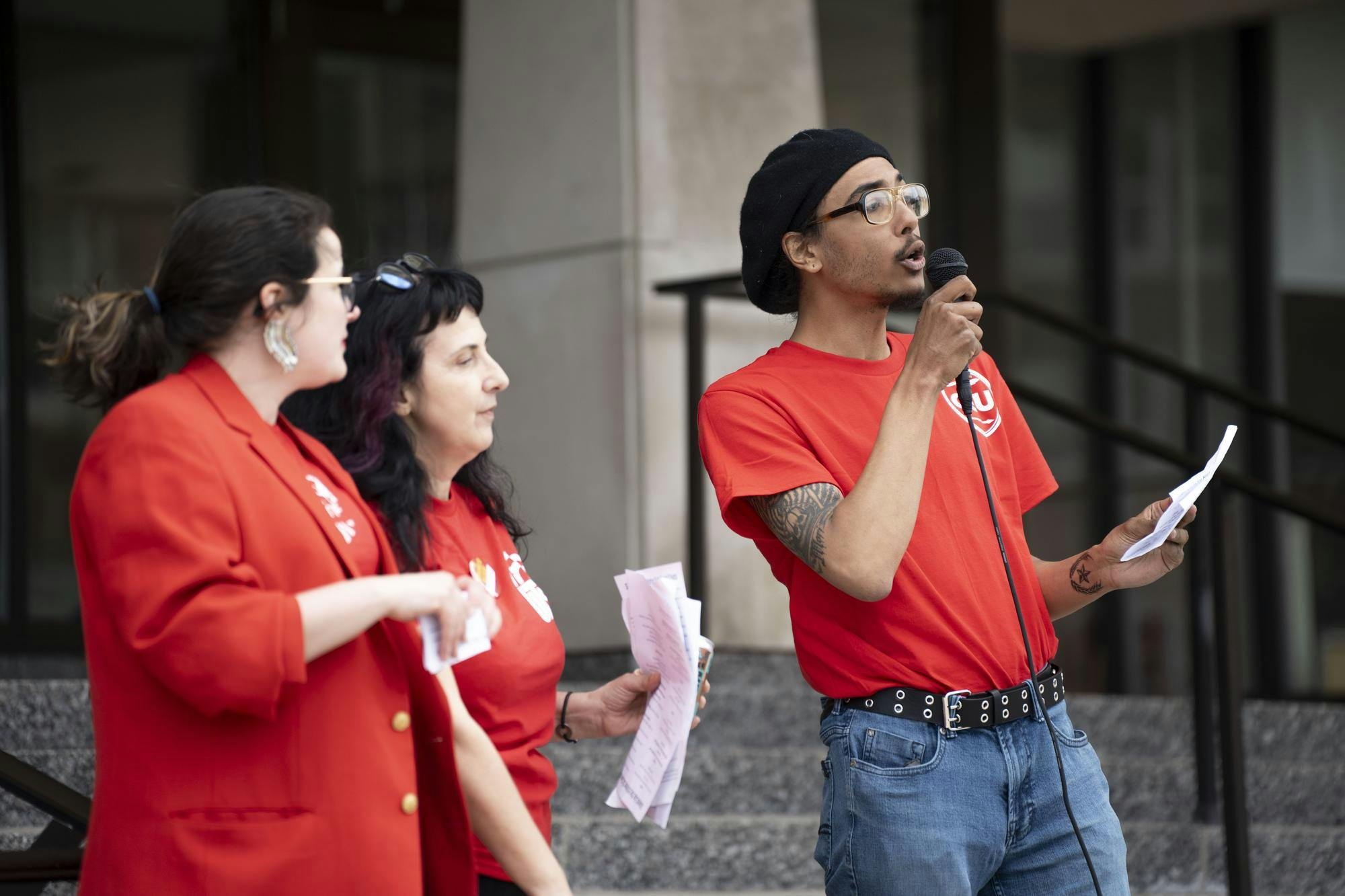
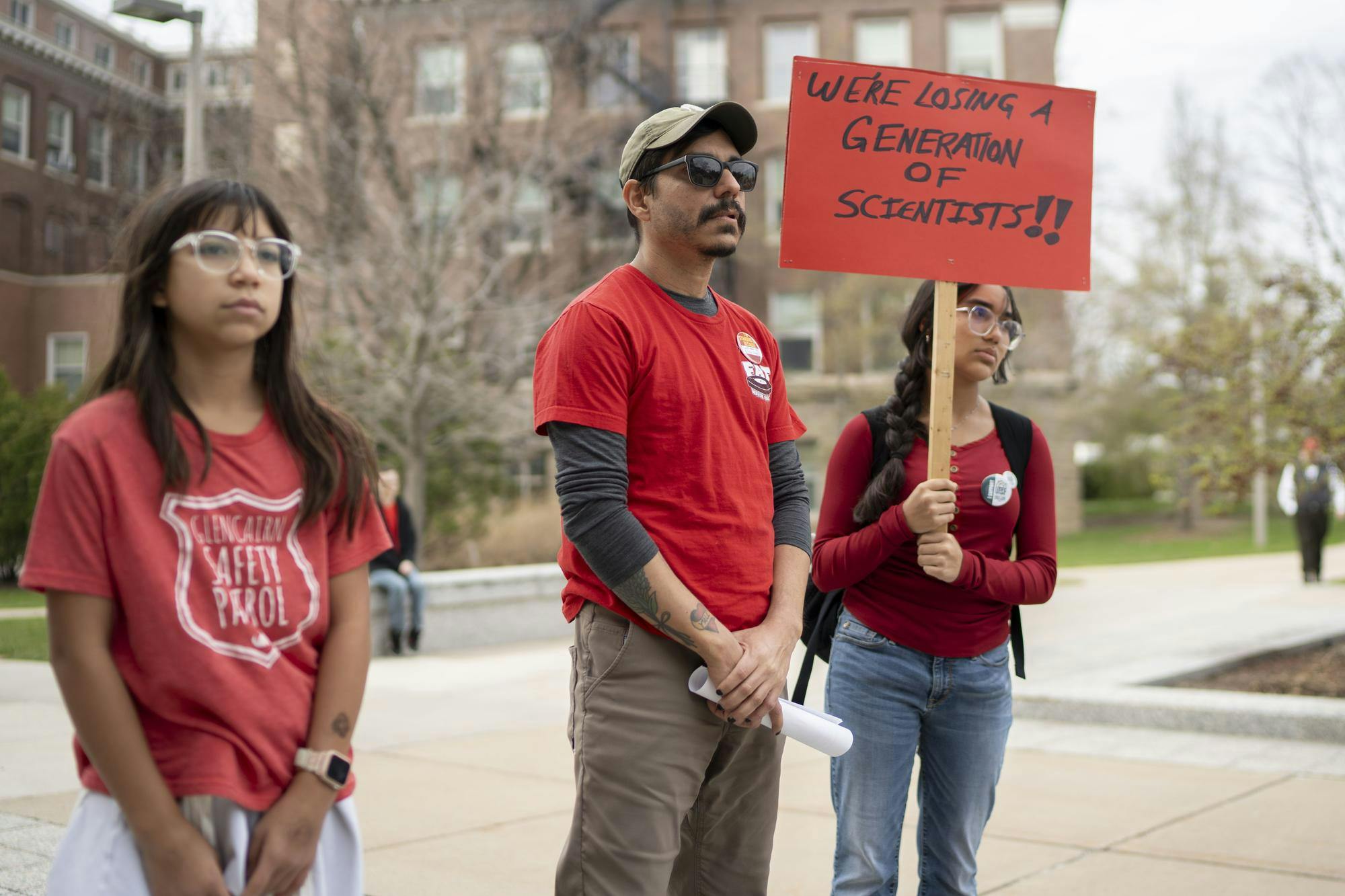
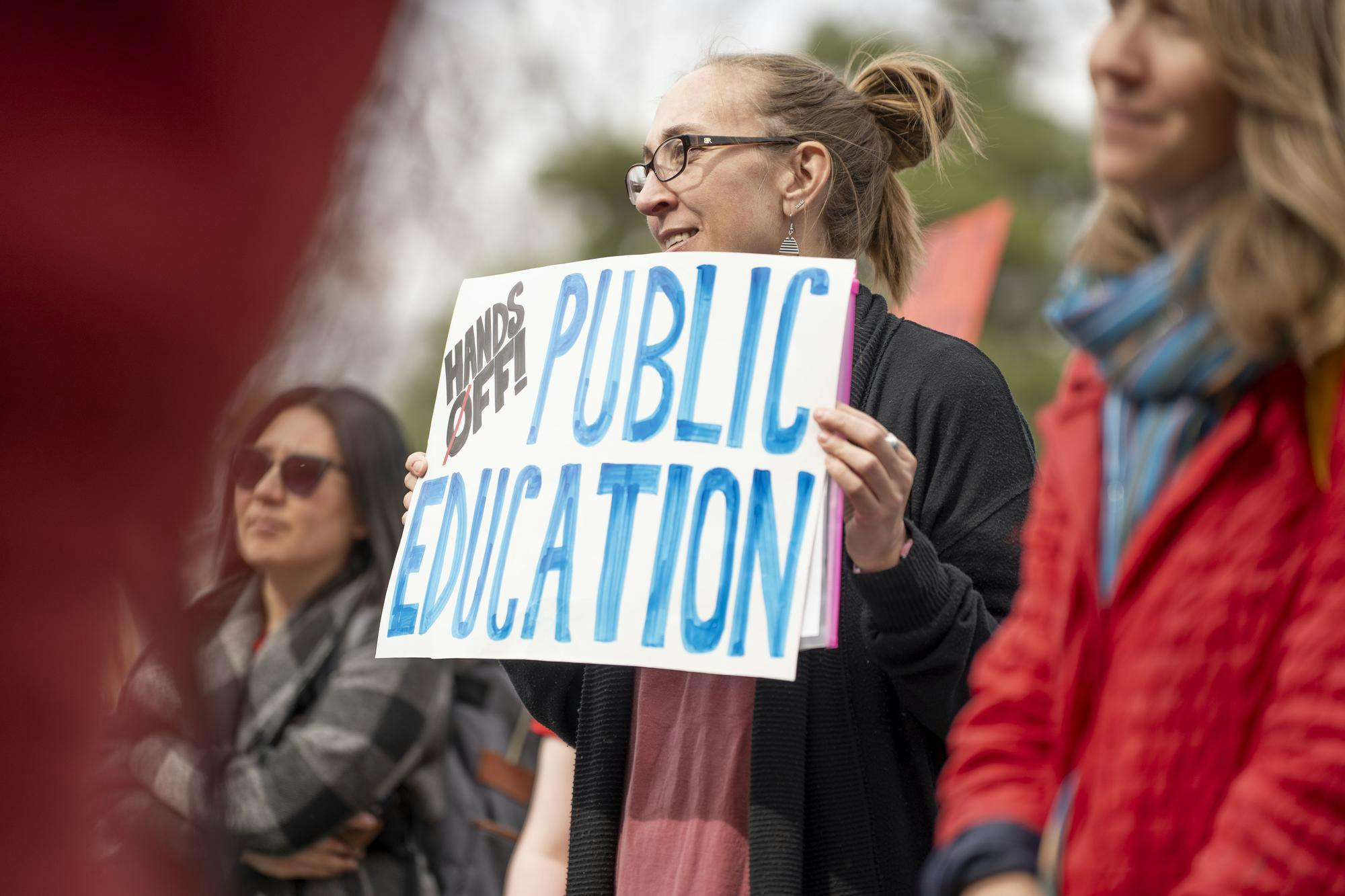
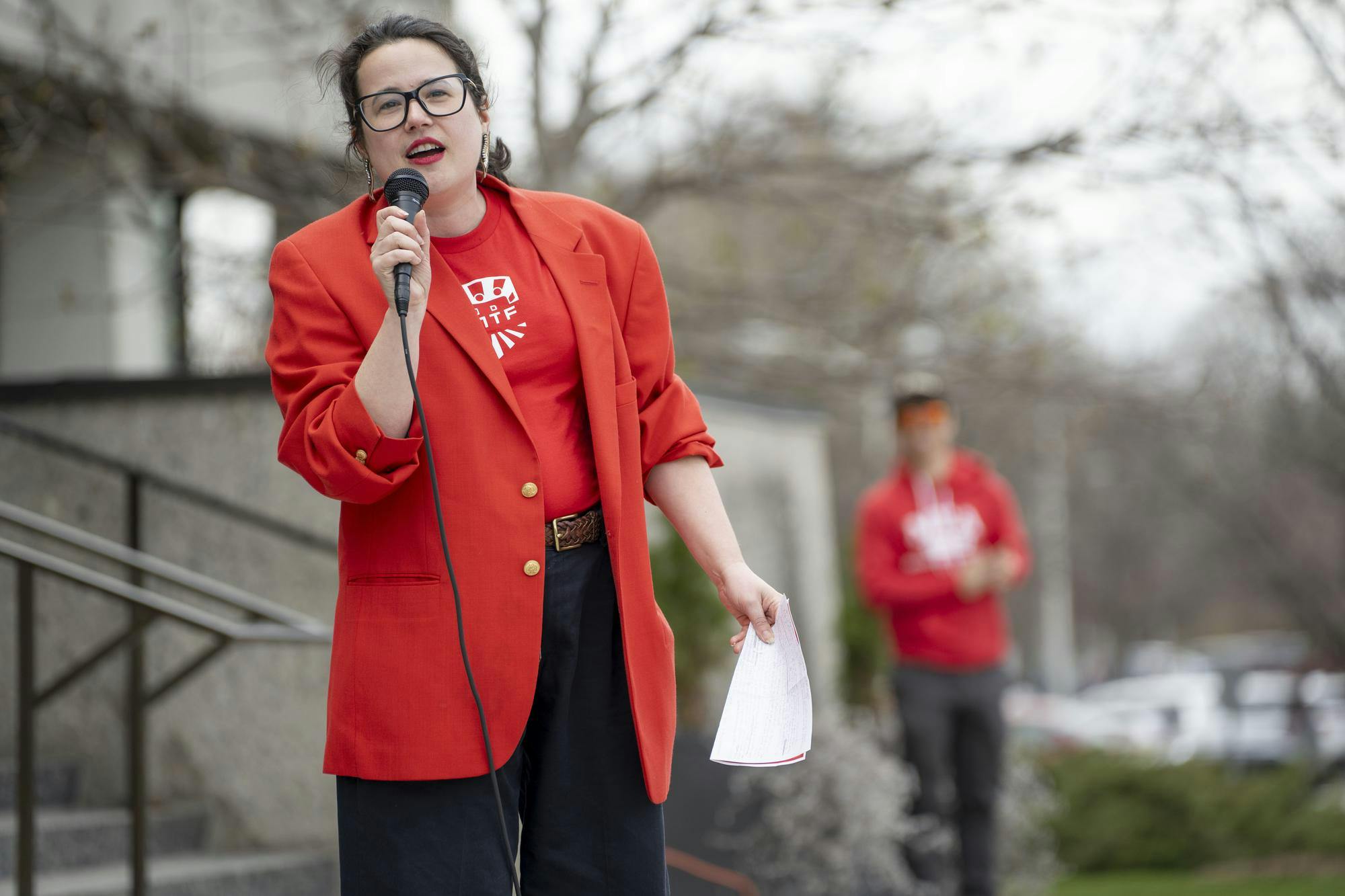
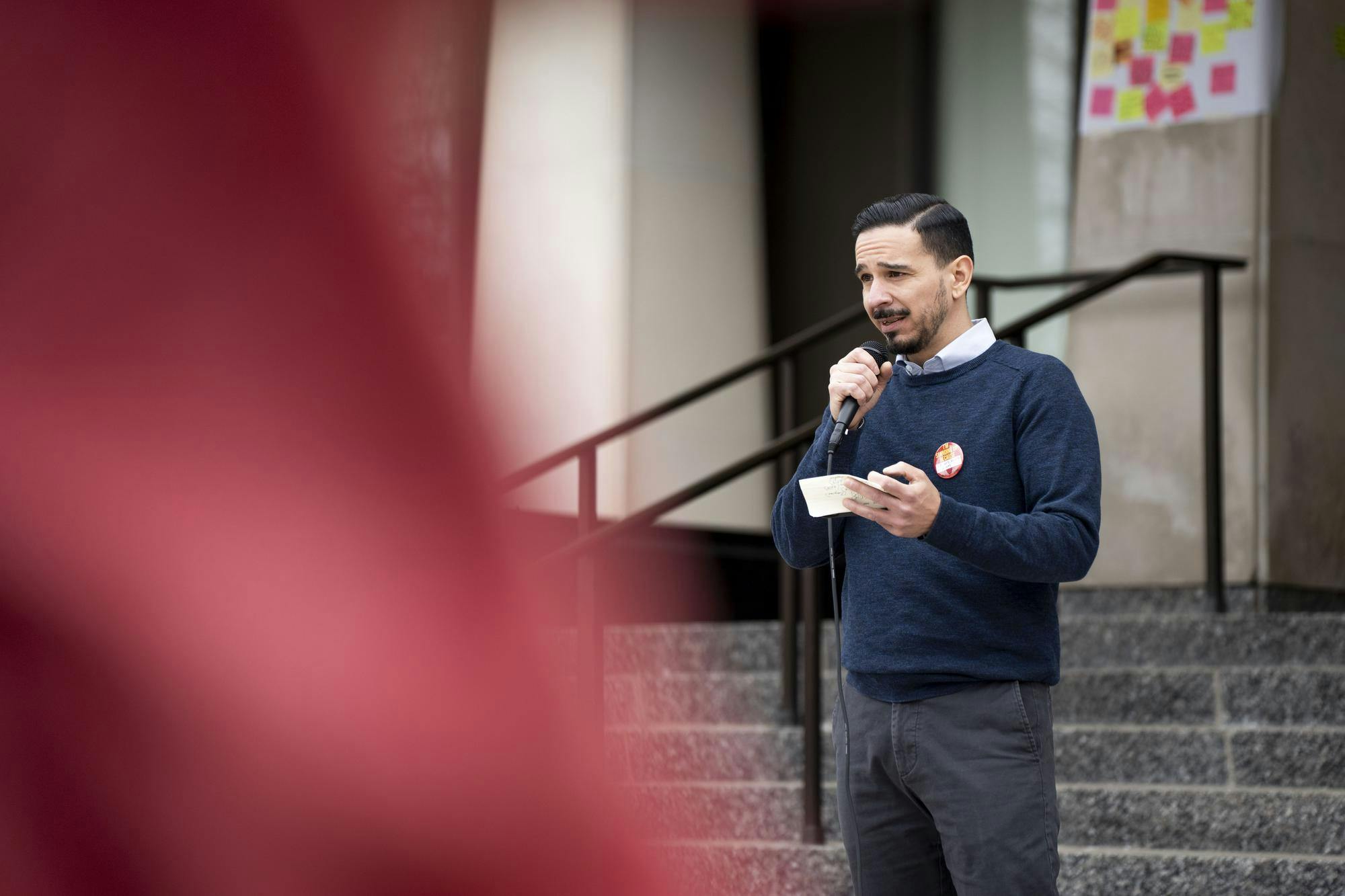
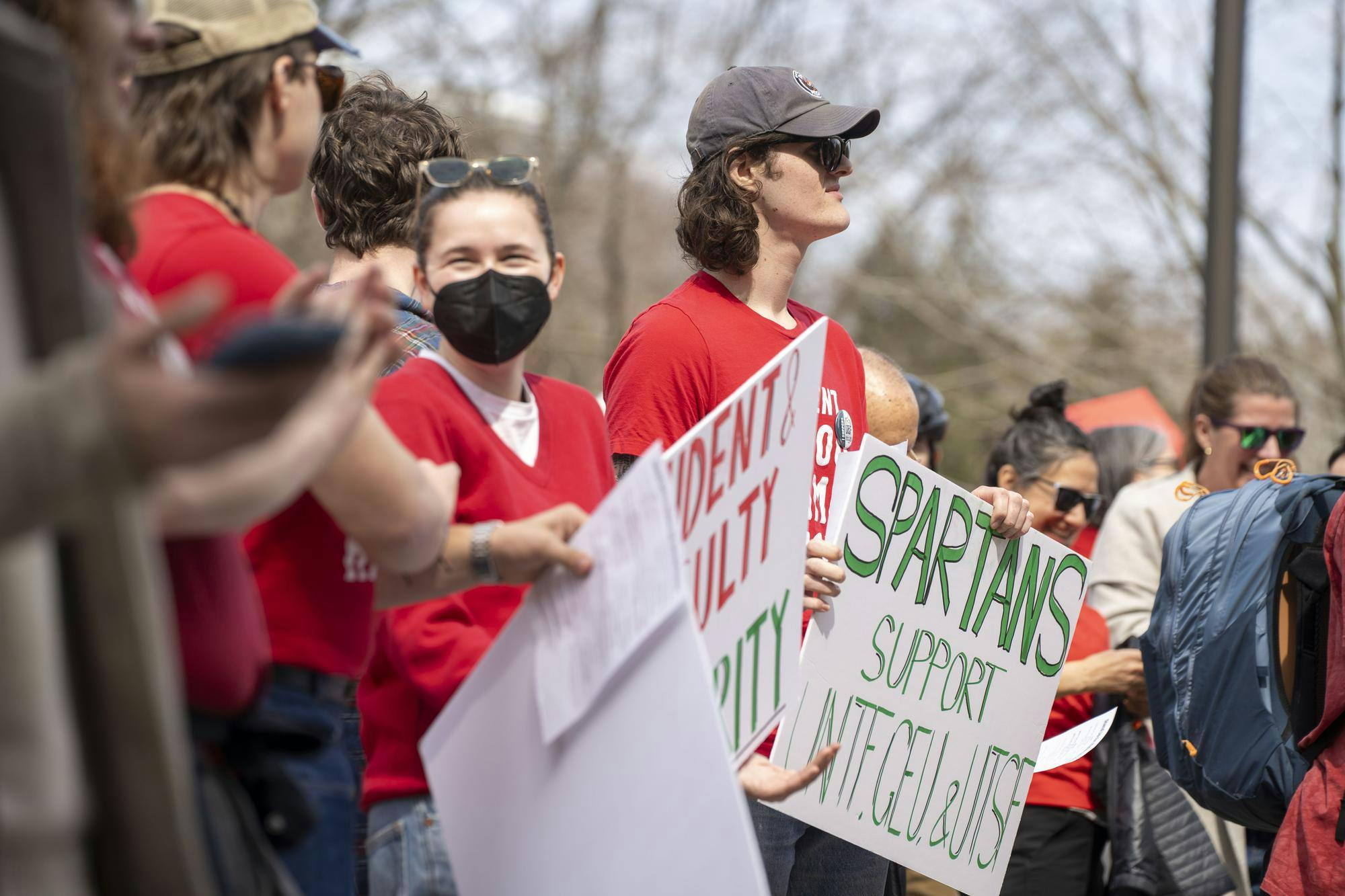
Speakers address over 100 attendees of the Stand Up for Higher Education Rally outside the Hannah Administration Building on April 17, 2025.
Nearly 100 Michigan State University faculty, staff and students took a stand against the federal government’s threats to higher education Thursday in a demonstration they expect to be the first of many.
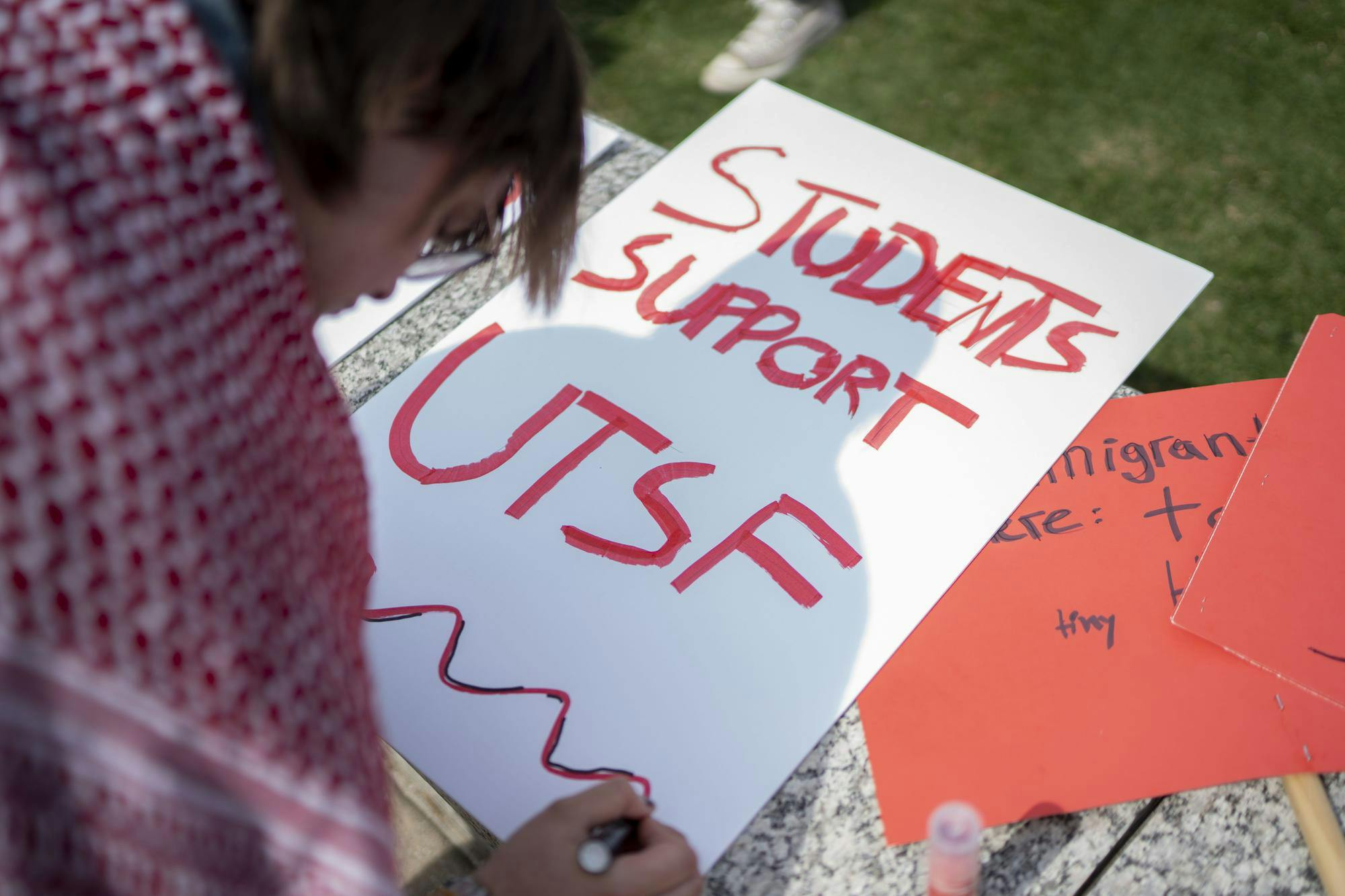
The rally, held outside the Hannah Administration Building, was organized by the MSU Union of Tenure System Faculty, Graduate Employees Union, and Union of Non-Tenure Track Faculty. It was part of a nationwide day of action to fight back against federal suppression of academic freedom and campus protests, as well as the revocation of student visas.
The rally was in response to threats to diversity, equity and inclusion nationwide and threats to research. Those threats have already materialized here at MSU, with all of the university's USAID projects being terminated in February. Also on Thursday, several faculty members gathered near the Rock to spread awareness about those USAID cuts.
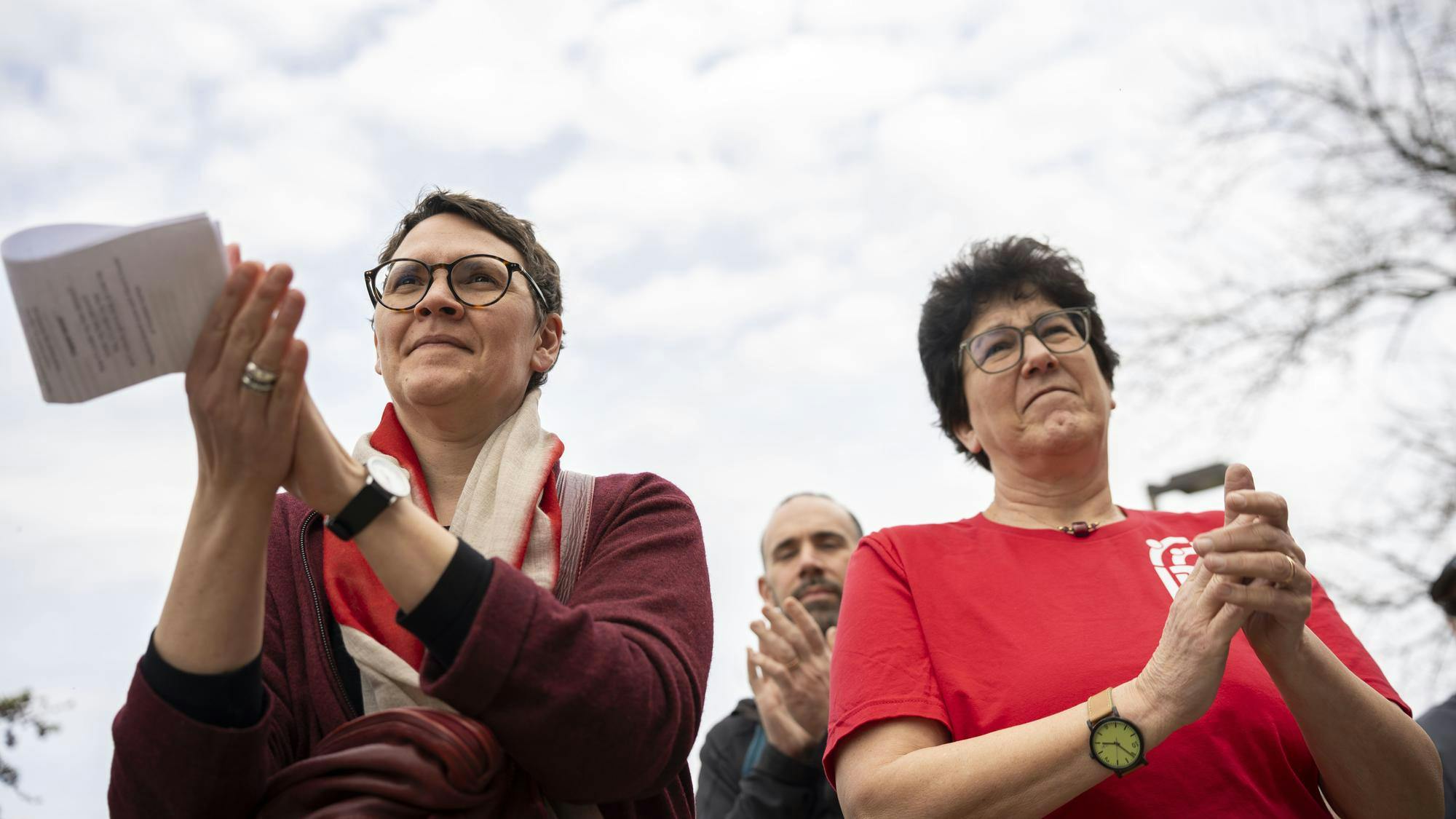
Attendees at the rally chanted and sang in between speeches given by faculty regarding what they called the suppression of academic freedom enacted by the Trump administration.
They also protested a continued lack of formal recognition of the Union of Tenure System Faculty by the university, who they say is stalling their efforts.
The UTSF has been engaged in a legal battle with MSU for over a year to be recognized by the university. In December of last year, it filed an Unfair Labor Practice charge against the administration for allegedly violating the Public Employee Relations Act (PERA). PERA protects employees from coercive and obstructive tactics to hinder unionization efforts.
Last September, UTSF held a rally to protest this lack of progress, although MSU President Kevin Guskiewicz denied that the administration has been obstructive in union negotiations.
Thursday's rally — though primarily focused on the federal government — also acted as an opportunity for UTSF to make another push toward formal recognition of the union.
Federal administrative threats to academics
Danny Caballero, a professor in the Department of Physics and Astronomy, is one of the many affected by federal threats to DEI. The Howard Hughes Medical Institute has recently cut a grant meant to bring diversity to science education. This has affected two major programs in Caballero's department, he said.
In addition to this, federal threats to the National Science Foundation funded programs at MSU, like a Research Experience for Undergraduates in the physics program that has existed for more than 20 years, has been put on hold, he said.
"Ultimately, it's not officially canceled, but it's effectively canceled because without the funding, we can't actually run the program this summer, and so we had to tell students that we were not going to run," Caballero said.
He said he is hopeful they can secure funding to run in the future. In the meantime, Caballero urged attendees to stand together against the suppression of academics.
"We need to adopt an organizer's mindset," he said. "When the Trump administration attacks our community, our academic freedom, our right to organize and the labor that sustains our campus, we must respond by standing together. We must agitate, educate, deepen our sense of community and exercise solidarity."
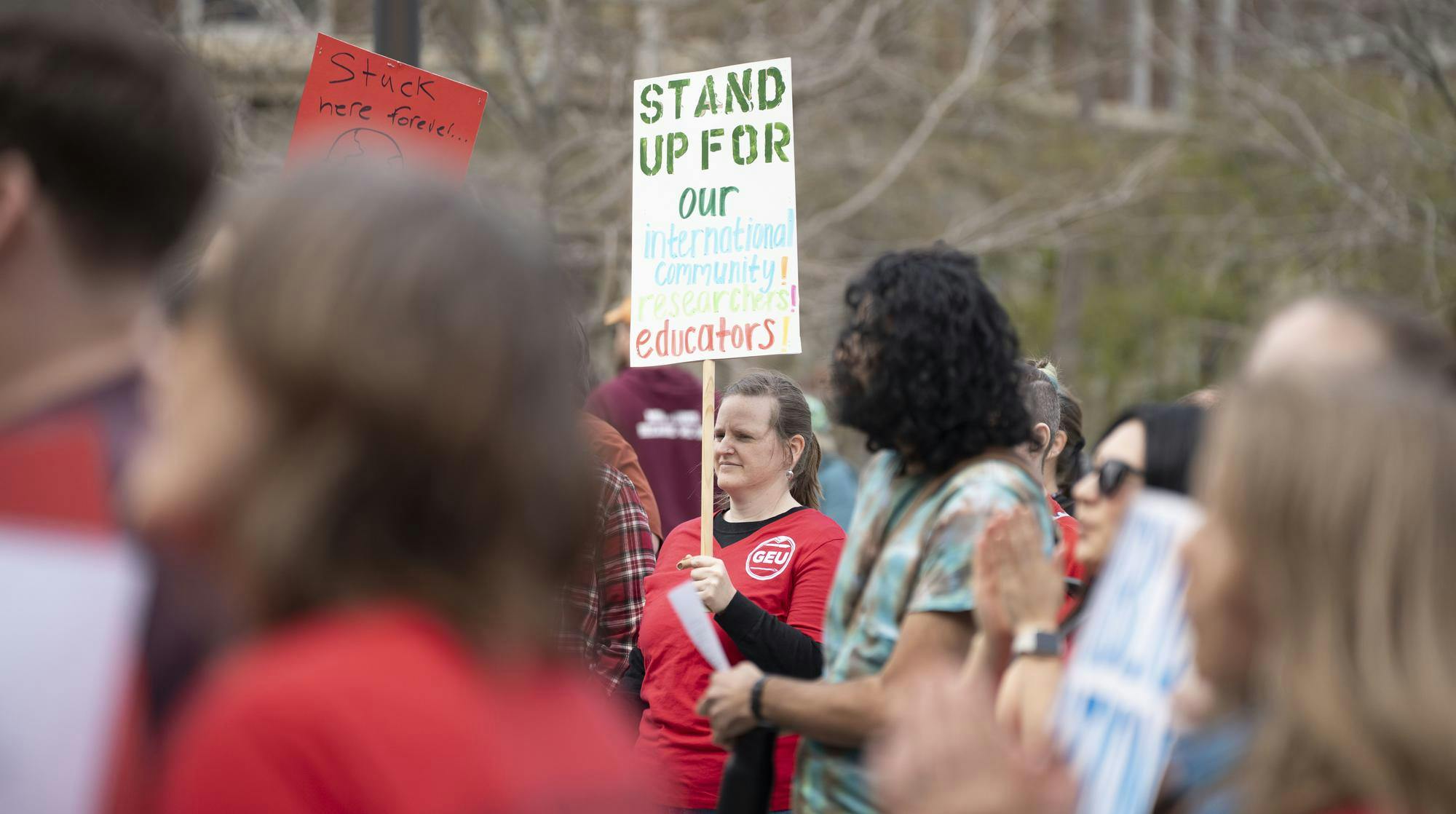
International students' statuses have also been threatened by the federal administration, with those who have protested Israel's war in Gaza especially vulnerable to visa revocations. These revocations have extended to MSU’s campus, with the university currently aware of 12 students affected.
Assistant professor in the College of Education Hannah Grisham spoke to attendees about her Jewish identity and the hate she faced being raised in a heavily Christian area.
"When I say that Judaism and Zionism are not the same thing, though often conflated, I really need y'all to know where I'm coming from," Grisham said. "Attacks when the Trump administration, the Anti-Defamation League, weaponized anti-Zionism to attack students in this institution and others to help disappear people who protest for Palestinian rights, that is not my faith tradition. That is not Judaism. Weaponizing antisemitism hurts everybody, including our most vulnerable."
Support student media!
Please consider donating to The State News and help fund the future of journalism.
The rally ended with Rachel Rudis, a graduate teaching assistant at MSU, listing demands of the Graduate Employees Union to MSU’s administration to stand with the international community.
The demands include free legal services for non-citizen students and employees affected by immigration enforcement; allowing students who have had visas revoked to finish their studies online if necessary; honoring promises of funding made to students at the beginning of their study; financial stability for graduate workers and employees should their visas be revoked; for MSU to join the mutual defense compact against federal policies; and for the university to reject collaboration with Immigration and Customs Enforcement and the Department of Homeland Security.
Guskiewicz said last week that the university is managing the revocations of international students' visas on a "case-by-case basis" to determine if they will be able to complete their degree programs. That will largely depend on a student's academic program and the education laws of whatever country they return to, he said.
Also last week, university leaders reaffirmed the fact that MSU Police officers are not required to assist federal agents like those from Immigration and Customs Enforcement, even in the wake of visa revocations at MSU.
It is still unclear, however, whether MSU will heed the Faculty Senate's vote earlier this week for a Big Ten mutual defense compact.
Before the rally dissipated, Victor Rodriguez-Pereira, assistant professor in the College of Arts and Letters, urged attendees to speak with everyone they know about the current political climate in the U.S.
"You have to remember something: This is not over," he said. "This is only starting."
Progress on union negotiations
The Board of Trustees passed a resolution in 2021 to adopt a stance of neutrality on all collective bargaining activities and voluntarily cooperate with these efforts. UTSF took advantage of this resolution, as in December 2023, it announced it had received a majority of support from tenure system faculty, meeting the requirementnecessary for the university to then take steps to recognize the union voluntarily.
The parties, however, have been unable to agree on who meets requirements to be considered as tenure system faculty in arbitration negotiations that began in March of last year, slowing progress.
Chemistry professor Robert Maleczka, who has been involved in UTSF's negotiations with MSU, said he doesn’t see an end in sight. The goal of the negotiations is to determine what faculty should be considered part of the union and what faculty should be categorized as "management," Maleczka said.
"They have their own systems that classify us in various ways," he said. "And it would be, I think, a simple thing to use their own systems to define whose management and who's a non-management tenure system faculty member."
The administration has also brought repeat witnesses to speak to delay the process even further, he said.
The third-party arbitrator in charge of negotiations even suggested methods to expedite the process a few weeks ago, Maleczka said, which include having more witnesses testify at each meeting and defining a set speaking time limit. UTSF agreed to these suggestions, though Maleczka said the university representatives were not as eager to accept.
"The arbitrator made the recommendation," he said. "At the end of that meeting, we nodded our heads. I don't recall the university reps saying, 'Yeah, let's do that.'"
Discussion
Share and discuss “MSU faculty rally for academic freedom, international community” on social media.