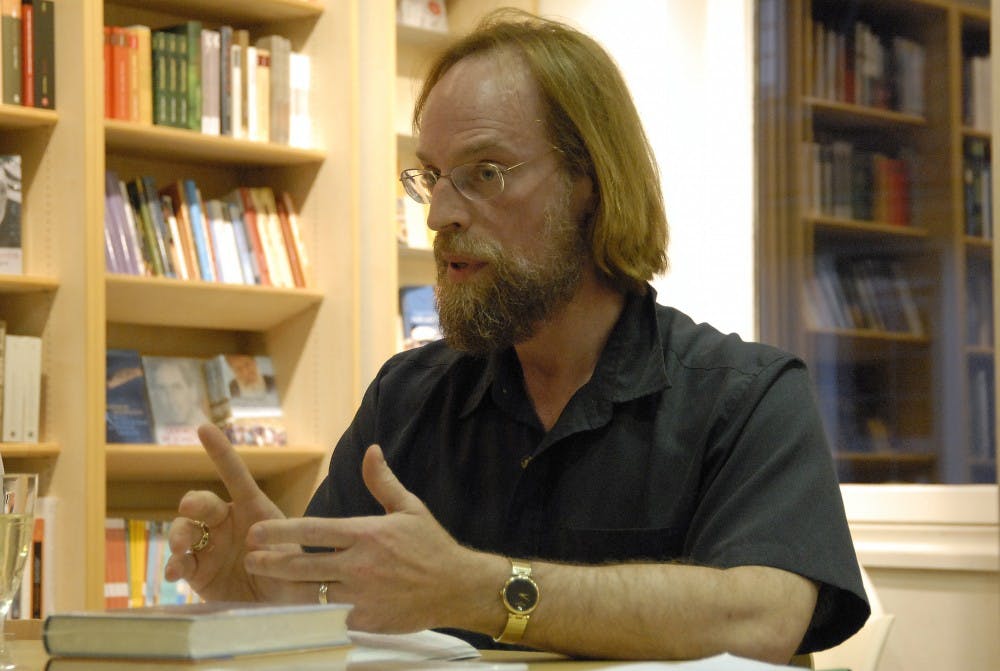
As the child of two Holocaust survivors, author and MSU assistant professor in literature Lev Raphael said he grew up surrounded by absence.
Almost all of his extended family was murdered or died of starvation during the Holocaust, except a handful of relatives in his native New York City, Canada and Israel.
Raphael said he grew up with little record of the extended family the Nazis took from him.
Most of his family’s photos were lost in the chaos and his parents were, for the most part, unwilling to discuss their painful past.
“Our family history had, in a sense, been destroyed,” Raphael said.
For a child of survivors, the Holocaust’s wounds breed a sense of isolation difficult for outsiders to fully comprehend.
“It was like growing up on another planet,” Raphael said. “That feeling of feeling very different and very alien.”
He said his parents experiences gave him a different, possibly more fearful, outlook on life.
“You grow up knowing from an early age that the world can be filled with mass murderers, and that those murderers killed your family,” he said.
The lack of an extended family was a continual reminder of how he was different from his peers.
“I was always aware that my non-Jewish friends and even some of my Jewish friends had extended families,” Raphael said. “I didn’t know what an extended family was.”
For Raphael, becoming a writer was a means of addressing his perceived lack of roots.
“I created my own life in literature,” Raphael said. “I became an author, and authors create their own worlds.”
Becoming an educator was also a means of continuing a family legacy. He said many family members on his mother’s side were some type of educator through the generations.
Peter Berg, head of Special Collections for the MSU Libraries, said Raphael’s range of works set him apart. Berg included Raphael’s works in the library’s Michigan author’s collection.
“He has a wide breadth of interests and he has written on them well,” Berg said.
Raphael’s productivity further sets him apart, having written 25 books throughout the course of his career.
“He is highly productive, that is definitely something that distinguishes him in all the different fields he writes in,” David Stowe, professor and interim chair of MSU’s English Department, said.
His work as a writer and educator eventually took him to Germany, a country he once held in serious contempt because of his family’s Holocaust experiences.
“To me, it was the Death Star,” Raphael said. “It was 80 million Darth Vaders.”
Though he was anxious about going there, he said the time was right.
“There are moments in your life when a door opens and you think, ‘it’s time to go through,’” he said.
He visited Germany a number of times in the years following his first visit, but he said his first time was the most special.
“I was overwhelmed by finally being some place I swore I would never go to, but as a writer I was just noting everything and taking it all in,” Raphael said.
Still, his visits to Germany did not completely salve the burning pain he felt the Holocaust inflicted on his family.
“The apartment house that my mother grew up in Poland is still standing,” Raphael said. “The farm where my father grew up on is probably still standing, but I don’t want to go back there because I think it would be too painful to see someone else living there.”
These visits formed the basis for his 2009 book, “My Germany: A Jewish Writer Returns to the World His Parents Left Behind,” in which he discusses his relationship and reconciliation with the country.
As a whole, Raphael said he is grateful he visited Germany.
“To finally go there made a huge difference,” he said. “It made Germany real.”



