Sometimes, the most unassuming buildings on campus have the most impressive histories. It’s a safe wager that most Spartans know the history of Beaumont Tower, Breslin Center or Spartan Stadium. What few realize is how close they are to a landmark with a unique past.
This under-the-radar landmark is the MSU Alumni Memorial Chapel. Established in 1951 and dedicated by former president John Hannah in 1952, the chapel functions as a haven for students and faculty alike to stop in and worship or pay respects to MSU’s fallen soldiers.
The origins of the chapel go back to the 1940s, when then-Alumni Association director Glen C. Stewart began gathering funds to construct a joint chapel and international center on MSU’s campus, then known as Michigan State College of Agriculture and Applied Science.
The chapel was originally planned as a combination international center and chapel but the alumni association was unable to procure enough funds for both. They did, however, have enough to go ahead with just the chapel. Entirely funded through private donations from approximately 5,000 alumni and friends, construction totaled about $200,000, almost 2 million dollars today adjusting for inflation, according to the CPI inflation calculator provided by the Bureau of Labor Statistics.
For some time, MSU did have another chapel available to students, which was located in the area between the Beaumont Tower and Main Library. After it collapsed because of a failed reinforcement, the memorial chapel became even more necessary.
“It was a major part of the thinking behind those that did the planning, was that it would be a house of worship that would be for all people,” Steve Aikin, the chapel’s sexton, said.
Aside from its role as a house of prayer, the “memorial” portion of its title is central as to why it exists. Housed within the chapel is a set of tablets marked with the names of all former students of the university who died while serving in the U.S. armed forces.
These tablets were included with the original design of the building, and currently list names of MSU alumni wartime casualties starting from the Civil War and up until the Iraq War in 2003.
There is also a special plaque dedicated to university aid workers that were caught in crossfire during the Vietnam War. During the dedication of this plaque in 1971, president John Hannah read its inscription aloud.
“Honored here are those Americans whose lives were lost under extraordinary circumstances while serving the cause of human advancement in U.S. economic assistance programs throughout the world,” the inscription reads. “Their sacrifice is not forgotten.”
Honoring such loss is not only engraved in the building, it’s part of the chapel’s literal structure. During its construction, the chapel received stones from famous European cathedrals that were damaged during World War II.
Some of the more famous stones are ones from Westminster Abbey and St. Paul’s Cathedral in London, and the Paderborn Cathedral in Germany. A hand-made brick from the old White House was also included in the design.
Not only is the chapel imbued with English stones, its architecture is influenced by Anglican styles, Aikin said.
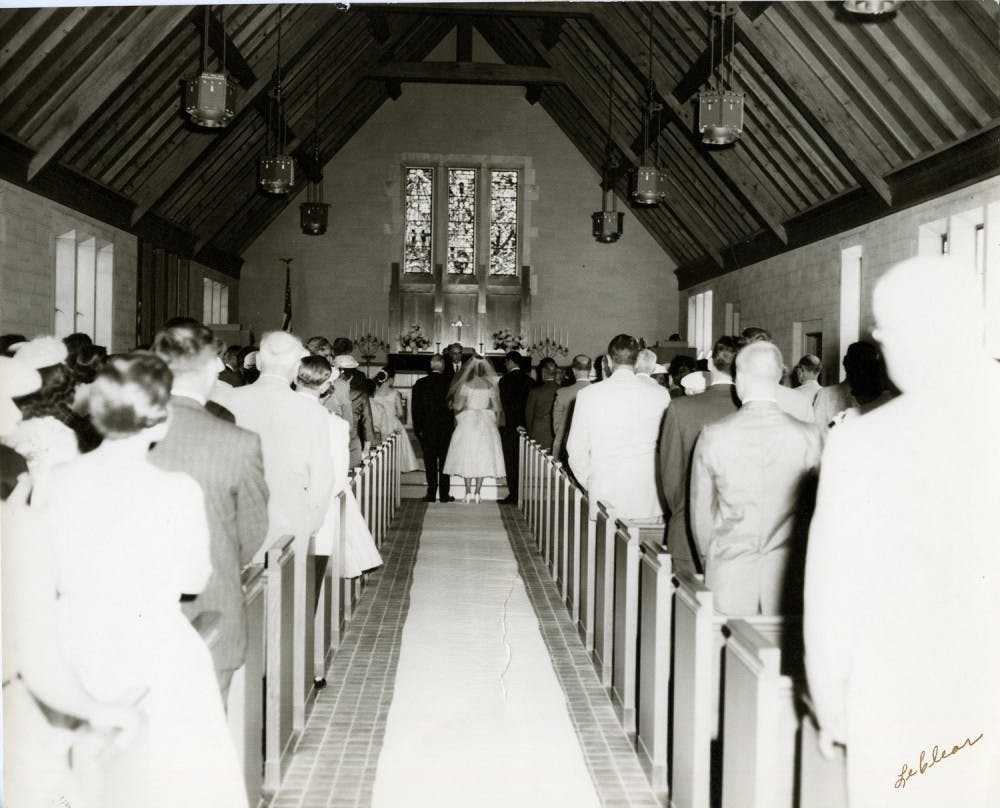
“It’s long, it’s narrow, it’s high peaked," he said. "Very conducive to weddings because if you’re a bride you want to have a nice long aisle to come down on."
The allure of hosting a wedding in the chapel comes not only from its arches and aisles but also from its set of stained glass windows. Designed by Henry Willet, a friend of the chapel’s architect Ralph Calder, the windows depict various themes related to the university’s ethos as a learning institution and the chapel’s ethos as a non-denominational place of worship.
Windows on the chapel’s eastern wall of its nave are devoted to themes of work, community and leadership. The east and west side window designs of the chapel itself are geared towards themes of prayer, charity, and sacrifice among others.
“The stained glass windows are just absolutely beautiful. The colors are deep and rich, a lot of reds, greens. For weddings, that’s got to be one of the big draws. You can do a wedding with zero amount of decorating and it still is beautiful because the windows bring you so much color,” Aikin said.
Even the floor has a story to tell. It is made up of Pewabic tile, a special type of historical Michigan pottery that mimics a cobblestone look. The tiles are hand-crafted by Pewabic, a historical pottery society in Detroit that created its signature look back in 1903. Pewabic pottery can also be found in galleries at the Louvre in Paris, at Chicago’s Shedd Aquarium and inside Cowles House, which is the university president’s house, on campus.