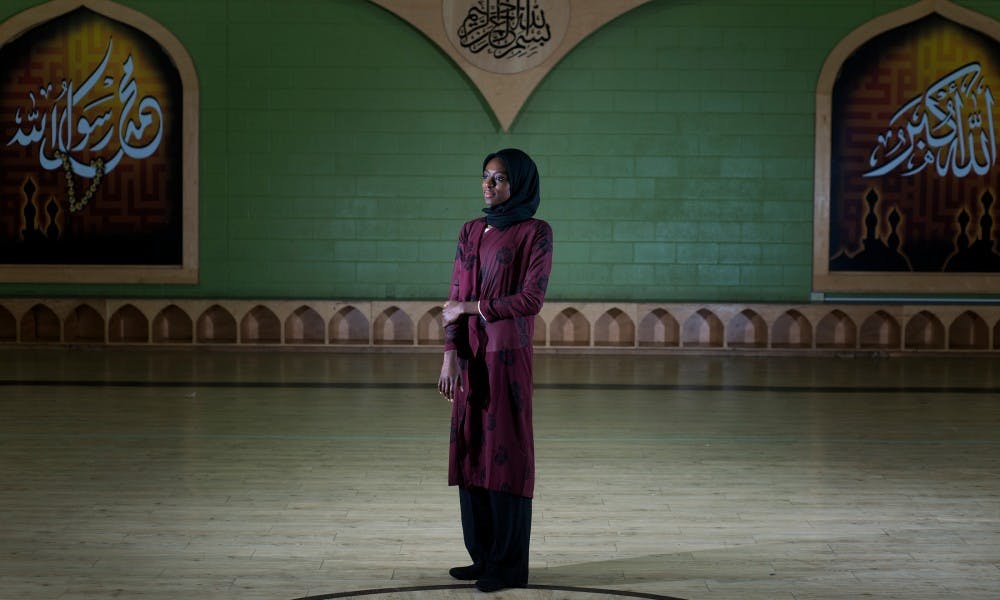
In light of the recent atrocities in Paris, Beirut and Baghdad, many individuals of the Islamic community explore a duality between feeling total remorse for the victims of these tragedies along with fearing how their fellow Americans will now perceive them — a duality that can be see in MSU Muslim students.
“My first reaction is fear, and I just hope the attacker isn’t Muslim,” neuroscience junior Rafiah Anjum said.
The precedent set by reactionary vandalism against Muslim-Americans after 9/11 has had a profound impact on many Muslim individuals, including those who attend MSU.
Communication senior Fatima Mroue said she was extremely nervous upon her arrival to campus, fearing judgment for being visibly different from other students.
“I was aware of the way people would look at me,” Mroue said.
However, as her first semester progressed, she said she noticed how welcoming her dorm community was, often working around her religious schedule to plan hangouts.
Professor Mohammad Khalil is the director of the Muslim Studies Program at MSU and said most individuals on campus are “educated enough” to know that radical fundamentalists do not represent the entirety of the Islamic community.
However, he said the fact of the matter is these terrorist groups invoke Islam when they conduct their attacks.
“There is so much ignorance behind groups like the Islamic State,” Khalil said. “This is not the Islam of Muslims around the world.”
Khalil drew attention to a common critique regarding the supposed lack of Muslim condemnation against radicals, a notion that simply isn’t true, he said.
Khalil said Muslims throughout the world have been continuously outspoken against acts of terror, including those directed at the U.S.
For example, Khalil referenced an anti-ISIS march that took place in Afghanistan a few months ago. The march still took place in light of the turmoil that currently plagues the region, he said. Muslim scholars have almost universally condemned radicalism, specifically ISIS, Khalil said.
While Khalil thinks it is best to speak out against ISIS to disassociate Islam from the terrorist group, advertising junior Hauwa Abass disagrees with the notion of apologizing for the groups' actions.
“We just don’t understand why we should apologize for something we had nothing to do with,” Abbas said.
Khalil praised social media movements such as “#NotInMyName,” as well as movements to completely disassociate the religion of Islam from radicalism.
“When you have all this hatred depicted on news outlets, it seems to affect all,” Mroue said. “The action of one person unfortunately defines an entire religion.”
The two see this as especially present on anonymous forms of social media outlets, such as Yik Yak, Twitter and the Facebook accounts for MSU Confessions.
“This is exactly what ISIS wants,” Khalil said. “To draw a line between Muslims and non-Muslims, to promote conflict, along with each side painting a cartoonish image of the other side.”
Khalil said it is vital people shatter this barrier.
Anjum and Mroue also see this as important and seek to bridge the cultural gap through their organization, the MSU Muslim Students’ Association.
“It is a safe place to come and ask questions,” Mroue said. “The intention is to learn and educate.”
Both Mroue and Anjum said they would rather have someone ask questions at their events and learn about the religion than be afraid of being perceived as offensive.
“It is extremely important to have these areas of moderate discussion with no judgment,” Anjum said.
Mroue also said she is confident once people read into the religion, they will see that groups like ISIS have no value for human life and therefore have no connection with Islam, as practiced by most Muslims.
“We are just as afraid as everyone else — like every other American,” Anjum said.