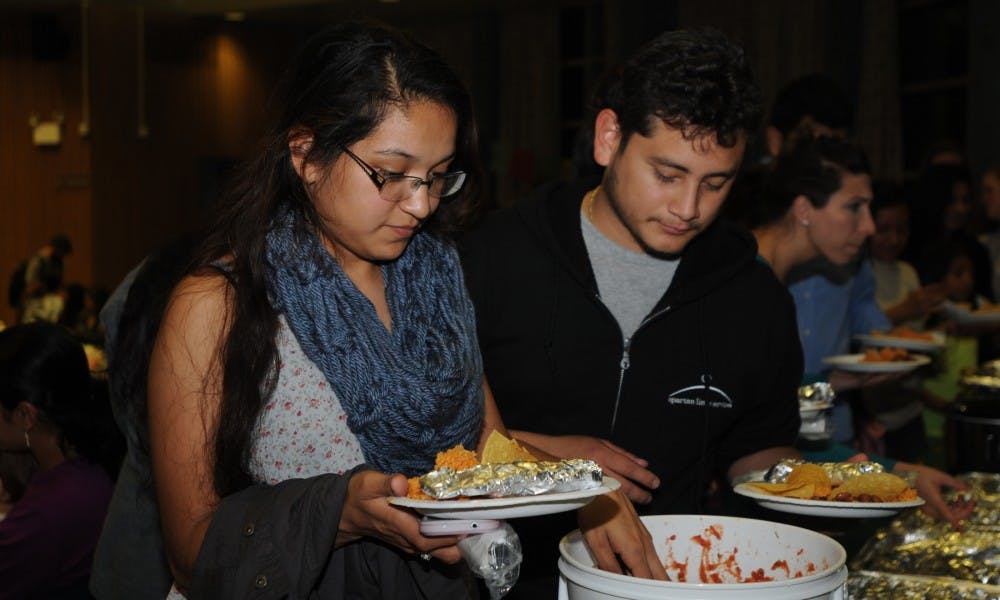
In Mexican culture, Día de los Muertos, or Day of the Dead, is about celebrating the lives of the deceased, but for people like MSU doctoral student Santos Ramos, it is a way to reconnect with their Mexican heritage, while being as far away as Michigan.
“Día de los Muertos is about re-establishing connections to both our culture and to people who have passed away,” one of the event’s organizers and doctoral student Santos Ramos said.
Many of the event’s organizers and attendants didn’t grow up celebrating Día de los Muertos.
“I didn’t grow up practicing Día de los Muertos, but when I grew up and started hearing about it from my friends, then I started to ask questions of my grandma,” Ramos said. “As I got older I started doing things with my friends.”
Ramos said he doesn’t want to lose his connection to Mexican culture, but his Mexican identity is different.
“There is a disconnect between our culture, because it’s framed as Mexican culture most of the time, but we don’t live in Mexico,” Ramos said. “I’ve only been to Mexico one time, I don’t know what it means to be Mexican in a nationalist sort of way.”
For Ramos, reconnecting with Mexican culture necessitates acknowledging the diversity within his own background.
“For me, it’s been a lot about dealing with the question of hybridity and what that means,” Ramos said. “My mom is Irish, so I’m interested in Irish culture, but I’ve never felt the need to go too far out of my way to reconnect with that, because it’s already been so present in my life. Whereas Mexican cultural traditions have been taken away from me.”
Ramos and the event’s other participants observe Día de los Muertos for the uniquely Mexican perspective it offers on death.
“My elders told me not to be afraid of death — it’s an important process of understanding and fulfillment,” MSU alumnus and one of the event’s performers DJ Sacramento Knoxx said.
For Ramos, Día de los Muertos is a reminder that death is just another part of life.
“It’s reflective of the different relationship that we have with death than a lot of people, viewing our loved ones who have passed on as still playing a major role in our lives,” Ramos said.
Ramos said the event was not only for remembering family members, but also a time for people to remember victims of state violence and people who have been incarcerated.
Graduate student and a co-event organizer Christian Ramirez said he uses the holiday as a way to remember cultural icons.
“I’m from Corpus Christi, Texas, and that’s where the artist Selena Quintanilla is from,” he said. “We remember her as someone who really influenced Mexican-American culture within the mainstream.”
These range of cultural expressions are all part of what MICCA hoped to achieve by putting on the event.
“We wanted to do a public event to create community in a different way, on a bigger scale,” Ramos said.


