Jewish students and community members reflect on the past year for Yom Kippur
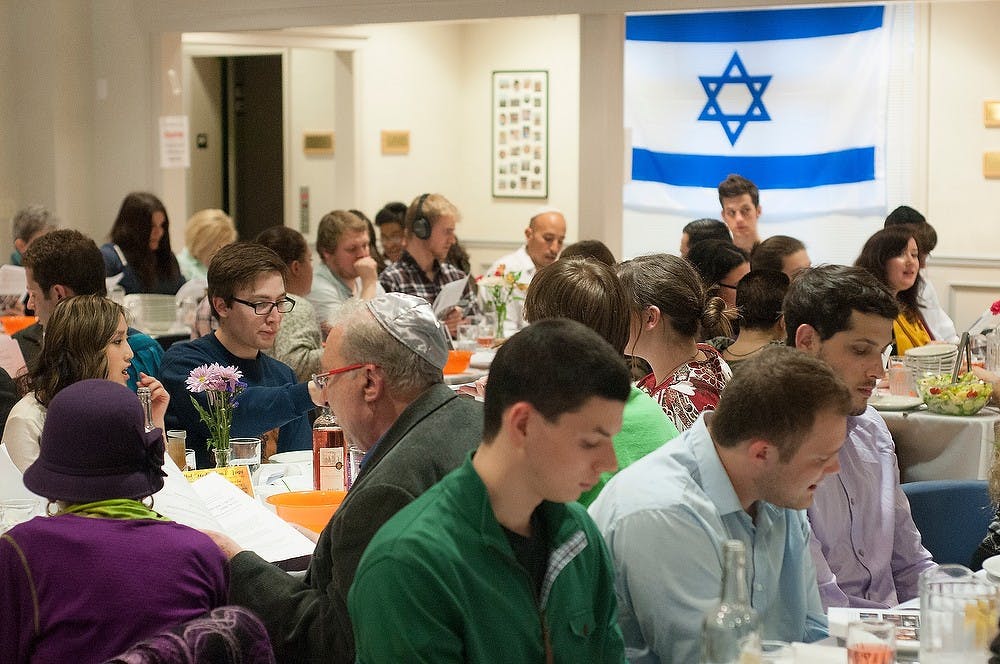
Students and community members join for a Passover supper April 3, 2015, at the Lester and Jewell Morris Hillel Jewish Student Center, 360 Charles St. in East Lansing. Passover is a traditional celebration that commemorates Jewish freedom from slavery in Egypt. Alice Kole/The State News
While many students look forward to ushering in the new year on January 1, for Jewish students, new year celebrations are already taking place.
Rosh Hashanah, the celebration of the new year in the Jewish faith, took place last week and as the 10 day period between the holidays comes to an end, students are prepared to celebrate Yom Kippur, also known as the Day of Atonement.
The holidays, seen by many as some of the most important days of the year, are a time for reflection, atonement and new beginnings for members of the Jewish faith.
History and Traditions
This year brings the beginning of the year 5776 on the Jewish calendar, which is based on lunar cycles. As Jewish students celebrate this new beginning they reflect on the past year, atone for their sins and ask for the coming year to be a good one. The ten days that elapse between Rosh Hashanah and Yom Kippur are used for both personal and communal reflection and introspection.
On the holidays, practitioners attend religious ceremonies where they hear readings from the Torah, sing religious hymns and hear the sounds of the Shofar, a rams horn that is used as a call to prayer for the High Holy Days. These days are considered to be the some of the holiest days of the year in the Hebrew calendar, spanish junior Hannah Kahn said.
The main focus during the High Holy Days is reflection on past sins, Associate Professor of Jewish History Kirsten Fermaglich said.
“You’re supposed to be considering your mistakes, your sins for the past year, what you could have done better, and then you’re supposed to be apologizing for them,” she said. “You’re supposed to be praying and taking stock of the year beforehand, taking stock of what you’re doing wrong...apologizing, and asking God to forgive you.”
In addition to reflecting on past sins, the holidays also allow people to come together to practice various traditions and customs.
“During Rosh Hashanah, we tend to eat apples dipped in honey to symbolize a sweet new year, as well as get together with family and friends to attend services,” said arts and humanities junior Rachel Passer. “One of my favorite festivities that takes place during Rosh Hashanah is simply attending services and singing merry songs with my temple’s congregation.”
Many jews find the Yizkor service to be particularly meaningful because it allows time to reflect on deceased friends and loved ones. Yizkor is a portion of Yom Kippur services set aside to remember those who died in the past year.
“I think that Yizkor, specifically during the time of Yom Kippur is a time not only to really be present with the memory of those we’ve lost,” “trying to keep their memory alive through what they taught us” said MSU Hillel Jewish Student Center rabbi Dana Benson.
However the holiday is not just about looking backward.
“I think that Yizkor specifically during the time of Yom Kippur is a time not only to really be present with the memory of those we’ve lost, but also to remember that those mentors of our lives that we’ve lost,” said Benson.
While the practice of self-reflection is incredibly important during the High Holy Days, Fermaglich stressed that there is a very strong communal aspect to the celebrations.
“It’s the time when everybody goes to synagogue and that’s when you see everyone, so it’s communally important,” she said.
The holidays are also a time when those who practice the Jewish faith come together to fast, pray and learn more about their religion.
On Yom Kippur, a day where Jews fast from sunset on Tuesday to sunset on Wednesday as a final stage of their atonement, learning sessions are often held at synagogues so that those observing the holiday can fast together and deepen their faith as a community. There are also multiple services held throughout the day for participants to attend.
“The purpose of us fasting is so that we may fully engage in repenting our sins without being subjected to distractions,” Passer said. The purpose of us fasting is so that we may fully engage in repenting our sins without being subjected to distractions."
Support student media!
Please consider donating to The State News and help fund the future of journalism.
Many practitioners often spend the holidays with family or close friends. Family meals, especially the breaking of the fast on Yom Kippur are an important part of the celebration.
Celebrating Away From Home
The communal aspect of the holidays is important to those celebrating, so it is important that MSU students who can’t make it home to the celebrated feel as though they have somewhere they can experience the communal aspect of the holidays, Rabbi Dana Benson said.
This is where the Lester & Jewell Morris Hillel Jewish Student Center comes into play. The organization was founded in 1939 and is "the place to be for more than 3,500 Jewish students at MSU. Students take ownership of Hillel as their Jewish community center on campus. Our mission is to enrich the lives of Jewish students so that they may enrich the Jewish people and the world,” according to their website.
They hold fast to this mission during the High Holidays providing multiple free services and dinners for students to come together and celebrate in a community of their peers.
“It’s important that students who are on a college campus have the opportunity to celebrate the holidays and have the support for that,” she said. “It’s a holiday that is quite meaningful so it's good for them to have a place where they can come together to pray, to fast, to be in community as they celebrate that holiday since for some of them home is very far away.”
She added that students from all over the country and even international students come to celebrate the holidays at Hillel.
For students like Kahn, who comes from the suburbs of Chicago, HIllel provides a solid community for her to celebrate with her friends when she is unable to go home and celebrate with her family.
MSU HIllel has a full day of events planned for students who wish to observe the holiday this year, Benson said.
“Wednesday services begin at 9:30 and that’s our service with the torah reading," Benson said. "11:30 will be Yizkor which is a memorial service for those who we’ve lost. At 1:30 pm there will be a learning session with me so people who are fasting or celebrating to have that added support during the day. And our closing service Ne’ila will be held at 7:30 with the break fast to follow.”
Students who are interested in attending the breakfast meal tonight at Hillel can RSVP on their website.
Discussion
Share and discuss “Jewish students and community members reflect on the past year for Yom Kippur” on social media.