“In European countries they learn from the age of seven the difference between Bach and Tchaikovsky. I know the difference between artillery and aerial bombardment, between a car bomb and a suicide bombing.”
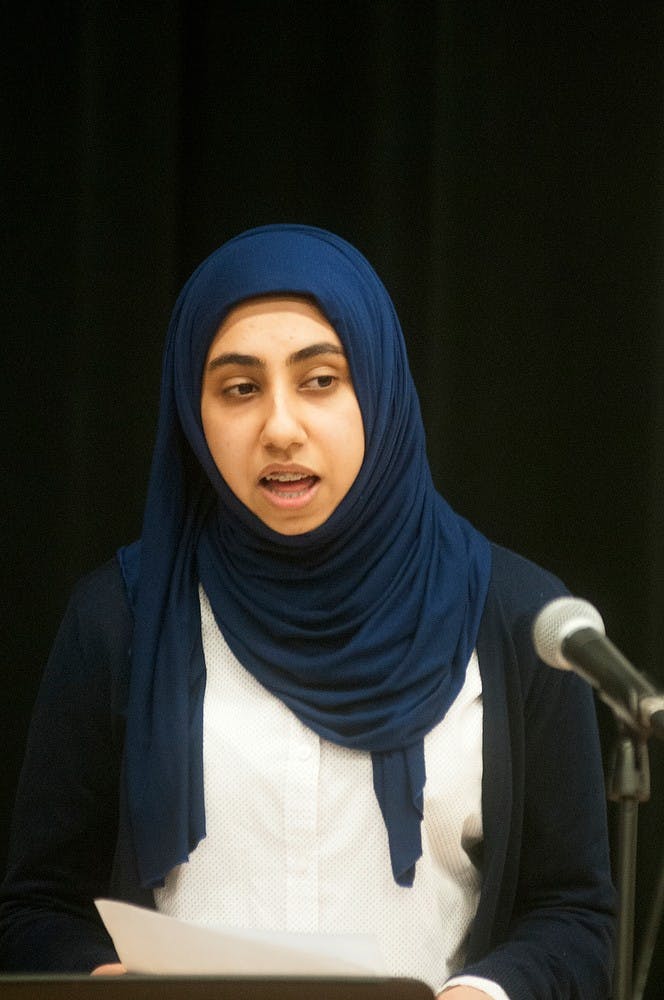
This is just an excerpt from the poem “Arab Child” by Dima Khatib, which was read aloud by international relations junior Naseim Omeish during Arabic Poetry Night.
The event, co-sponsored by the MSU Saudi Intercultural Exchange Club and RCAH Center for Poetry, took place Tuesday evening in the RCAH Theater in the basement of Snyder and Phillips Halls.
Omeish’s reading of the poem was emotional, focusing on the terrors Arab children face in their everyday lives and contrasting their life-threatening worries to the casual concerns of children in other countries.
“She tries to capture the moment of Arab childhood and how that affects you,” Omeish said. “It’s not a very normal life.”
In addition to Omeish, multiple other Arab students shared pieces of poetry.
Guest speaker and sociology professor Abdullah Alrebh spoke at the beginning of the event, giving a brief lecture on poetry in Arabic countries and its significance to the culture, which he titled “Poetry is the Memory of the Arabs.”
He explained that Arabic poetry typically falls into one of 16 different meters and made a distinction between classical and modern Arabic poetry, the latter of which strays from those traditional meters.
To fully understand the significance of poetry in Arab culture, Alrebh encouraged the audience to consider Arabic history and the interconnection of poetry with social structure.
“Poetry used to be used as social mobility,” he said.
Examples of both classical and modern poetry were performed throughout the night in a somewhat chronological order, beginning with pre-Islamic poetry and ending with a poem that was written by a student participating in the event.
The themes of the evening’s poetry ranged from romantic to panegyric to satirical. Many of the pieces selected were critical toward the everyday violence in Arab countries
Though all of the poems were performed in Arabic, an English translation was projected behind the speaker so the meaning of each poem would not be lost.
Ahmed Matar’s “My Friend Hassan” was performed by chemical engineering freshman Haidar Albardawil.
Matar is known for his criticism of Arab regimes and the absence of democracy in Arab countries, which he addresses with satire and sarcasm.
In this poem, Matar’s heavy criticism is pointed toward the neglect of Arab leaders for their countrymen. It concludes with the narrator’s friend — who earlier criticized the leader — being kidnapped or worse.
The evening concluded with an original love poem titled “Wait For Me” performed by its writer, supply chain management sophomore Ahmad Abo Al-Borgol.