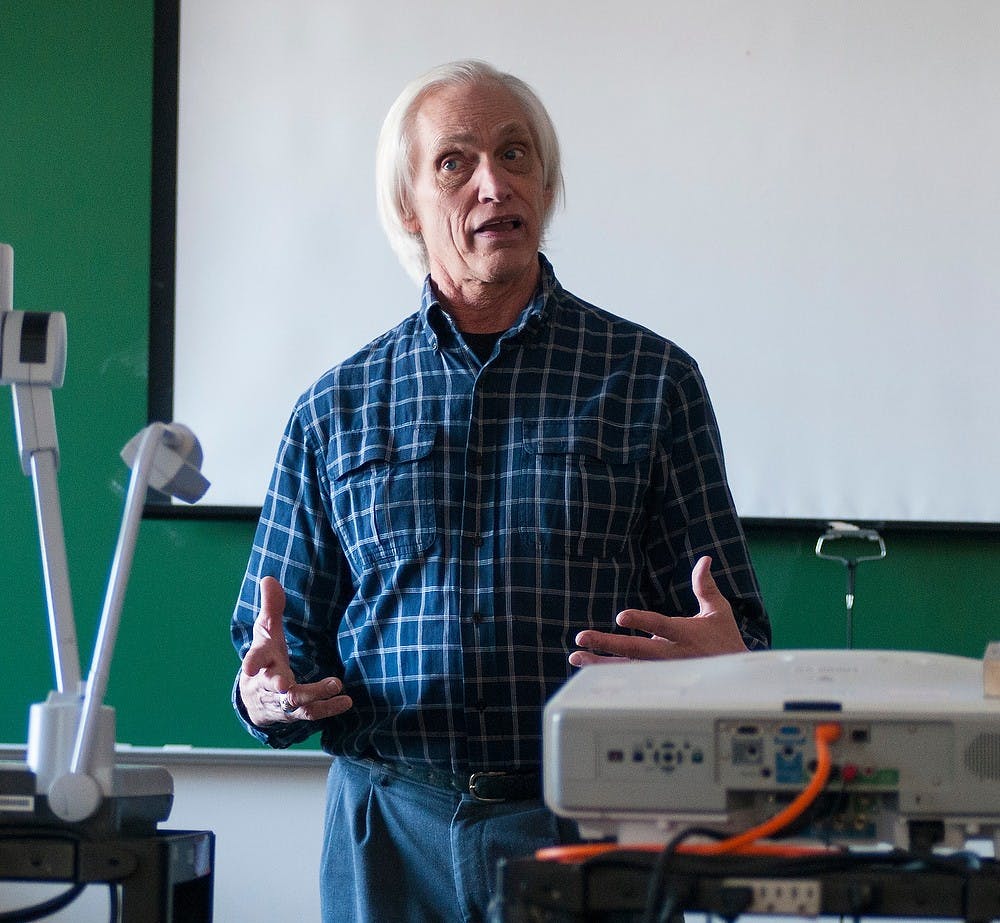
When he was an infant, Duncan Wyeth’s parents were told by doctors he wouldn’t live past 40.
Diagnosed with cerebral palsy, doctors told Wyeth’s parents not to expect Wyeth to walk or retain any intelligence and suggested placing Wyeth into an institution and to have another child.
“In 1946, our understanding was limited,” Wyeth said.
Sixty-nine years later, Wyeth is an active and mobile MSU professor teaching the course Disability in a Diverse Society, and the proud owner of 14 athletic medals — proving all the doctors wrong.
Wyeth learned basic motor skills without the aid of a physical therapist, although slightly slower than the average toddler. He sported leg braces until the age of 4, when his grandfather taught him how to walk.
Wyeth credits his hard work and determination to his supportive family who, in his early childhood, gave him opportunities that even then he realized weren’t the norm.
“Throughout my childhood, I had a conscious realization I was always the only one that had a visible disability,” Wyeth said. “The majority of individuals with physical disabilities weren’t particularly visible in society.”
Wyeth distinctly remembers being the only disabled person in his school.
“I brought the responsibility to always push the boundaries of expectations and be a good role model. With that there’s a dark side, because I was ‘different.’ It would sometimes put me in a position on the receiving side of teasing, bullying, being picked on,” he said.
At age 7, Wyeth acquired an interest in bicycling with his peers around the neighborhood. After pitching in time and manual labor helping his father install a patio and do landscaping on the front lawn, Wyeth earned enough money to purchase his first bicycle — changing his life forever.
“It was the Cadillac of Schwinn bicycles,” Wyeth said. “It had a horn, chrome fenders — Hollywood is in town.”
Wyeth saw the new wheels as more than just a way to enjoy the Michigan sunshine after school. Although he couldn’t keep up with his friends when walking, he said the bike proved to be a “great equalizer.”
“I wasn’t embarrassed,” Wyeth said. “I wasn’t a block or two behind them.”
Wyeth transitioned to an active lifestyle in high school when he participated in various intramural sports and managed several teams.
After graduation, Wyeth spent his first year at Alma College, but contracted a case of pneumonia that almost killed him. While recovering at Sparrow Hospital, his proximity to MSU allowed him to continue his education, enrolling full time in the university after being discharged.
Wyeth discovered a sense of community when he began to cycle seriously with the Mid-Michigan Tri-County Bicycle Association — presently the largest touring club in the U.S.
Graduating magna cum laude from MSU in 1969 and earning his master’s degree there in 1972, Wyeth studied interdisciplinary studies with a minor in history, science and a secondary teaching degree. That degree became useful later in life when he taught in the Lansing Catholic Schools system.
Wyeth didn’t begin a competitive career in cycling until 1978 when, at age 32, he competed in his first physically disabled sports competition at the Michigan Cerebral Palsy Sport State Games in Detroit. Wyeth walked away with one silver and five gold medals, two from cycling.
“It was my first time competing with people with the same motor skills, similar functional experience,” Wyeth said. “I signed up for everything. I was a kid in a candy store.”
Following the state games, Wyeth competed nationally, qualifying him to compete in the 1982 World Cerebral Palsy Games in Greve, Denmark. He won a bronze medal for cycling — the first medal ever won by an American in cerebral palsy cycling.
Six years later, Wyeth competed in the 1988 Paralympics in Seoul, South Korea, and was awarded “Male Athlete of the Year Award” from the United States Olympic Committee.
Following the 1988 Paralympics, Wyeth competed in the 1992 Paralympic Games in Barcelona, Spain.
In addition to a career in education and cycling, Wyeth has paved a successful path advocating for the physically disabled and their families.
Wyeth is an adamant believer that a minority person can excel and become a role model for change.
“Doesn’t matter who you are, no matter if you were born into an environment with a lot of resources, everyone is constantly dealing with expectations,” he said. “The challenge is to always strive to exceed the expectations that others put on us. Even more important is striving to exceed the expectations that we put on ourselves.”
Today Wyeth is teaching Disability in a Diverse Society at MSU, using education as his primary avenue to achieving social change and participating with the MSU Adaptive Sports and Recreation Program. Wyeth believes physical activity is just as important today as it was 65 years ago.
“Stay healthy, exercise (the) body, keep function ability, meet people and make connections,” he said.
As an alumnus, Wyeth sees a future adding value to activities in the MSU community.
“Maybe it will be teaching adaptive sports, mentoring students and faculty or staff who have disabilities and stay open to new ideas and opportunities and take advantage of all the wonderful resources on the campus.”
In his lifetime, Wyeth has received 14 medals for his athletic achievements, personally met President Bill Clinton and Vice President Al Gore, was published in USA TODAY and several textbooks used by Ivy League universities, received the Outstanding Alumnus Award from MSU and has been inducted into the Michigan Athletics with Disabilities Hall of Fame.
“Been a pretty damn good life,” Wyeth said.