Mahatma Gandhi’s grandson is still trying to carry on the legacy of the "Father of India.”
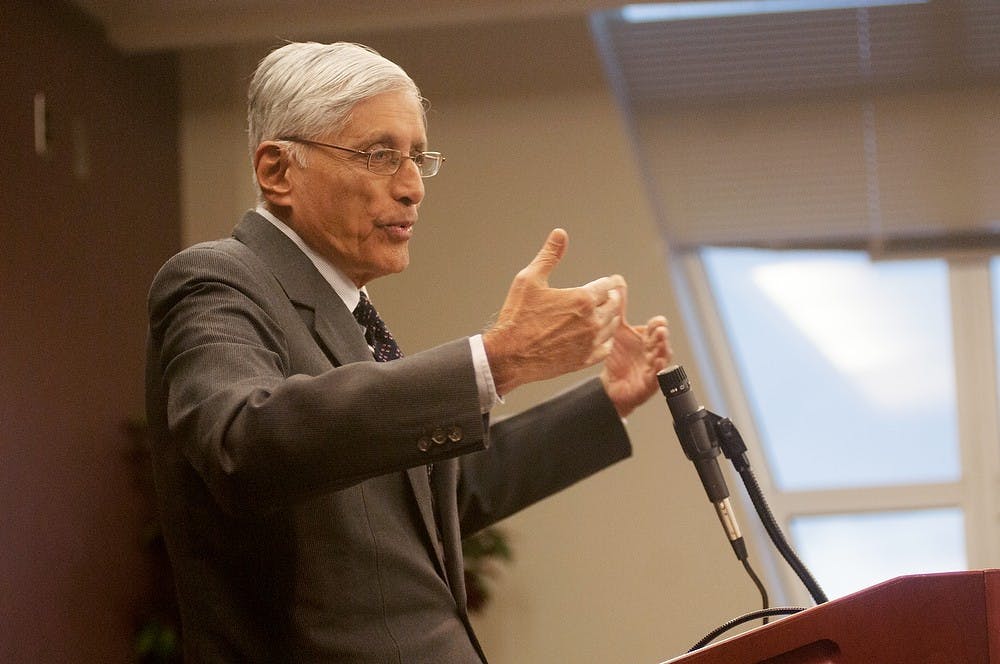
Rajmohan Gandhi came to campus Tuesday to address a standing-room-only crowd at the International Center about his father and the family’s mission to improve relations between Hindu and Muslim citizens within the country of India.
Gandhi, a research professor at the University of Illinois, spoke of his grandfather’s desire to create unity between the two most prevalent religions in India.
Gandhi said he came to campus to make others more aware of the ongoing struggle between Hindus and Muslims in his home country.
“My wish for the students is that they would keep their connection with the outer world,” Gandhi said. “This is an important part of the world. It has a large population.”
The crowd was filled with MSU faculty, students and other visitor as Gandhi gave a history of the centuries of tension between the two groups and how the current relationship is improving, but still needs plenty of work.
Many audience members stayed after his 35-minute speech for a question and answer session.
Political science freshman Katlynn Kretz attended because of Gandhi’s expertise in Middle East relations.
“I’m really interested in Middle Eastern politics, especially in India,” Kretz said. “I thought this was the best opportunity I could get to hear a structured, knowledgeable pretext to the different problems happening in India, especially when it comes to religion.”
Others attended as part of class, but stayed late to shake hands and briefly speak with Gandhi.
“I came here because I really wanted to, not because we were given extra credit,” said history junior Alex Reed. “When I heard it was the grandson of Gandhi, I wanted to be there.”
After the speech, most of the talk was about what could be done to further improve the Hindu-Muslim relations in India and its surrounding countries.
“The most that I took away from this is that although Gandhi’s dream (of Hindu-Muslim unity) didn’t actually come true, his grandson still has hope that there could be a possibility of that,” Kretz said. “Especially when it comes to two conflicting religions, there is the possibility of things changing.”