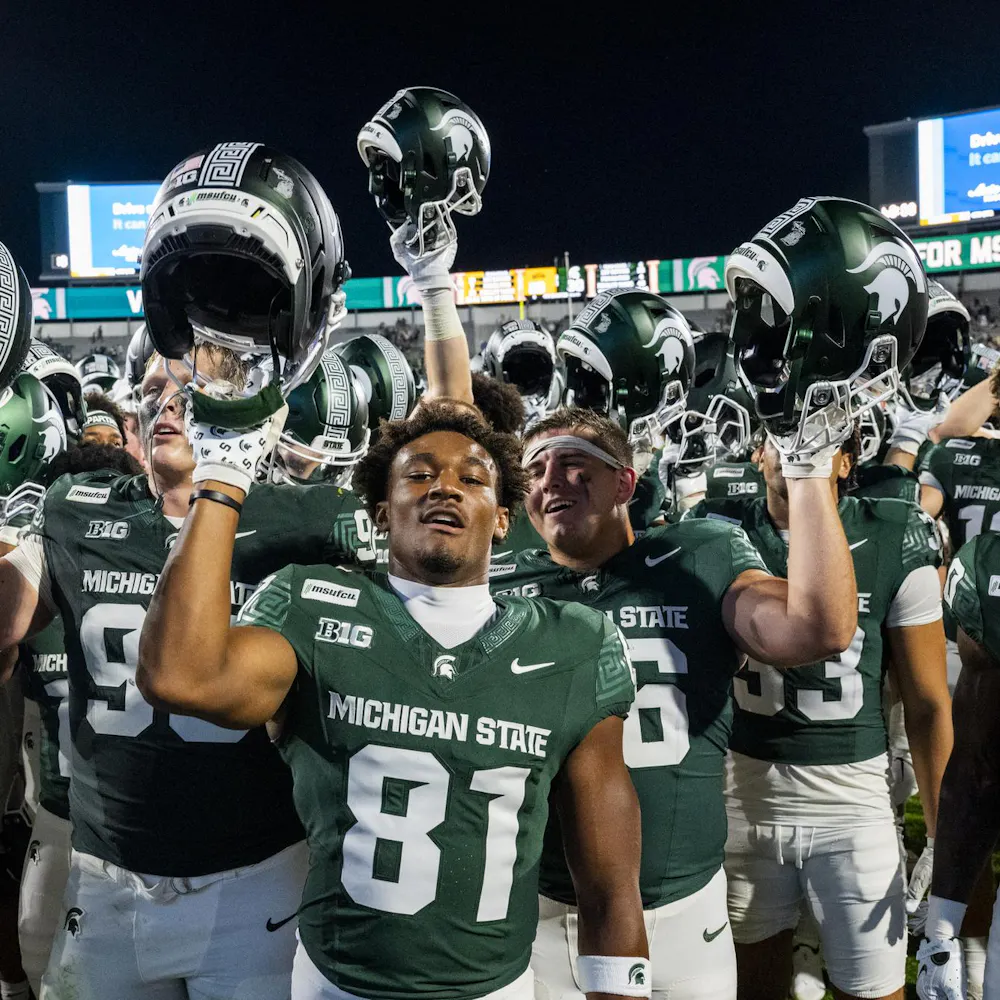
In football, being in the red zone means you are close to putting more points on the board. In business, being in the red zone means you are over budget, a problem MSU and many other athletic departments around the nation have been running into as universities build higher and pay more to stay among the top programs in the nation. MSU reported a $1.5 million loss in 2007-08, its fourth straight year with a budget deficit. Over the last four years they have lost $4.85 million. And they’re not alone.
In a report released by the NCAA in April, only 16 of the 119 Division I college football schools reported positive revenues in the period between the 2004-06 academic years.
During that time, average expenses for athletic departments rose 23 percent while revenues only increased 16 percent.
From 2007-09, MSU’s athletic budget is expected to rise 16.3 percent, an increase of more than $10 million in spending.
“Arms race”
Michael Granof, a University of Texas-Austin accounting professor who has studied accounting in collegiate athletics, said if collegiate sports continue on this path they will “crumble under their own weight.”
“Don’t think athletic departments will be self-sustaining,” Granof said. “It may be true at a few schools but not very many.”
Amy Perko, the executive director of the Knight Commission on Intercollegiate Athletics, said that of those 16 schools, only six institutions consistently generate positive net revenues when institutional revenue, or money given to the program by the university, is not included.
“Athletic expenses at D-I schools have been at a growth rate two or three times that of university expense growth,” Perko said. “Actions have to be taken to help this model of rising expenses. Many people agree that this cannot be sustained at this rate.”
The Knight Commission is an independent group compiled of current and former university presidents and former student athletes that seeks to better connect athletic programs with the academic goals of the universities they represent. Perko said the group has been a harsh critic of ballooning expense rates since they began in 1989.
“One of our primary recommendations coming out of our meeting in 2003-04 was for the NCAA to make changes in the way they collect financial data, so there is more transparency with data,” Perko said.
“They have since made a few changes, and have more costs in the data, but it’s still not completely transparent.”
College athletic departments are mired in an “arms race” that is getting out of control, Granof said.
“MSU has to compete with Ohio State, Michigan, Notre Dame, all of the Midwest schools as well as with schools like Texas nationally,” Granof said. “If you want to get players you have to improve the way that Texas does. Every school has to compete with bigger and better facilities. Coaches’ salaries are out-of-sight. Assistant coaches’ salaries are out-of-sight.”
MSU head football coach Mark Dantonio makes $1.1 million a year, near the nationwide average while head basketball coach Tom Izzo makes $2.6 million, one of the highest in the nation. The average salary for basketball coaches in 2007 was $800,000.
Stocking up
MSU Trustee George Perles, a former MSU head football coach and athletics director, said the only thing the university can offer an athlete is its facilities, making it more important to have top-of-the-line facilities.
“You go to a school and figure you’ll get a good education at all of the Big Ten schools, and the one big difference is the facilities,” Perles said.
“In all fairness, when I played there were only nine games, now there’s 12 or 13. In some ways we’re exploiting the kids. So, the facilities are becoming very important.”
In an effort to update the football facilities on campus, the university is adding the $15-million Skandalaris Football Center to expand the Duffy Daugherty Football Building. The building is expected to be completed in the fall.
Support student media!
Please consider donating to The State News and help fund the future of journalism.
Cutting back
Some of the problem could be the number of teams MSU supports, Perles said.
“It’s not only at MSU, it’s all over the country,” Perles said. “The Big Ten says to belong to the conference you have to have 16 teams. The (Southeastern Conference) has 19, we’re at 25.”
Yet Title IX, a federal law passed in 1972 that guarantees women the same access to sports as men, makes schools watch which programs they cut.
“The problem is if you cut back teams, who do you cut back?” Perles said. “You can’t cut women back, you have to have equal teams. So men’s sports get cut, and that might be a little unfair.”
MSU cut men’s gymnastics from its list of varsity sports in 2001 to help comply with Title IX.
However, schools can be left with little options to reverse the trend, Granof said.
“An obvious solution to limit coaches’ salaries would be if schools got together and simply agreed not to pay them that much,” Granof said.
“But you can’t do that because it violates anti-trust laws. But no school can do that individually because they would get left behind.”
The competition
The mark of many profitable institutions, such as Ohio State or U-M, are good programs in the revenue-earning sports, football and men’s basketball, Granof said. It helps the university earn marketing and broadcasting deals, as well as brings in postseason revenue.
“You can do the math, if someone’s not selling tickets in football or basketball they’re probably not doing that well,” said Mick Walker, assistant athletics director for business operations at the University of Iowa. “Just look at the school 60 miles from you.”
Ohio State and U-M, other than being perennial contenders in college football, are also a few of the schools that can run a profit.
In 2007-08, U-M had a $14.2 million surplus, even giving a $1.5 million donation back to the university to support need-based financial aid. They have also budgeted for a $10.3 million surplus in 2009.
Ohio State had a surplus of just more than $1,600, but also operated on a budget of nearly $37 million more than MSU — and offered 12 more varsity sports. In 2009, Ohio State budgeted to increase spending by 5 percent, nearly $6 million and still expects a surplus of just more than $2,000.
But MSU is looking forward, Perles said.
“Now with MSU, the football building is going to be up at the top of the Big Ten,” Perles said.
“Basketball is already there, hockey is already there. Some of these things are investments. They haven’t shown their potential yet. We put in the suites and still have some other things. It’s not only athletics, it’s the whole university. Money’s tight right now.”
After repeated attempts, MSU athletics director Mark Hollis was unavailable for comment.
Discussion
Share and discuss “Seeing red” on social media.