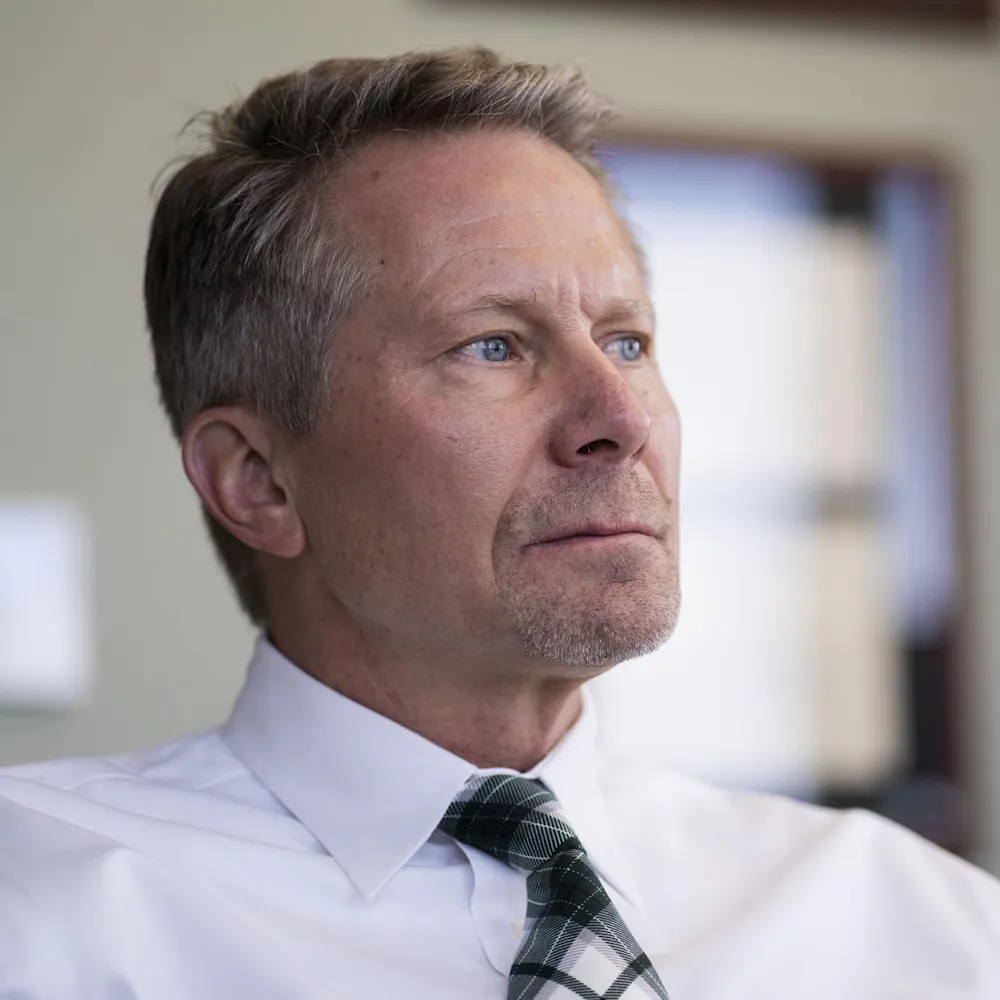
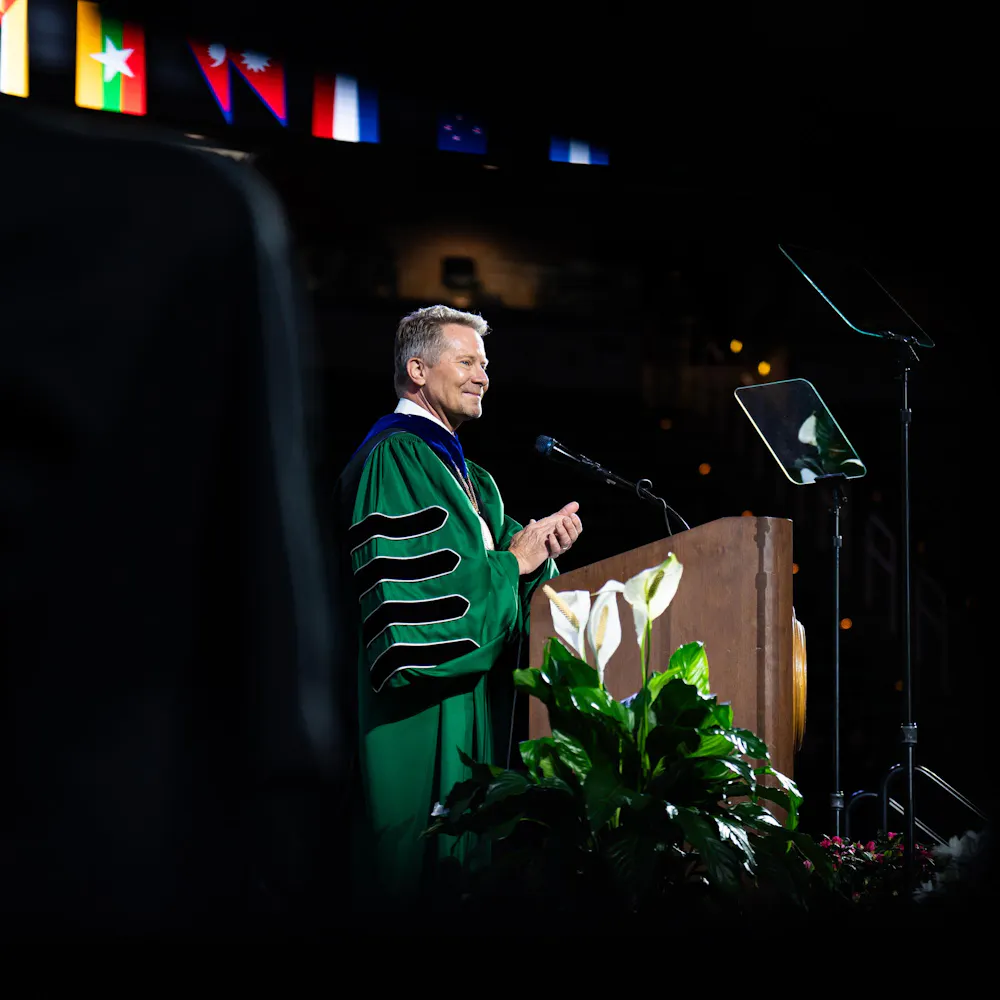
Marsha Rappley has been spending a lot of time in her car.
She's learned that for the dean of MSU's College of Human Medicine, it comes with the territory.
"I'm on the road quite a lot — that's part of my job," said Rappley, who was named acting dean of the college in September.
At least once a week, she makes a trip to Flint, Saginaw, Kalamazoo or Marquette, in the Upper Peninsula.
Those locations, along with East Lansing, are home to five of the school's campuses across the state.
On Nov. 16, MSU President Lou Anna K. Simon and west Michigan interest groups announced their intention to expand the college's sixth campus in Grand Rapids to include first- and second-year students — who are currently taught only in Lansing.
Rappley now has an office near the Van Andel Institute in Grand Rapids and said she is there about two days per week. The college's leaders find themselves splitting their time and resources — and their students — among the campuses.
In that sense, the desire to expand outside Lansing is an ingrained characteristic of the medical school, which was founded on a "community-based" model.
"If you see the College of Human Medicine as being a real lever for the improvement of health care within the state, what's really important is that we're keeping the community campus system," Simon said. "You can look at any part of this as a gain or a loss in a narrow parochial view.
"It has to be a statewide role. That's what distinguishes us."
The announcement eased some fears among faculty in the college and around the university.
"I think the faculty seem far more satisfied now that this is an expansion rather than a move," said Ved Gossain, a professor in the medical school.
But the latest plan hasn't eliminated all concerns.
Grover Hudson, president of the MSU chapter of the American Association of University Professors, said he has yet to consult with the college's faculty, but he is worried the transition puts too much emphasis on the Grand Rapids campus.
"MSU would immediately be a secondary branch," said Hudson, a linguistics professor. "It certainly looks like it has the potential to lead to reduction and loss here."
Growth factor
The college was intended to operate under a multiple-campus system when it was established 40 years ago. Initially, it was only a two-year school, and third- and fourth-year students transferred to other universities.
But after the full four-year program was up and running, the college began distributing students among the six campuses.
The third- and fourth-year curriculum requires hands-on training inside hospitals.
"The system can only accommodate so many students and give them a good experience," said Denise Holmes, the college's assistant dean for government relations and outreach. "Lansing was simply not big enough to absorb and give 100 medical students that kind of experience.
"Because Grand Rapids is bigger than many of our other community campus cities, it naturally has taken a larger number of students."
The college currently sends about 30 students out of each class to Grand Rapids during their third year. A similar number go to Flint. Lansing and Kalamazoo take about 20 students each, and a handful of students go to both Saginaw and Marquette.
Those numbers fluctuate slightly from year to year. In total, the college partners with 12 hospitals around the state to train medical students.
Preventative measures
Simon's argument for having two similar four-year campuses was, "Why not?"
A dual-campus model has been successful elsewhere, she said, pointing to the University of Illinois as a prime example.
Once the four-year program is up and running in Grand Rapids — something the project's planners hope to have accomplished by 2010 — the college's class size will roughly double. That could possibly translate into more students getting their third- and fourth-year education in the Lansing area than at present, since the school's other campuses would help soak up the additional students.
The College of Human Medicine hopes to increase its incoming class by 50 students in 2007.
More medical students will mean more doctors, who are sorely needed in Michigan. The state is expected to have a shortage of specialty physicians by next year, and a shortage of primary care physicians by 2018, Rappley said.
"The shortage will be worse in Michigan than it is for the country as a whole," Holmes said. "We need to do everything we can to make our area as attractive as possible."
College officials have been working to keep more graduates in the state for their internships and residencies. Where a graduate does his or her residency is a primary determinant of where the graduate will end up practicing. The Lansing region has more than 100 residency positions open each year, Holmes said.
Since it takes 11 years to train a doctor, the university's medical schools, including the College of Osteopathic Medicine, need to start preparing to fill the shortage immediately, Rappley said.
As additional students are admitted, the college will have the final say as to where they are placed, but student preference will be considered, Holmes said.
Exactly how specialties and unique identities will develop between the East Lansing and Grand Rapids campuses remains to be seen.
East Lansing will likely remain focused primarily on basic science education, while the Grand Rapids campus will attract more research-oriented students and faculty, officials said.
"We have to recognize that with the dean moving, there is a gravitas in west Michigan that reflects a more typical academic medical center," Simon said. "What we're trying to do is find the best of both worlds between a community-based model and a more classical academic medical center model."
MSU officials are anticipating opportunities to expand clinical trials and research partnerships in Grand Rapids.
"The reputation of any medical school is deeply embedded in the research portfolio," Rappley said.
Early diagnoses
The movement of the dean, which will happen once the new four-year program is established, has been an issue of some contention.
Simon said having the dean and a dedicated medical building in Grand Rapids are key factors in anchoring MSU's identity to the west Michigan school.
From a business perspective, the dean's presence in Grand Rapids will be the difference between having a division and the headquarters, said David Van Andel, who chaired a committee of the project's stakeholders.
"I'd rather have the headquarters. That's where the decisions are coming from ? that's important," Van Andel said.
Although the dean and some of the administrative staff will relocate, most of the college's faculty members are expected to stay in mid-Michigan.
MSU physicians took issue with the project early on. There was an outcry on campus after former MSU President M. Peter McPherson unveiled his original plan in May 2004, which led to the formation of a faculty oversight committee to monitor the project.
"There was a lot of confusion initially. Everybody was upset," said Norm Abeles, a psychology professor who chaired the oversight committee. "I think they've come on board, mostly."
The faculty committee was provided with all of the details of the process, including the financial aspects, said Holmes.
Dr. Harvey Sparks, a professor in the college who also was a member of the committee, said they received regular reports from Holmes and Simon.
"We stayed very involved," Sparks said. "That's why the oversight committee was formed — to make sure there was faculty input."
Gossain said although he felt the faculty voice in the process was effective, there are still unanswered questions, particularly in regard to moving the dean.
"That is something of a concern to me, because it says that the focus of the medical school would shift," he said. "I would like to see the focus remain in East Lansing."
Simon didn't deny that Grand Rapids would become the "hub" of the college, but she believes it's the right move for the university — and for the entire state.
"This geographic parochialism, where if it's not here it doesn't help, is really not a part of the way I think the world has to function over the next 20 or 25 years," Simon said. "It's just a different world, and I think the people who get stuck in the old frame of thinking about things get their communities and institutions stuck.
"I'm not going to buy into this sort of losing and winning conversation, because I think that's short-sighted," she added. "Michigan will win for sure, and I think both communities will win."