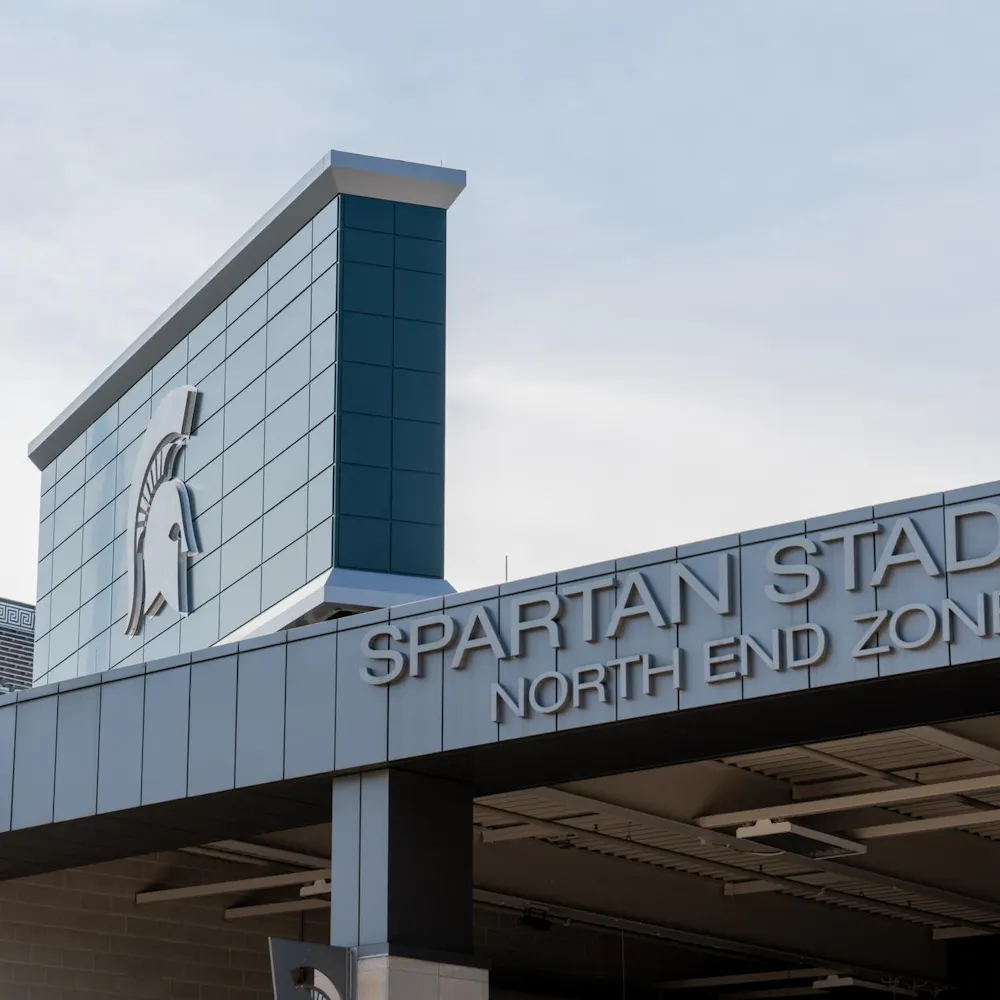
When Mark Collins watches an MSU football game, he pays attention to something many others might give little thought - the grass.
Collins, farm manager at MSU's Hancock Turfgrass Research Center, was involved in growing the grass that now sits in Spartan Stadium and said the results give him a sense of pride in his work.
"I expect this will be the same way," he said Wednesday, standing in the 4-acre plot of grass that will become the new home turf of the Lansing Lugnuts this September.
The field, planted last September, is being grown by MSU employees at the turfgrass center, a 56-acre site south of the main campus.
The new field to be located in Oldsmobile Park is part of a long-term arrangement by both the Lugnuts organization and the city of Lansing, which owns the ballpark. In an agreement signed by Lansing Mayor Tony Benavides that will keep the Lugnuts in Lansing through 2020, the city committed to invest $3 million in the park in the next three years.
The agreement comes as an early renewal of the Lugnuts' contract with the city, which would have expired in 2010.
"So many teams now are holding their communities hostage," said Jeff Calhoun, general manager for the Lugnuts. "We want to be here long term."
The agreement must be approved by the Lansing City Council and will be discussed at today's regular meeting, said council President Sandy Allen.
The city has a contract with the MSU Land Management Office to grow the field, Collins said.
Crop and soil sciences Professor Trey Rogers, who consulted for the city when the original field was installed in 1995 and who Calhoun referred to as "the grass guru," will be consulting again on the installation of the new field.
"I'm just kind of the guy steering the ship," Rogers said, adding he was confident in the abilities of Collins and Lugnuts Head Groundskeeper Matt Anderson, an MSU alumnus, to handle the operation.
MSU's turfgrass researchers don't work for outside clients often, Rogers said, but the university's long-standing relationship with the city of Lansing made the collaboration ideal.
"This is pretty much the only situation outside the university that we would grow a field for," he said.
At the conclusion of the Lugnuts' season, the old field will be removed from Oldsmobile Park, improvements will be made to the irrigation system, and the ground will be regraded, Collins said. Then the sod from the research center will be cut in strips, loaded onto a semi-truck and transported downtown.
By the time the field is ready to be installed, MSU employees will have put more than 800 tons of sand into the soil. It is important to match the soil in the sod to the soil already in Oldsmobile Park, Collins said, and workers have been applying 50 tons of sand to the field each week in an effort to create a soil mixture that is roughly 90 percent sand and 10 percent clay. Grass grows well in sand, he said, and it improves drainage.
The field is composed of Kentucky bluegrass, the same variety as is in Spartan Stadium.
It takes anywhere from 12 to 18 months to grow an athletic field, Collins said, but they've been able to accelerate the process with the Lugnuts field.
"You could play ball on it today," he said.
Collins walks the field several times a week to examine its condition and the grass is mowed three times a week and fertilized with nitrogen every 10 days. MSU employees will maintain a nursery for the Lugnuts if any of the grass ever needs to be replaced and will oversee the installation of the field at Oldsmobile Park.
"If you can give them a quality field ? then you feel like you've done your job," Collins said.